

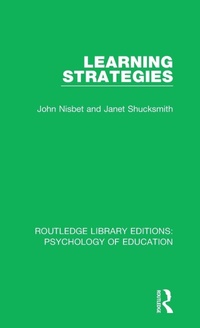
Learning Strategies
1st Edition
Published on 18. September 2017
Book
Hardback
114 pages
978-1-138-73204-9 (ISBN)
Description
Originally published in 1986, designed for teachers and those concerned with the education of primary and secondary school pupils, Learning Strategies presented a new approach to 'learning to learn'. Its aim was to encourage teachers to start thinking about different approaches to harnessing the potential of young learners. It was also relevant to adult learners, and to those who teach them. Thus, although about learning, the book is also very much about teaching.
Learning Strategies presents a critical view of the study skills courses offered in schools at the time, and assesses in non-technical language what contributions could be made to the learning debate by recent developments in cognitive psychology. The traditional curriculum concentrated on 'information' and developing skills in reading, writing, mathematics and specialist subjects, while the more general strategies of how to learn, to solve problems, and to select appropriate methods of working, were too often neglected.
Learning to learn involves strategies like planning ahead, monitoring one's performance, checking and self-testing. Strategies like these are taught in schools, but children do not learn to apply them beyond specific applications in narrowly defined tasks. The book examines the broader notion of learning strategies, and the means by which we can control and regulate our use of skills in learning. It also shows how these ideas can be translated into classroom practice. The final chapter reviews the place of learning strategies in the curriculum.
Learning Strategies presents a critical view of the study skills courses offered in schools at the time, and assesses in non-technical language what contributions could be made to the learning debate by recent developments in cognitive psychology. The traditional curriculum concentrated on 'information' and developing skills in reading, writing, mathematics and specialist subjects, while the more general strategies of how to learn, to solve problems, and to select appropriate methods of working, were too often neglected.
Learning to learn involves strategies like planning ahead, monitoring one's performance, checking and self-testing. Strategies like these are taught in schools, but children do not learn to apply them beyond specific applications in narrowly defined tasks. The book examines the broader notion of learning strategies, and the means by which we can control and regulate our use of skills in learning. It also shows how these ideas can be translated into classroom practice. The final chapter reviews the place of learning strategies in the curriculum.
More details
Series
Language
English
Place of publication
London
United Kingdom
Publishing group
Taylor & Francis Ltd
Target group
College/higher education
Professional and scholarly
Dimensions
Height: 222 mm
Width: 145 mm
Thickness: 10 mm
Weight
287 gr
ISBN-13
978-1-138-73204-9 (9781138732049)
Copyright in bibliographic data and cover images is held by Nielsen Book Services Limited or by the publishers or by their respective licensors: all rights reserved.
Schweitzer Classification
Other editions
Additional editions
John Nisbet | Janet Shucksmith
Learning Strategies
Book
10/2019
1st Edition
Routledge
€53.40
Shipment within 10-20 days
John Nisbet | Janet Shucksmith
Learning Strategies
E-Book
09/2017
Routledge
€47.49
Available for download
John Nisbet | Janet Shucksmith
Learning Strategies
E-Book
09/2017
Routledge
€47.49
Available for download
Persons
Nisbet, John; Shucksmith, Janet
Content
Acknowledgments. Introduction. 1. Learning to Learn 2. Learning to Learn: The Study Skills Approach 3. What are Learning Strategies? 4. Young Learners: Knowledge and Strategies 5. Improving Understanding 6. In the Classroom: Teaching Approaches 7. Working with Children and Teachers 8. Learning Strategies in the Curriculum. Bibliography. Index of Authors. Subject Index.