

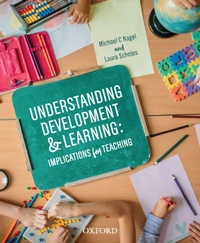
Understanding Development and Learning
Implications for Teaching
Published on 25. October 2016
Book
Paperback/Softback
340 pages
978-0-19-551965-5 (ISBN)
Description
Understanding Development and Learning assists future teachers to develop their understanding of the process of learning. It seeks to enhance their abilities as educators by explaining the principles of educational psychology through contemporary research and ideas drawn from a range of sources, including neuroeducation or neuroscience as it applies to education.
Written specifically for a one-semester educational psychology subject, the text provides a concise explanation of the current and emerging theories in child development and educational psychology. The theoretical aspects are well matched to relevant examples of educational and classroom-based scenarios to assist students with their own teaching practice development.
Written specifically for a one-semester educational psychology subject, the text provides a concise explanation of the current and emerging theories in child development and educational psychology. The theoretical aspects are well matched to relevant examples of educational and classroom-based scenarios to assist students with their own teaching practice development.
More details
Language
English
Place of publication
Melbourne
Australia
Publishing group
Oxford University Press Australia
Target group
College/higher education
Product notice
Paperback (trade)
Unsewn / adhesive bound
Illustrations
20
Dimensions
Height: 246 mm
Width: 203 mm
Thickness: 15 mm
Weight
794 gr
ISBN-13
978-0-19-551965-5 (9780195519655)
Copyright in bibliographic data and cover images is held by Nielsen Book Services Limited or by the publishers or by their respective licensors: all rights reserved.
Schweitzer Classification
Persons
Michael C Nagel is an Associate Professor in the School of Education at the University of the Sunshine Coast
Laura Scholes is a Research Associate in the School of Early Childhood in the Faculty of Education at Queensland University of Technology
Laura Scholes is a Research Associate in the School of Early Childhood in the Faculty of Education at Queensland University of Technology
Content
Chapter 1: What Is Learning? Defining teaching Defining learning A brief history of 'learning' and 'teaching' in Western schools Theories of 'learning', past and present Chapter 2: The Links between Human Development and LearningBasic issues in human developmentDomains of human developmentChapter 3: Understanding Brain DevelopmentThe developing brain-the early yearsStructures of the brainThe developing brain and adolescenceChapter 4: Learning, Thinking and IntelligenceMeasuring intelligenceNotions of multiple intelligencesThe neuroscience of intelligenceControversies over intelligenceChapter 5: Language Development and LearningLanguage development in childrenTraditional theories of language developmentLanguage and the brainMaturation and biological sex differencesEnhancing language developmentChapter 6: Memory and LearningThe neurobiology of memorySystems and stages of memoryWhat hinders memory and why we forgetEnhancing memory: educational and pedagogical considerationsChapter 7: Motivation and LearningThe neurobiology of motivationThe psychology of motivationUnderstanding contemporary learnersMotivation in school: affective and effective considerationsChapter 8: Inclusive LearningThose who can, doDifferent brains, different learnersReaching the hard-to-reach studentExtending the exceptional learnerChapter 9: Sociocultural Factors of LearningSome backgroundVygotskySociocultural theory of cognitive developmentBronfenbrennerEcological systems theoryBio-ecological modelGender, socio-economic background and culture in the classroomChapter 10: Nurturing LearningThe perils of standards and testingEnrichment does not mean more!Homework: a necessary evil?Stress and learning do not mixRising to the challengesThe creative arts and learningThe brain, movement and learningGlossaryReferencesIndex