

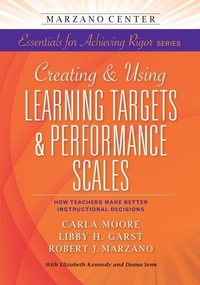
Creating & Using Learning Targets & Performance Scales
How Teachers Make Better Instructional Decisions
Published on 10. June 2015
Book
Paperback/Softback
136 pages
978-1-941112-01-4 (ISBN)
Description
Can your students understand and even generate performance scales? Academic standards call for increased rigor, but simply raising complexity is not enough. Students need to be able to understand learning goals, embedded in performance scales, which include application of knowledge. They should even be capable of generating their own learning scales. In turn, teachers must become adept at providing rigorous learning goals and planning and scaffolding instruction to meet students' needs. Creating & Using Learning Targets & Performance Scales: How Teachers Make Better Instructional Decisions explores explicit techniques for mastering this crucial strategy of instructional practice. It includes: Explicit steps for implementation Recommendations for monitoring students' ability to understand learning goals Adaptations for students who struggle, have special needs, or excel in learning Examples and nonexamples from classroom practice Common mistakes and ways to avoid them The Essentials for Achieving Rigor series of instructional guides helps educators become highly skilled at implementing, monitoring, and adapting instruction. Put it to practical use immediately, adopting day-to-day examples as models for application in your own classroom.
More details
Series
Language
English
Place of publication
West Palm Beach
United States
Target group
Professional and scholarly
Product notice
Paperback (trade)
Unsewn / adhesive bound
Dimensions
Height: 249 mm
Width: 175 mm
Thickness: 10 mm
Weight
295 gr
ISBN-13
978-1-941112-01-4 (9781941112014)
Copyright in bibliographic data and cover images is held by Nielsen Book Services Limited or by the publishers or by their respective licensors: all rights reserved.
Schweitzer Classification
Persons
An experienced professional developer, teacher, and administrator, Carla Moore, MSEd, oversees professional development and product development for Learning Sciences International, with a special emphasis on teacher and administrator effectiveness. For more than a decade, she was a member of the Learning Sciences professional development team and served in many roles, including director of quality instruction at St. Lucie County Public Schools in Florida. She co-led the implementation of the Marzano Teacher Evaluation Model and supported training within the district to meet strategic milestones for student achievement. She is nationally recognized for her commitment to K-12 education, having received the 2013 Florida Association of Staff Development Award, the Schlechty Centre Conference Fellowship, and the Treasure Coast News Lifetime Achiever of Education Award, among others.
Libby Garst, MSEd, enjoyed a successful business career for more than 15 years before turning to teaching. She spent nearly 15 years in education as a middle school classroom teacher and an elementary instructional math coach. Today she brings together both of her backgrounds to offer teachers, schools, and districts a truly unique perspective. Ms. Garst earned her master's degree at University of Virginia.
Robert J. Marzano, PhD, is a nationally recognized education researcher, speaker, trainer, and author of more than 30 books and 150 articles on topics such as instruction, assessment, writing and implementing standards, cognition, effective leadership, and school intervention. His practical translations of the most current research and theory into classroom strategies are widely practiced internationally by both teachers and administrators. Dr. Marzano has partnered with Learning Sciences International to offer the Marzano Teacher Evaluation Model, the Marzano School Leadership Evaluation Model, and the Marzano District Leader Evaluation Model. The Marzano evaluation models have been adopted by school districts across the country because they don't simply measure ability, they actually help teachers and leaders grow, improving their instruction over time. Dr. Marzano also co-developed the Learning Sciences Marzano Center Essential Strategies for Achieving Rigor, a model of instruction that fosters essential teaching skills and strategies to support college and career readiness standards.
Libby Garst, MSEd, enjoyed a successful business career for more than 15 years before turning to teaching. She spent nearly 15 years in education as a middle school classroom teacher and an elementary instructional math coach. Today she brings together both of her backgrounds to offer teachers, schools, and districts a truly unique perspective. Ms. Garst earned her master's degree at University of Virginia.
Robert J. Marzano, PhD, is a nationally recognized education researcher, speaker, trainer, and author of more than 30 books and 150 articles on topics such as instruction, assessment, writing and implementing standards, cognition, effective leadership, and school intervention. His practical translations of the most current research and theory into classroom strategies are widely practiced internationally by both teachers and administrators. Dr. Marzano has partnered with Learning Sciences International to offer the Marzano Teacher Evaluation Model, the Marzano School Leadership Evaluation Model, and the Marzano District Leader Evaluation Model. The Marzano evaluation models have been adopted by school districts across the country because they don't simply measure ability, they actually help teachers and leaders grow, improving their instruction over time. Dr. Marzano also co-developed the Learning Sciences Marzano Center Essential Strategies for Achieving Rigor, a model of instruction that fosters essential teaching skills and strategies to support college and career readiness standards.