

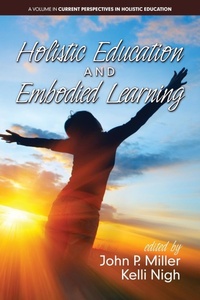
Holistic Education and Embodied Learning
Published on 20. March 2017
Book
Paperback/Softback
364 pages
978-1-68123-840-1 (ISBN)
Description
Learning often begins with an experience in the body. Our body can tighten or feel expansive depending on different learning contexts. This experience of learning in the body is crucial to holistic education. This book explores embodied learning from several perspectives.
This first section explores how psychology can inform us about embodied learning; for example, the work of Carl Jung and Wilhelm Reich devoted much of their thinking to how energy manifests itself in the body. Meditation and movement are also examined as ways of embodied learning; for example, Dalcroze, a form of movement education, is presented within the context of whole person education. The book also presents schools where embodied learning is nurtured. Waldorf education is discussed as well as a public school in Toronto where the body is central to holistic education. The book also presents visions of embodied learning. John Miller presents a holistic vision of teacher education and Tobin Hart, who has written extensively in this field, writes about the embodied mind.
Embodied learning is an emerging area of inquiry in holistic education and this book presents a variety of perspectives and practices that should be helpful to both scholars and practitioners.
This first section explores how psychology can inform us about embodied learning; for example, the work of Carl Jung and Wilhelm Reich devoted much of their thinking to how energy manifests itself in the body. Meditation and movement are also examined as ways of embodied learning; for example, Dalcroze, a form of movement education, is presented within the context of whole person education. The book also presents schools where embodied learning is nurtured. Waldorf education is discussed as well as a public school in Toronto where the body is central to holistic education. The book also presents visions of embodied learning. John Miller presents a holistic vision of teacher education and Tobin Hart, who has written extensively in this field, writes about the embodied mind.
Embodied learning is an emerging area of inquiry in holistic education and this book presents a variety of perspectives and practices that should be helpful to both scholars and practitioners.
More details
Series
Language
English
Place of publication
Charlotte
United States
Publishing group
Emerald Publishing Inc
Target group
Professional and scholarly
Dimensions
Height: 234 mm
Width: 156 mm
Thickness: 20 mm
Weight
553 gr
ISBN-13
978-1-68123-840-1 (9781681238401)
Copyright in bibliographic data and cover images is held by Nielsen Book Services Limited or by the publishers or by their respective licensors: all rights reserved.
Schweitzer Classification
Other editions
Additional editions
John P. Miller
Holistic Education and Embodied Learning
E-Book
01/2017
1st Edition
Information Age Publishing
from
€62.33
Available for download
Content
Foreword.
Preface.
Acknowledgments.
Section I. Psychological Perspectives.
Chapter 1. A Full and Flexible Life: Carl Jung and Wilhelm Reich; Kelli Nigh.
Chapter 2. Transformational Growth Into Wholeness: A Holistic, Experiential, Process Method; Jim McNamara and Caroline Mardon.
Chapter 3. Healing Archetypes: Reclaiming Teacher Wellbeing by Embodying the Wild Feminine; Joanna Krop.
Section II. Schools.
Chapter 4. The Art of Education: Waldorf Education in Practice; Warren Lee Cohen and Brian Daniel Bresnihan.
Chapter 5. Compassionate Teaching; Young-Yie Kim.
Chapter 6. Equinox: Portrait of a Holistic School; John P. Miller.
Chapter 7. A Vision for a Holistic Secondary School; Misha Abarbanel.
Section III. Meditation, Contemplation, and Movement.
Chapter 8. Loving Kindness Meditation: Awakening Teacher Eros in Modern Educational Settings; Keith Brown.
Chapter 9. Contemplation in Action: An Engaging Pedagogy for Our Times; Jennifer Motha.
Chapter 10. Dalcroze Pedagogy: Reflections on Rhythm and Felt Learning; Sharon E. Dutton.
Section IV. Visions.
Chapter 11. A Journeyman Professor's Walk Through Metaphor and Philosophy in Search of Holistic Approaches to Teacher Education Curriculum; Rupert Clive Collister.
Chapter 12. Growing Spiritual Wings: Cultivating Creativity and Spiritual Intelligence in Holistic Education; Isabella Colalillo Kates.
Chapter 13. Embodying the Mind; Tobin Hart.
Chapter 14. A Holistic Vision of Teacher Education; John P. Miller.
About the Contributors.
Index.
Preface.
Acknowledgments.
Section I. Psychological Perspectives.
Chapter 1. A Full and Flexible Life: Carl Jung and Wilhelm Reich; Kelli Nigh.
Chapter 2. Transformational Growth Into Wholeness: A Holistic, Experiential, Process Method; Jim McNamara and Caroline Mardon.
Chapter 3. Healing Archetypes: Reclaiming Teacher Wellbeing by Embodying the Wild Feminine; Joanna Krop.
Section II. Schools.
Chapter 4. The Art of Education: Waldorf Education in Practice; Warren Lee Cohen and Brian Daniel Bresnihan.
Chapter 5. Compassionate Teaching; Young-Yie Kim.
Chapter 6. Equinox: Portrait of a Holistic School; John P. Miller.
Chapter 7. A Vision for a Holistic Secondary School; Misha Abarbanel.
Section III. Meditation, Contemplation, and Movement.
Chapter 8. Loving Kindness Meditation: Awakening Teacher Eros in Modern Educational Settings; Keith Brown.
Chapter 9. Contemplation in Action: An Engaging Pedagogy for Our Times; Jennifer Motha.
Chapter 10. Dalcroze Pedagogy: Reflections on Rhythm and Felt Learning; Sharon E. Dutton.
Section IV. Visions.
Chapter 11. A Journeyman Professor's Walk Through Metaphor and Philosophy in Search of Holistic Approaches to Teacher Education Curriculum; Rupert Clive Collister.
Chapter 12. Growing Spiritual Wings: Cultivating Creativity and Spiritual Intelligence in Holistic Education; Isabella Colalillo Kates.
Chapter 13. Embodying the Mind; Tobin Hart.
Chapter 14. A Holistic Vision of Teacher Education; John P. Miller.
About the Contributors.
Index.