

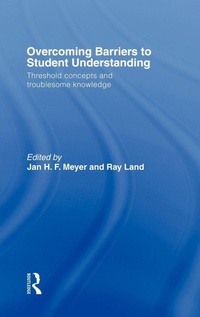
Overcoming Barriers to Student Understanding
Threshold Concepts and Troublesome Knowledge
1st Edition
Published on 30. June 2006
Book
Hardback
238 pages
978-0-415-37430-9 (ISBN)
Description
It has long been a matter of concern to teachers in higher education why certain students 'get stuck' at particular points in the curriculum whilst others grasp concepts with comparative ease. What accounts for this variation in student performance and, more importantly, how can teachers change their teaching and courses to help students overcome such barriers?
This book examines the difficulties of student learning and offers advice on how to overcome them through course design, assessment practice and teaching methods. It also provides innovative case material from a wide range of institutions and disciplines, including the social sciences, the humanities, the sciences and economics.
This book examines the difficulties of student learning and offers advice on how to overcome them through course design, assessment practice and teaching methods. It also provides innovative case material from a wide range of institutions and disciplines, including the social sciences, the humanities, the sciences and economics.
More details
Language
English
Place of publication
London
United Kingdom
Publishing group
Taylor & Francis Ltd
Target group
College/higher education
Illustrations
4 s/w Abbildungen, 4 s/w Tabellen
4 Tables, black and white; 4 Illustrations, black and white
Dimensions
Height: 240 mm
Width: 161 mm
Thickness: 18 mm
Weight
529 gr
ISBN-13
978-0-415-37430-9 (9780415374309)
Copyright in bibliographic data and cover images is held by Nielsen Book Services Limited or by the publishers or by their respective licensors: all rights reserved.
Schweitzer Classification
Other editions
Additional editions
Jan Meyer | Ray Land
Overcoming Barriers to Student Understanding
Threshold Concepts and Troublesome Knowledge
Book
03/2012
1st Edition
Routledge
€76.40
Shipment within 15-20 days
Jan Meyer | Ray Land
Overcoming Barriers to Student Understanding
Threshold Concepts and Troublesome Knowledge
E-Book
09/2006
1st Edition
Routledge
€69.99
Available for download
Jan Meyer | Ray Land
Overcoming Barriers to Student Understanding
Threshold Concepts and Troublesome Knowledge
E-Book
09/2006
1st Edition
Routledge
€69.99
Available for download
Persons
Jan Meyer is Professor of Education and foundation Director of the Centre for Learning, Teaching, and Research in Higher Education, University of Durham.
Ray Land is Professor of Higher Education Development and Director, Centre for Higher Education Development, Coventry University. Education in Cyberspace , He has written widely on higher education, and his books include Education and Cyberspace (RoutledgeFalmer, 2004) and Educational Development: Discourse, Identity and Practice (SRHE/McGraw-Hill Open University Press, 2004).
Ray Land is Professor of Higher Education Development and Director, Centre for Higher Education Development, Coventry University. Education in Cyberspace , He has written widely on higher education, and his books include Education and Cyberspace (RoutledgeFalmer, 2004) and Educational Development: Discourse, Identity and Practice (SRHE/McGraw-Hill Open University Press, 2004).
Content
Section 1: Towards a Theoretical Framework 1. Threshold concepts and troublesome knowledge: an introduction 2. Threshold concepts and troublesome knowledge: issues of liminality 3. Constructivism and troublesome knowledge 4. Metacognition, affect and conceptual difficulty 5. Threshold concepts: how can we recognise them? Section 2: Threshold Concepts in Practice 6. Threshold concepts in Biology - do they fit the definition? 7. The troublesome nature of a threshold concept in Economics 8. Threshold concepts in Economics - a case study 9. Threshold concepts, troublesome knowledge and emotional capital: an exploration into learning about others 10. Threshold concepts in Introductory Accounting 11. Disjunction as a form of troublesome knowledge in problem-based learning 12. On the mastery of philosophical concepts: Socratic discourse and the unexpected 'affect' 13. Using analogy in science teaching as a bridge to students' understanding of complex issues 14. Implications of threshold concepts for curriculum design and evaluation