

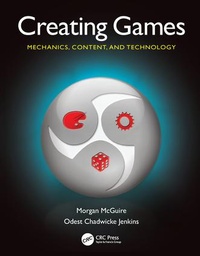
Creating Games
Mechanics, Content, and Technology
1st Edition
Will be published approx. on 23. December 2008
Book
Hardback
500 pages
978-1-56881-305-9 (ISBN)
Description
Creating Games offers a comprehensive overview of the technology, content, and mechanics of game design. It emphasizes the broad view of a games team and teaches you enough about your teammates' areas so that you can work effectively with them. The authors have included many worksheets and exercises to help get your small indie team off the ground.
Special features:
Exercises at the end of each chapter combine comprehension tests with problems that help the reader interact with the material
Worksheet exercises provide creative activities to help project teams generate new ideas and then structure them in a modified version of the format of a game industry design document
Pointers to the best resources for digging deeper into each specialized area of game development
Website with worksheets, figures from the book, and teacher materials including study guides, lecture presentations, syllabi, supplemental exercises, and assessment materials
Special features:
Exercises at the end of each chapter combine comprehension tests with problems that help the reader interact with the material
Worksheet exercises provide creative activities to help project teams generate new ideas and then structure them in a modified version of the format of a game industry design document
Pointers to the best resources for digging deeper into each specialized area of game development
Website with worksheets, figures from the book, and teacher materials including study guides, lecture presentations, syllabi, supplemental exercises, and assessment materials
Reviews / Votes
Williams College Professor Morgan McGuire takes his games very seriously. So seriously, in fact, that he has written a book about it. ... While teaching his game design class, McGuire couldn't find a book that covered this, so he called up his colleague Professor Chad Jenkins at Brown, and they co-wrote the book to help other people design games. It combines scientific theories about rule systems with more practical advice about the process of designing a game.-- L452The Berkshire Eagle , November 2008
Apply Game Design as a Science for Public Policy to Rescue Economy, Planet: They are all subject to analysis as games: scenarios where intelligent agents (players) seek to maximize their payoff (win) under a set of rules. Although some seem like fun and others like work, an understanding of each instance informs the others, and insights for any improve how we both work and play.
-- Morgan McGuire, Infinite Connection, April 2009
The writing is friendly and just casual enough that the authors' personalities come through. The book is engaging, clear, and well focused. The text combines a general survey of each topic with occasional asides offering specific and well-chosen detail. This combination gives the book a sense of confident authority. . . .This ambitious, wide-ranging book succeeds in giving its readers a broad overview of many topics that contribute to contemporary video game design. For someone who has never worked in the field, this book will give a general understanding of how a game is designed, the working of a modern studio, the roles of different departments and the people in them, the tools they use, and the technical issues that are important to them. The exercises at the end of each chapter enhance the book's value as a course textbook.
With its wealth of information on many subjects important to game design, the book would serve well as an introductory text for a student considering a career as a game designer.
-- Andrew Glassner, SIAM, January 2010
More details
Language
English
Place of publication
Natick
United States
Publishing group
Taylor & Francis Inc
Target group
College/higher education
Professional and scholarly
This book is for people in the computer game programming & design field.
Dimensions
Height: 235 mm
Width: 191 mm
Weight
1065 gr
ISBN-13
978-1-56881-305-9 (9781568813059)
Copyright in bibliographic data and cover images is held by Nielsen Book Services Limited or by the publishers or by their respective licensors: all rights reserved.
Schweitzer Classification
Other editions
Additional editions
E-Book
12/2008
1st Edition
CRC Press
€121.99
Available for download
E-Book
12/2008
CRC Press
€121.99
Available for download
Persons
Morgan McGuire is an Assistant Professor of Computer Science at Williams College, where he teaches computer graphics and games. He is also a games industry consultant with credits including Titan Quest (2006), ROBLOX (2005), Zen of Sudoku (2007), and a yet-unannounced Activision title. He received his Ph.D in Computer Science from Brown University.
Odest Chadwicke Jenkins is an Assistant Professor of Computer Science at Brown University. In 2007, Jenkins received the Presidential Early Career Award for Scientists and Engineers and Young Investigator funding from the Office of Naval Research. He received his Ph.D in Computer Science from the University of Southern California.
Odest Chadwicke Jenkins is an Assistant Professor of Computer Science at Brown University. In 2007, Jenkins received the Presidential Early Career Award for Scientists and Engineers and Young Investigator funding from the Office of Naval Research. He received his Ph.D in Computer Science from the University of Southern California.
Content
Minigame Design Exercise. The Process of Development and Theory of Design. Managing Innovation. Critique and Proposal. The Design Document.
Game Technology. Strategic Thought. Balance. Mechanics. Creating a World.
Art Direction. 3D Modeling. Real-Time Rendering. Physical Simulation. Network Programming. User Input. Artificial Intelligence. Social Issues. Appendices. Bibliography. Index.
Game Technology. Strategic Thought. Balance. Mechanics. Creating a World.
Art Direction. 3D Modeling. Real-Time Rendering. Physical Simulation. Network Programming. User Input. Artificial Intelligence. Social Issues. Appendices. Bibliography. Index.