

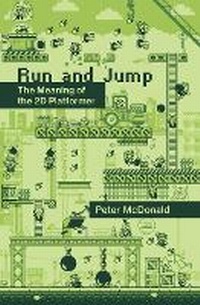
Run and Jump
The Meaning of the 2D Platformer
Published on 6. February 2024
Book
Paperback/Softback
192 pages
978-0-262-54739-0 (ISBN)
Description
How abstract design decisions in 2D platform games create rich worlds of meaning for players.
Since the 1980s, 2D platform games have captivated their audiences. Whether the player scrambles up the ladders in Donkey Kong or leaps atop an impossibly tall pipe in Super Mario Bros., this deceptively simple visual language has persisted in our cultural imagination of video games. In Run and Jump, Peter McDonald surveys the legacy of 2D platform games and examines how abstract and formal design choices have kept players playing. McDonald argues that there is a rich layer of meaning underneath, say, the quality of an avatar’s movement, the pacing and rhythm of level design, the personalities expressed by different enemies, and the emotion elicited by collecting a coin.
To understand these games, McDonald draws on technical discussions by game designers as well as theoretical work about the nature of signs from structuralist semiotics. Interspersed throughout are design exercises that show how critical interpretation can become a tool for game designers to communicate with their players. With examples drawn from over forty years of game history, and from games made by artists, hobbyists, iconic designers, and industry studios, Run and Jump presents a comprehensive—and engaging—vision of this slice of game history.
Since the 1980s, 2D platform games have captivated their audiences. Whether the player scrambles up the ladders in Donkey Kong or leaps atop an impossibly tall pipe in Super Mario Bros., this deceptively simple visual language has persisted in our cultural imagination of video games. In Run and Jump, Peter McDonald surveys the legacy of 2D platform games and examines how abstract and formal design choices have kept players playing. McDonald argues that there is a rich layer of meaning underneath, say, the quality of an avatar’s movement, the pacing and rhythm of level design, the personalities expressed by different enemies, and the emotion elicited by collecting a coin.
To understand these games, McDonald draws on technical discussions by game designers as well as theoretical work about the nature of signs from structuralist semiotics. Interspersed throughout are design exercises that show how critical interpretation can become a tool for game designers to communicate with their players. With examples drawn from over forty years of game history, and from games made by artists, hobbyists, iconic designers, and industry studios, Run and Jump presents a comprehensive—and engaging—vision of this slice of game history.
More details
Language
English
Place of publication
Cambridge (Massachusetts)
United States
Publishing group
MIT Press Ltd
Illustrations
32 BLACK AND WHITE ILLUS.
Dimensions
Height: 176 mm
Width: 127 mm
Thickness: 20 mm
Weight
212 gr
ISBN-13
978-0-262-54739-0 (9780262547390)
Copyright in bibliographic data and cover images is held by Nielsen Book Services Limited or by the publishers or by their respective licensors: all rights reserved.
Schweitzer Classification
Other editions
Additional editions
E-Book
02/2024
MIT Press
€33.99
Available for download
Person
Peter McDonald
Content
Contents
On Thinking Playfully vii
Acknowledgments ix
Introduction: A Curious Persistence 1
1 Jumping 21
2 Dirt Suspended in the Air 51
3 Philosophy of the Enemy 81
4 Every Game Is Two Games 107
Conclusion: No Cheat Code 129
Notes 139
Ludography 153
Bibliography 157
Index 167
On Thinking Playfully vii
Acknowledgments ix
Introduction: A Curious Persistence 1
1 Jumping 21
2 Dirt Suspended in the Air 51
3 Philosophy of the Enemy 81
4 Every Game Is Two Games 107
Conclusion: No Cheat Code 129
Notes 139
Ludography 153
Bibliography 157
Index 167