

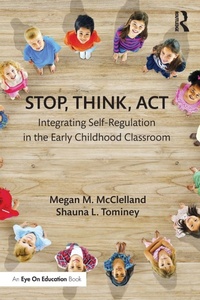
Stop, Think, Act
Integrating Self-Regulation in the Early Childhood Classroom
1st Edition
Published on 9. September 2015
Book
Paperback/Softback
11 pages
978-0-415-74523-9 (ISBN)
Description
Stop, Think, Act: Integrating Self-regulation in the Early Childhood Classroom offers early childhood teachers the latest research and a wide variety of hands-on activities to help children learn and practice self-regulation techniques. Self-regulation in early childhood leads to strong academic performance, helps students form healthy friendships, and gives them the social and emotional resources they need to face high-stress situations throughout life.
The book takes you through everything you need to know about using self-regulation principles during circle time, in literacy and math instruction, and during gross motor and outdoor play. Each chapter includes a solid research base as well as practical, developmentally-appropriate games, songs, and strategies that you can easily incorporate in your own classroom. With Stop, Think, Act, you'll be prepared to integrate self-regulation into every aspect of the school day.
The book takes you through everything you need to know about using self-regulation principles during circle time, in literacy and math instruction, and during gross motor and outdoor play. Each chapter includes a solid research base as well as practical, developmentally-appropriate games, songs, and strategies that you can easily incorporate in your own classroom. With Stop, Think, Act, you'll be prepared to integrate self-regulation into every aspect of the school day.
More details
Language
English
Place of publication
London
United Kingdom
Publishing group
Taylor & Francis Ltd
Target group
Professional and scholarly
Parents, Professional, and Professional Practice & Development
Illustrations
4 s/w Abbildungen, 6 s/w Tabellen
6 Tables, black and white; 4 Illustrations, black and white
Dimensions
Height: 229 mm
Width: 152 mm
Thickness: 8 mm
Weight
220 gr
ISBN-13
978-0-415-74523-9 (9780415745239)
Copyright in bibliographic data and cover images is held by Nielsen Book Services Limited or by the publishers or by their respective licensors: all rights reserved.
Schweitzer Classification
Other editions
Additional editions
Megan M. McClelland | Shauna L. Tominey
Stop, Think, Act
Integrating Self-Regulation in the Early Childhood Classroom
Book
10/2015
1st Edition
Routledge
€170.20
Shipment within 15-20 days
Megan M. McClelland | Shauna L. Tominey
Stop, Think, Act
Integrating Self-Regulation in the Early Childhood Classroom
E-Book
08/2015
Routledge
€41.99
Available for download
Megan M. McClelland | Shauna L. Tominey
Stop, Think, Act
Integrating Self-Regulation in the Early Childhood Classroom
E-Book
08/2015
Routledge
€41.99
Available for download
Persons
Megan M. McClelland is the Katherine E. Smith Healthy Children and Families Professor in Human Development and Family Sciences at Oregon State University. Her research focuses on optimizing children's development, especially as it relates to children's self-regulation and school readiness, including links between self-regulation and academic achievement from early childhood to adulthood, recent advances in measuring self-regulation, and intervention efforts to improve these skills in young children.
Shauna L. Tominey is an associate research scientist at the Yale Center for Emotional Intelligence. As the Director of Early Childhood Programming and Teacher Education, her work focuses on developing and implementing programs aimed at improving social and emotional outcomes for children and families.
Shauna L. Tominey is an associate research scientist at the Yale Center for Emotional Intelligence. As the Director of Early Childhood Programming and Teacher Education, her work focuses on developing and implementing programs aimed at improving social and emotional outcomes for children and families.
Content
Chapter 1: Self-Regulation in Early Childhood. Chapter 2: Laying the Foundation for Self-Regulation. Chapter 3: Setting up the Classroom for Self-Regulation Success. Activity Break #1: Circle Time Games to Promote Self-Regulation. Chapter 4: Self-Regulation and Circle Time. Activity Break #2: Supporting Circle Time Transitions Through Self-Regulation. Chapter 5: Self-Regulation and Curriculum Areas: Literacy and Math. Activity Break #3: Self-Regulation Games Promoting Literacy and Math. Chapter 6: Integrating Self-Regulation into Outdoor and Gross Motor Play. Activity Break #4: Self-Regulation Games in Outdoor and Gross Motor Play. Chapter 7: Engaging Families in Self-Regulation Development. Chapter 8: Self-Regulation Assessment and Intervention. Chapter 9: Conclusions and Additional Resources.