

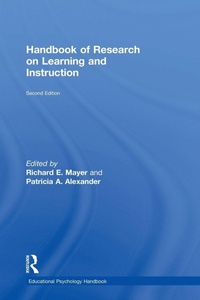
Handbook of Research on Learning and Instruction
2nd Edition
Published on 14. October 2016
Book
Hardback
596 pages
978-1-138-83175-9 (ISBN)
Description
During the past 30 years, researchers have made exciting progress in the science of learning (i.e., how people learn) and the science of instruction (i.e., how to help people learn). This second edition of the Handbook of Research on Learning and Instruction is intended to provide an overview of these research advances. With chapters written by leading researchers from around the world, this volume examines learning and instruction in a variety of learning environments including in classrooms and out of classrooms, and with a variety of learners including K-16 students and adult learners. Contributors to this volume demonstrate how and why educational practice should be guided by research evidence concerning what works in instruction. The Handbook is written at a level that is appropriate for graduate students, researchers, and practitioners interested in an evidence-based approach to learning and instruction.
The book is divided into two sections: learning and instruction. The learning section consists of chapters on how people learn in reading, writing, mathematics, science, history, second language, and physical education, as well as how people acquire the knowledge and processes required for critical thinking, studying, self-regulation, and motivation. The instruction section consists of chapters on effective instructional methods-feedback, examples, questioning, tutoring, visualizations, simulations, inquiry, discussion, collaboration, peer modeling, and adaptive instruction.
Each chapter in this second edition of the Handbook has been thoroughly revised to integrate recent advances in the field of educational psychology. Two chapters have been added to reflect advances in both helping students develop learning strategies and using technology to individualize instruction. As with the first edition, this updated volume showcases the best research being done on learning and instruction by traversing a broad array of academic domains, learning constructs, and instructional methods.
The book is divided into two sections: learning and instruction. The learning section consists of chapters on how people learn in reading, writing, mathematics, science, history, second language, and physical education, as well as how people acquire the knowledge and processes required for critical thinking, studying, self-regulation, and motivation. The instruction section consists of chapters on effective instructional methods-feedback, examples, questioning, tutoring, visualizations, simulations, inquiry, discussion, collaboration, peer modeling, and adaptive instruction.
Each chapter in this second edition of the Handbook has been thoroughly revised to integrate recent advances in the field of educational psychology. Two chapters have been added to reflect advances in both helping students develop learning strategies and using technology to individualize instruction. As with the first edition, this updated volume showcases the best research being done on learning and instruction by traversing a broad array of academic domains, learning constructs, and instructional methods.
Reviews / Votes
"Two of the world's leading researchers in the area of cognitive processes and instructional design, Richard E. Mayer and Patricia A. Alexander, have combined the work of the major figures in our discipline in this edited collection. The result is a brilliant compilation of what we know about the learning sciences. It should be essential reading by all with a serious interest in this area. I expect it to be a critical source for years to come."John Sweller, Emeritus Professor of Educational Psychology, School of Education, University of New South Wales, Australia
"This is an extremely informative handbook of the research and theory on learning and instruction. The coverage is superb, the writing organized and accessible. Scholars, teachers, and advanced students will find this volume indispensable. You will be reaching again and again for this resource."
Mark McDaniel, Co-Director of the Center for Integrative Research on Cognition, Learning, and Education (CIRCLE) and Professor, Department of Psychological and Brain Sciences, Washington University, USA
More details
Series
Edition
2nd edition
Language
English
Place of publication
London
United Kingdom
Publishing group
Taylor & Francis Ltd
Target group
College/higher education
Professional and scholarly
Postgraduate and Professional
Illustrations
4 s/w Photographien bzw. Rasterbilder, 7 s/w Zeichnungen, 13 s/w Tabellen
13 Tables, black and white; 7 Line drawings, black and white; 4 Halftones, black and white
Dimensions
Height: 260 mm
Width: 183 mm
Thickness: 36 mm
Weight
1304 gr
ISBN-13
978-1-138-83175-9 (9781138831759)
Copyright in bibliographic data and cover images is held by Nielsen Book Services Limited or by the publishers or by their respective licensors: all rights reserved.
Schweitzer Classification
Other editions
New editions
Richard E. Mayer | Patricia A. Alexander | Logan Fiorella
Handbook of Research on Learning and Instruction
Book
approx. 12/2025
3rd Edition
Routledge
€341.70
Not yet published
Additional editions
Richard E. Mayer | Patricia A. Alexander
Handbook of Research on Learning and Instruction
Book
10/2016
2nd Edition
Routledge
€176.40
Shipment within 10-20 days
Richard E. Mayer | Patricia A. Alexander
Handbook of Research on Learning and Instruction
E-Book
10/2016
2nd Edition
Routledge
€171.99
Available for download
Richard E. Mayer | Patricia A. Alexander
Handbook of Research on Learning and Instruction
E-Book
10/2016
2nd Edition
Routledge
€172.99
Available for download
Previous edition
Richard E. Mayer | Patricia A. Alexander
Handbook of Research on Learning and Instruction
Book
02/2011
Routledge
€274.84
Article exhausted; check for reprint
Persons
Richard E. Mayer is Distinguished Professor of Psychology at the University of California, Santa Barbara (UCSB), USA.
Patricia A. Alexander is the Jean Mullan Professor of Literacy and Distinguished Scholar-Teacher in the Department of Human Development and Quantitative Methodology at the University of Maryland, USA.
Patricia A. Alexander is the Jean Mullan Professor of Literacy and Distinguished Scholar-Teacher in the Department of Human Development and Quantitative Methodology at the University of Maryland, USA.
Content
Contents
About the Editors
Contributors
Preface
Acknowledgements
PART 1: RESEARCH ON LEARNING
1. Introduction to Research on Learning
Richard E. Mayer and Patricia A. Alexander
2. Learning to Read
Emily Fox and Patricia A. Alexander
3. Learning to Write
Susan De La Paz and Deborah McCutchen
4. Learning Mathematics
Ann R. Edwards, Indigo Esmonde, Joseph F. Wagner, and Rachel L. Beattie
5. Learning Science
Richard Hamilton and Richard Duschl
6. Learning History
Linda Levstik
7. Learning a Second Language
Min Wang
8. Learning Motor Skill in Physical Education
Catherine D. Ennis and Ang Chen
9. Learning to Think Critically
Christina R. Bonney and Robert J. Sternberg
10. Learning to Study Strategically
Daniel L. Dinsmore, Emily M. Grossnickle, and Denis Dumas
11. Learning to Self-Monitor and Self-Regulate
Marcel V. J. Veenman
12. Learning with Motivation
Hadley J. Solomon and Eric M. Anderman
PART 2: RESEARCH ON INSTRUCTION
13. Introduction to Research on Instruction
Patricia A. Alexander and Richard E. Mayer
14. Instruction Based on Feedback
John Hattie, Mark Gan, and Cameron Brooks
15. Instruction Based on Examples
Alexander Renkl
16. Instruction Based on Self-Explanation
Bethany Rittle-Johnson and Abbey M. Loehr
17. Instruction Based on Peer Interaction
Kathryn R. Wentzel and Deborah Watkins Edelman
18. Instruction Based on Cooperative Learning
Robert E. Slavin
19. Instruction Based on Inquiry
Sofie M. M. Loyens and Remy M. J. P. Rikers
20. Instruction Based on Discussion
P. Karen Murphy, Ian A. G., Wilkinson, Anna O. Soter and Carla M. Firetto
21. Instruction Based on Tutoring
Arthur C. Graesser, Vasile Rus, and Xiangen Hu
22. Instruction Based on Visualizations
Richard E. Mayer
23. Instruction Based on Computer Simulations and Virtual Laboratories
Ton de Jong
24, Instruction Based on Adaptive Learning Technologies
Vincent Aleven, Elizabeth A. McLaughlin, R. Amos Glenn, and Kenneth R. Koedinger
Author Index
Subject Index
About the Editors
Contributors
Preface
Acknowledgements
PART 1: RESEARCH ON LEARNING
1. Introduction to Research on Learning
Richard E. Mayer and Patricia A. Alexander
2. Learning to Read
Emily Fox and Patricia A. Alexander
3. Learning to Write
Susan De La Paz and Deborah McCutchen
4. Learning Mathematics
Ann R. Edwards, Indigo Esmonde, Joseph F. Wagner, and Rachel L. Beattie
5. Learning Science
Richard Hamilton and Richard Duschl
6. Learning History
Linda Levstik
7. Learning a Second Language
Min Wang
8. Learning Motor Skill in Physical Education
Catherine D. Ennis and Ang Chen
9. Learning to Think Critically
Christina R. Bonney and Robert J. Sternberg
10. Learning to Study Strategically
Daniel L. Dinsmore, Emily M. Grossnickle, and Denis Dumas
11. Learning to Self-Monitor and Self-Regulate
Marcel V. J. Veenman
12. Learning with Motivation
Hadley J. Solomon and Eric M. Anderman
PART 2: RESEARCH ON INSTRUCTION
13. Introduction to Research on Instruction
Patricia A. Alexander and Richard E. Mayer
14. Instruction Based on Feedback
John Hattie, Mark Gan, and Cameron Brooks
15. Instruction Based on Examples
Alexander Renkl
16. Instruction Based on Self-Explanation
Bethany Rittle-Johnson and Abbey M. Loehr
17. Instruction Based on Peer Interaction
Kathryn R. Wentzel and Deborah Watkins Edelman
18. Instruction Based on Cooperative Learning
Robert E. Slavin
19. Instruction Based on Inquiry
Sofie M. M. Loyens and Remy M. J. P. Rikers
20. Instruction Based on Discussion
P. Karen Murphy, Ian A. G., Wilkinson, Anna O. Soter and Carla M. Firetto
21. Instruction Based on Tutoring
Arthur C. Graesser, Vasile Rus, and Xiangen Hu
22. Instruction Based on Visualizations
Richard E. Mayer
23. Instruction Based on Computer Simulations and Virtual Laboratories
Ton de Jong
24, Instruction Based on Adaptive Learning Technologies
Vincent Aleven, Elizabeth A. McLaughlin, R. Amos Glenn, and Kenneth R. Koedinger
Author Index
Subject Index