

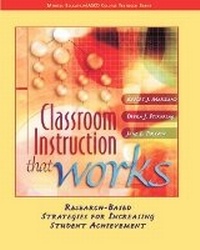
Classroom Instruction that Works
Research-Based Strategies for Increasing Student Achievement
Published on 12. September 2005
Book
Paperback/Softback
192 pages
978-0-13-119503-5 (ISBN)
Description
This is a perfect resource for all educators seeking research on the best strategies for raising student achievement through classroom instruction. A guide for educators of students in K-12, readers will find a wealth of research evidence, statistical data, and case studies. Nine categories of instructional strategies that maximize student learning are introduced, along with the pertinent information to understand and synthesize each:
Studies in effect size and percentile gain units
Guiding principles for using the strategies
Classroom examples of model instructional practice
Charts, frames, rubrics, organizers, and other tools--will help teachers to apply the strategies immediately in the classoom.
Studies in effect size and percentile gain units
Guiding principles for using the strategies
Classroom examples of model instructional practice
Charts, frames, rubrics, organizers, and other tools--will help teachers to apply the strategies immediately in the classoom.
More details
Language
English
Place of publication
United States
Publishing group
Pearson Education (US)
Target group
Professional and scholarly
Dimensions
Height: 204 mm
Width: 256 mm
Thickness: 7 mm
Weight
313 gr
ISBN-13
978-0-13-119503-5 (9780131195035)
Copyright in bibliographic data and cover images is held by Nielsen Book Services Limited or by the publishers or by their respective licensors: all rights reserved.
Schweitzer Classification
Other editions
New editions
Ceri Dean | Ceri B. Dean | Elizabeth Ross Hubbell
Classroom Instruction that Works: Research-Based Strategies for Increasing Student Achievement
Research-Based Strategies for Increasing Student Achievement
Book
02/2013
2nd Edition
Pearson
€43.99
Shipment within 15-20 days
Content
List of Figures
Chapter 1. Applying Research on Instruction: An Idea Whose Time Has Come
Research-Based Strategies
Chapter 2. Identifying Similarities and Differences
Chapter 3. Summarizing and Note Taking
Chapter 4. Reinforcing Effort and Providing Recognition
Chapter 5. Homework and Practice
Chapter 6. Nonlinguistic Representations
Chapter 7. Cooperative Learning
Chapter 8. Setting Objectives and Providing Feedback
Chapter 9. Generating and Testing Hypotheses
Chapter 10. Cues, Questions, and Advance Organizers
Specific Applications
Chapter 11. Teaching Specific Types of Knowledge
Chapter 12. Using the Nine Categories in Instructional Planning
Chapter 13. Afterword
Appendix: Conversion Table for Effect Size/Percentile Gain
References
Index
About the Authors
Chapter 1. Applying Research on Instruction: An Idea Whose Time Has Come
Research-Based Strategies
Chapter 2. Identifying Similarities and Differences
Chapter 3. Summarizing and Note Taking
Chapter 4. Reinforcing Effort and Providing Recognition
Chapter 5. Homework and Practice
Chapter 6. Nonlinguistic Representations
Chapter 7. Cooperative Learning
Chapter 8. Setting Objectives and Providing Feedback
Chapter 9. Generating and Testing Hypotheses
Chapter 10. Cues, Questions, and Advance Organizers
Specific Applications
Chapter 11. Teaching Specific Types of Knowledge
Chapter 12. Using the Nine Categories in Instructional Planning
Chapter 13. Afterword
Appendix: Conversion Table for Effect Size/Percentile Gain
References
Index
About the Authors