

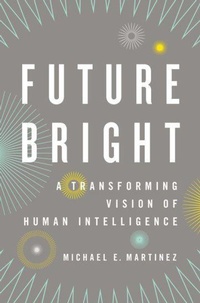
Future Bright
A Transforming Vision of Human Intelligence
Published on 1. August 2013
Book
Hardback
320 pages
978-0-19-978184-3 (ISBN)
Description
Future Bright introduces a radical idea: Intelligence is learnable. This idea is tremendously important because it means that with the right environment, intelligence levels can be increased intentionally. Intelligence is essential to the survival and prosperity of not only individuals, but also organizations, nations, and the entire planet.
Martinez first considers a seemingly simple question. What is intelligence? Examining some of the most fascinating stories in the history of cognitive science reveals the ways our ideas about intelligence have been shaped. Current research asks, "Is intelligence just one thing? Or are there many different ways of being intelligent?" For answers, we turn to the seat of intelligence, the brain. From the search for Einstein's brain to the curious case of a railroad worker whose frontal lobe was pierced by a tamping iron, researchers have sought to understand more about intelligence by understanding more about this mysterious organ. How do physical structures relate to how we think? How are memories made? How do the brain and the mind relate to one another?
Finally, Future Bright explores the provocative finding from recent cognitive science research that intelligence can be learned. Genetics play only one part in an individual's intelligence potential. It is that part that is influenced by the environment that is most interesting, however, because if intelligence can be learned, then it can be taught. Future Bright explores ways that the environment and educational contexts can influence the growth of a more intelligent society - one that will lead us into a brighter future indeed.
Martinez first considers a seemingly simple question. What is intelligence? Examining some of the most fascinating stories in the history of cognitive science reveals the ways our ideas about intelligence have been shaped. Current research asks, "Is intelligence just one thing? Or are there many different ways of being intelligent?" For answers, we turn to the seat of intelligence, the brain. From the search for Einstein's brain to the curious case of a railroad worker whose frontal lobe was pierced by a tamping iron, researchers have sought to understand more about intelligence by understanding more about this mysterious organ. How do physical structures relate to how we think? How are memories made? How do the brain and the mind relate to one another?
Finally, Future Bright explores the provocative finding from recent cognitive science research that intelligence can be learned. Genetics play only one part in an individual's intelligence potential. It is that part that is influenced by the environment that is most interesting, however, because if intelligence can be learned, then it can be taught. Future Bright explores ways that the environment and educational contexts can influence the growth of a more intelligent society - one that will lead us into a brighter future indeed.
Reviews / Votes
Clearly written and accessible. * The Psychologist *More details
Language
English
Place of publication
New York
United States
Target group
College/higher education
Professional and scholarly
Product notice
sewn/stitched
Cloth over boards
With dust jacket
Dimensions
Height: 236 mm
Width: 155 mm
Thickness: 30 mm
Weight
544 gr
ISBN-13
978-0-19-978184-3 (9780199781843)
Copyright in bibliographic data and cover images is held by Nielsen Book Services Limited or by the publishers or by their respective licensors: all rights reserved.
Schweitzer Classification
Other editions
Additional editions
E-Book
07/2013
1st Edition
OUP eBook
€16.99
Available for download
E-Book
07/2013
1st Edition
OUP eBook
€16.99
Available for download
Person
Dr. Michael Martinez (1956-2012) was a Professor of Education at the University of California, Irvine (UCI). A former high school science, teacher, Dr. Martinez received his Ph.D. in educational psychology from Stanford University in 1987. As a staff member at the Educational Testing Service in Princeton, New Jersey, he was instrumental in developing new forms of assessment in science, architecture, and engineering. His research at UCI primarily centered on the modifiability of intelligence, and the development of innovative programs for improving the science and math education of diverse learners.
Content
Introduction ; Chapter 1. The Sine Qua Non of Success ; Chapter 2. What is Intelligence? ; Chapter 3. Varieties of Intelligence ; Chapter 4. Brain and Mind ; Chapter 5. The Nature-Nurture Dilemma ; Chapter 6. How Experience Cultivates Intelligence ; Chapter 7. The Superstructure of Effectiveness ; Chapter 8. Ten Strategies to Enhance Intelligence