

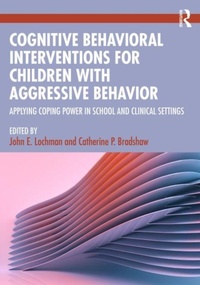
Cognitive Behavioral Interventions for Children with Aggressive Behavior
Applying Coping Power in School and Clinical Settings
1st Edition
Will be published approx. on 5. August 2026
Book
Paperback/Softback
276 pages
978-1-032-96881-0 (ISBN)
Description
Cognitive Behavioral Interventions for Children with Aggressive Behavior: Applying Coping Power in School and Clinical Settings explores the theoretical development, empirical foundations, and real-world implementation of one of today's most effective and outcomes-driven models for cognitive behavioral interventions in schools.
Coping Power, which developed from Anger Coping, was created to support prevention and early intervention efforts for aggressive, high-risk children and adolescents by school-based mental health professionals. Offering a basis for Coping Power's history, objectives, activities, and models, this book uses current implementation science models to explore the training, implementation, and dissemination of research inspired by the program. Further insights are offered on how Coping Power can be adapted across diverse community contexts and optimized with new methodological approaches.
Graduate students, teaching faculty, supervising professionals, and researchers in school psychology, school counseling, school social work, special education, clinical and community psychology and beyond will come away with new perspectives on how to intentionally develop and evaluate adaptations of existing evidence-based interventions in order to meet the needs of children who are less responsive to existing interventions.
Coping Power, which developed from Anger Coping, was created to support prevention and early intervention efforts for aggressive, high-risk children and adolescents by school-based mental health professionals. Offering a basis for Coping Power's history, objectives, activities, and models, this book uses current implementation science models to explore the training, implementation, and dissemination of research inspired by the program. Further insights are offered on how Coping Power can be adapted across diverse community contexts and optimized with new methodological approaches.
Graduate students, teaching faculty, supervising professionals, and researchers in school psychology, school counseling, school social work, special education, clinical and community psychology and beyond will come away with new perspectives on how to intentionally develop and evaluate adaptations of existing evidence-based interventions in order to meet the needs of children who are less responsive to existing interventions.
More details
Language
English
Place of publication
London
United Kingdom
Publishing group
Taylor & Francis Ltd
Target group
College/higher education
Professional and scholarly
Postgraduate, Professional Practice & Development, Professional Reference, and Professional Training
Illustrations
5 s/w Photographien bzw. Rasterbilder, 5 s/w Zeichnungen, 12 s/w Tabellen, 10 s/w Abbildungen
12 Tables, black and white; 5 Line drawings, black and white; 5 Halftones, black and white; 10 Illustrations, black and white
Dimensions
Height: 254 mm
Width: 178 mm
ISBN-13
978-1-032-96881-0 (9781032968810)
Copyright in bibliographic data and cover images is held by Nielsen Book Services Limited or by the publishers or by their respective licensors: all rights reserved.
Schweitzer Classification
Other editions
Additional editions

John E. Lochman | Catherine P. Bradshaw
Cognitive Behavioral Interventions for Children with Aggressive Behavior
Applying Coping Power in School and Clinical Settings
E-Book
approx. 08/2026
1st Edition
Routledge
€60.49
Not yet available

John E. Lochman | Catherine P. Bradshaw
Cognitive Behavioral Interventions for Children with Aggressive Behavior
Applying Coping Power in School and Clinical Settings
Book
approx. 08/2026
1st Edition
Routledge
€191.50
Not yet published
John E. Lochman | Catherine P. Bradshaw
Cognitive Behavioral Interventions for Children with Aggressive Behavior
Applying Coping Power in School and Clinical Settings
E-Book
approx. 08/2026
1st Edition
Routledge
€60.49
Not yet available
Persons
John E. Lochman is Saxon Professor Emeritus in Psychology at The University of Alabama, USA, Director Emeritus of the Center for Youth Development and Intervention, and Senior Fellow at Alabama Life Research Institute.
Catherine P. Bradshaw is University Professor and Senior Associate Dean for Research in the School of Education and Human Development at the University of Virginia, USA, and Adjunct Faculty in the Bloomberg School of Public Health at Johns Hopkins University, USA.
Catherine P. Bradshaw is University Professor and Senior Associate Dean for Research in the School of Education and Human Development at the University of Virginia, USA, and Adjunct Faculty in the Bloomberg School of Public Health at Johns Hopkins University, USA.
Content
Part I: History and Development of Coping Power 1. Coping Power: Background, Conceptual Framework, and Efficacy Studies Part II: Implementation Issues in Delivering Coping Power 2. Implementation Issues in Coping Power: Role of Training Intensity, Context, and Therapist Characteristics and Alliance 3. Overcoming Barriers Across the Implementation Continuum 4. Beyond Train & Hope: School-Hospital Partnership to Adopt & Sustain Anger Coping in Chicago Part III: Adapatation and Optimization of Coping Power 5. The Friend to Friend Program: A Review of Program Development and Adaptation, Refinement, and Testing 6. Effects of Delivering Coping Power in Individual versus Group Formats 7. Adaptations of Coping Power for Children with Clinical levels of Conduct Problems and for Youth with Mild Intellectual Disabilities 8. Adaptations of Coping Power for an Outpatient Clinical Setting 9. Adaptions and Affects of the Coping Power Child Component for Children in Swedish Child- and Adolescent Psychiatry 10. Adapting The Coping Power Program: The Italian Journey 11. Coping Power for Boys in Pakistan: A Cultural Adaptation 12. Tiered Adaptations for Implementation in Rural and Other Low Resource Settings 13. Optimizing Coping Power with Mindfulness 14. Transforming Coping Power: Hybrid and Online Versions to Address Practical, Clinical, and Systemic Needs 15. Crossover Effects of Adapted Versions of Coping Power for Adolescents: Lessons Learned from the Integrative Analysis Project Part IV: Innovative Methods for Assessing Implementation and Outcomes, and Scaling Up 16. Scaling up Screening Methods for Use in Preventive Interventions Part V: Conclusion 17. Conclusions and Reflections on the Multiple Adaptations of Coping Power to Promote Implementation: A Focus on Cross-Cutting Themes