

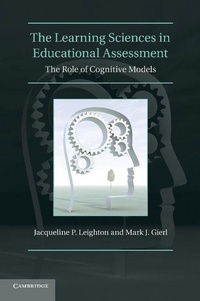
The Learning Sciences in Educational Assessment
The Role of Cognitive Models
Published on 1. May 2014
Book
Paperback/Softback
278 pages
978-0-521-12288-7 (ISBN)
Description
There is mounting hope in the United States that federal legislation in the form of No Child Left Behind will improve educational outcomes. As titanic as the challenge appears to be, however, the solution could be at our fingertips. This volume identifies visual types of cognitive models in reading, science and mathematics for researchers, test developers, school administrators, policy makers and teachers. In the process of identifying these cognitive models, the book also explores methodological or translation issues to consider as decisions are made about how to generate psychologically informative and psychometrically viable large-scale assessments based on the learning sciences. Initiatives to overhaul educational systems in disrepair may begin with national policies, but the success of these policies will hinge on how well stakeholders begin to rethink what is possible with a keystone of the educational system: large-scale assessment.
Reviews / Votes
"This book inhabits an important space in the current market for educational and psychological assessment and is very sorely needed."-Andre A. Rupp, University of Maryland
More details
Language
English
Place of publication
Cambridge
United Kingdom
Target group
Professional and scholarly
Product notice
Paperback (trade)
Illustrations
6 Tables, unspecified; 18 Line drawings, unspecified
Dimensions
Height: 229 mm
Width: 152 mm
Thickness: 15 mm
Weight
407 gr
ISBN-13
978-0-521-12288-7 (9780521122887)
Copyright in bibliographic data and cover images is held by Nielsen Book Services Limited or by the publishers or by their respective licensors: all rights reserved.
Schweitzer Classification
Other editions
Additional editions
Jacqueline P. Leighton | Mark J. Gierl
The Learning Sciences in Educational Assessment
The Role of Cognitive Models
Book
06/2011
Cambridge University Press
€93.50
Shipment within 15-20 days
Jacqueline P. Leighton | Mark J. Gierl
The Learning Sciences in Educational Assessment
The Role of Cognitive Models
E-Book
06/2011
1st Edition
Cambridge University Press
€26.49
Available for download
Persons
Jacqueline P. Leighton is Professor of Educational Psychology and Director of the Centre for Research in Applied Measurement and Evaluation (CRAME). She is also registered as a psychologist by the College of Alberta Psychologists. Her specialization is educational assessment and cognitive psychology, with an emphasis on test development and validity analysis. Dr Leighton's current research is on identifying and evaluating methods for generating cognitive models for educational assessment practice. Her research has been funded by the Natural Sciences and Engineering Research Council of Canada (NSERC) and the Canadian Education Statistics Council (CESC) and is currently funded by the Social Sciences and Humanities Research Council of Canada (SSHRC). Mark J. Gierl is Professor of Educational Psychology at the University of Alberta. His specialization is educational and psychological testing, with an emphasis on the application of cognitive principles to assessment practices. Dr Gierl's current research is focused on differential item and bundle functioning, cognitively diagnostic assessment and assessment engineering. His research is funded by both the College Board and the Social Sciences and Humanities Research Council of Canada (SSHRC). He holds the Canada Research Chair in Educational Measurement.
Content
1. The learning sciences in educational assessment: an introduction; 2. Evaluating cognitive models in large-scale educational assessments; 3. Cognitive models of task performance for reading comprehension; 4. Cognitive models of task performance for scientific reasoning and discovery; 5. Cognitive models of task performance for mathematical reasoning; 6. Putting it all together: cognitive models to inform the design and development of large-scale educational assessment; 7. Cognitively-based statistical methods - technical illustrations.