

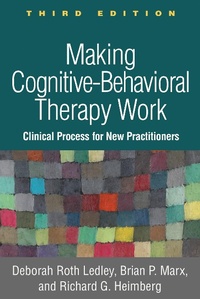
Making Cognitive-Behavioral Therapy Work, Third Edition
Clinical Process for New Practitioners
3rd Edition
Published on 10. August 2018
Book
Hardback
290 pages
978-1-4625-3563-7 (ISBN)
Description
"What should I do when a client asks me personal questions?" "How do my client's multiple problems fit together, and which ones should we focus on in treatment?" This engaging text--now revised and updated--has helped tens of thousands of students and novice cognitive-behavioral therapy (CBT) practitioners build skills and confidence for real-world clinical practice. Hands-on guidance is provided for developing strong therapeutic relationships and navigating each stage of treatment; vivid case material illustrates what CBT looks like in action. Aided by sample dialogues, questions to ask, and helpful checklists, readers learn how to conduct assessments, create strong case conceptualizations, deliver carefully planned interventions, comply with record-keeping requirements, and overcome frequently encountered challenges all along the way.
New to This Edition
*Chapter with advice on new CBT practitioners' most common anxieties.
*All-new case examples, now with a more complex extended case that runs throughout the book.
*Chapter on working with special populations (culturally diverse clients, children and families).
*Special attention to clinical and ethical implications of new technologies and social media.
*Updated throughout to reflect current research and the authors' ongoing clinical and teaching experience.
New to This Edition
*Chapter with advice on new CBT practitioners' most common anxieties.
*All-new case examples, now with a more complex extended case that runs throughout the book.
*Chapter on working with special populations (culturally diverse clients, children and families).
*Special attention to clinical and ethical implications of new technologies and social media.
*Updated throughout to reflect current research and the authors' ongoing clinical and teaching experience.
Reviews / Votes
"I have used this text in my graduate course on CBT and have found it to be a great resource for students on the journey to becoming competent clinicians. The third edition is overflowing with useful advice, enjoyable to read, and well suited for the novice clinician. The advice and narrative guidance is closely aligned with material I have been teaching for 30 years. Ledley, Marx and Heimberg include many realistic case examples that help the reader understand common clinical dilemmas."--James C. Overholser, PhD, ABPP, Department of Psychology, Case Western Reserve University"This is an excellent text for entry-level clinicians; I have used previous editions with doctoral students just beginning their clinical work. The book builds a bridge between academic training and actual clinical practice. Thankfully, it is not organized around CBT for particular diagnoses (as most texts are), because most clients do not fit neatly into diagnostic categories. Ethics, theory, case conceptualization, treatment planning, decision making, and collaborative empiricism are all included, to enable clinicians to develop individualized treatment plans for the clients sitting across from them. This text is validating and comforting for novice clinicians, and will likely reduce much of their anxiety. The new chapter that addresses CBT with children and families is a great addition."--Eva L. Feindler, PhD, Director, Clinical Psychology Doctoral Program, Long Island University Post
"This nicely written and well-orchestrated third edition fills an important gap in the training process for new as well as seasoned CBT clinicians. With an expansion of case illustrations and special population needs, the third edition is a welcome resource. I highly recommend it."--Frank M. Dattilio, PhD, ABPP, Department of Psychiatry, Harvard Medical School
"The authors do an outstanding job of identifying the challenges faced by new CBT clinicians--both realistic difficulties and potentially overblown worries usually kept to ourselves. They take a compassionate approach to trainees, effectively modeling how we all aspire to approach our clients. Understanding is followed with action, as the authors provide practical, thorough advice for managing each situation. The running case example is new to the third edition and well illustrates a number of complex issues, such as the effect of comorbidity on case conceptualization and treatment planning."--David A. F. Haaga, PhD, Department of Psychology, American University
"This is not your usual clinical handbook. Drawing on the authors' widely recognized expertise as clinicians, supervisors, and trainers, the volume offers sound advice on everything from the most basic aspects of professional practice and ethics to complex problems unique to CBT. Throughout the chapters, the sensitive, empathic presentation affirms the skills and integrity of the therapist. Step-by-step instructions and case illustrations deal with essential practice issues that cut across diagnostic boundaries. This is one of those rare CBT manuals that can transform your clinical practice, whether you are a novice or expert. At the very least, this book should be required reading for students and supervisors of any graduate or professional CBT training program."--David A. Clark, PhD, Department of Psychology (Emeritus), University of New Brunswick, Canada -Prepares the beginning therapist for all phases of CBT, from the first phone call to providing booster sessions. This text is easy and enjoyable to read. The authors do a nice job of explaining hard-to-understand therapeutic concepts in a manner that is easy to understand....We have used the book with beginning therapists in our doctoral training program, and it has received rave reviews. (on the first edition)--Behavioural and Cognitive Psychotherapy, 4/1/2007??The authors' many years of combined supervisory experience clearly comes through with their insights and pragmatic solutions to the many problems encountered by initiate therapists....A text that should be required reading in any graduate training program in psychology, regardless of orientation....Will benefit all starting therapists and may even help some supervisors do a better job! (on the first edition)--Child and Family Behavior Therapy, 1/1/2006??This is a great read on how to apply CBT to different clients....It is very helpful in explaining the basics of CBT. (on the second edition)--Doody's Review Service, 10/11/2013 "I have used this text in my graduate course on CBT and have found it to be a great resource for students on the journey to becoming competent clinicians. The third edition is overflowing with useful advice, enjoyable to read, and well suited for the novice clinician. The advice and narrative guidance is closely aligned with material I have been teaching for 30 years. Ledley, Marx and Heimberg include many realistic case examples that help the reader understand common clinical dilemmas."--James C. Overholser, PhD, ABPP, Department of Psychology, Case Western Reserve University
"This is an excellent text for entry-level clinicians; I have used previous editions with doctoral students just beginning their clinical work. The book builds a bridge between academic training and actual clinical practice. Thankfully, it is not organized around CBT for particular diagnoses (as most texts are), because most clients do not fit neatly into diagnostic categories. Ethics, theory, case conceptualization, treatment planning, decision making, and collaborative empiricism are all included, to enable clinicians to develop individualized treatment plans for the clients sitting across from them. This text is validating and comforting for novice clinicians, and will likely reduce much of their anxiety. The new chapter that addresses CBT with children and families is a great addition."--Eva L. Feindler, PhD, Director, Clinical Psychology Doctoral Program, Long Island University Post
"This nicely written and well-orchestrated third edition fills an important gap in the training process for new as well as seasoned CBT clinicians. With an expansion of case illustrations and special population needs, the third edition is a welcome resource. I highly recommend it."--Frank M. Dattilio, PhD, ABPP, Department of Psychiatry, Harvard Medical School
"The authors do an outstanding job of identifying the challenges faced by new CBT clinicians--both realistic difficulties and potentially overblown worries usually kept to ourselves. They take a compassionate approach to trainees, effectively modeling how we all aspire to approach our clients. Understanding is followed with action, as the authors provide practical, thorough advice for managing each situation. The running case example is new to the third edition and well illustrates a number of complex issues, such as the effect of comorbidity on case conceptualization and treatment planning."--David A. F. Haaga, PhD, Department of Psychology, American University
"This is not your usual clinical handbook. Drawing on the authors' widely recognized expertise as clinicians, supervisors, and trainers, the volume offers sound advice on everything from the most basic aspects of professional practice and ethics to complex problems unique to CBT. Throughout the chapters, the sensitive, empathic presentation affirms the skills and integrity of the therapist. Step-by-step instructions and case illustrations deal with essential practice issues that cut across diagnostic boundaries. This is one of those rare CBT manuals that can transform your clinical practice, whether you are a novice or expert. At the very least, this book should be required reading for students and supervisors of any graduate or professional CBT training program."--David A. Clark, PhD, Department of Psychology (Emeritus), University of New Brunswick, Canada -Prepares the beginning therapist for all phases of CBT, from the first phone call to providing booster sessions. This text is easy and enjoyable to read. The authors do a nice job of explaining hard-to-understand therapeutic concepts in a manner that is easy to understand....We have used the book with beginning therapists in our doctoral training program, and it has received rave reviews. (on the first edition)--Behavioural and Cognitive Psychotherapy, 4/1/2007AE'AE'The authors' many years of combined supervisory experience clearly comes through with their insights and pragmatic solutions to the many problems encountered by initiate therapists....A text that should be required reading in any graduate training program in psychology, regardless of orientation....Will benefit all starting therapists and may even help some supervisors do a better job! (on the first edition)--Child and Family Behavior Therapy, 1/1/2006AE'AE'This is a great read on how to apply CBT to different clientsaEUR|.It is very helpful in explaining the basics of CBT. (on the second edition)--Doody's Review Service, 10/11/2013
More details
Edition
3rd edition
Language
English
Place of publication
New York
United States
Publishing group
Guilford Publications
Target group
College/higher education
Clinical psychologists, psychiatrists, clinical social workers, counselors, and psychiatric nurses; graduate students and trainees. Serves as a primary or supplemental text in graduate-level CBT and psychotherapy courses.
Product notice
sewn/stitched
Cloth over boards
Dimensions
Height: 226 mm
Width: 152 mm
Thickness: 25 mm
Weight
544 gr
ISBN-13
978-1-4625-3563-7 (9781462535637)
Copyright in bibliographic data and cover images is held by Nielsen Book Services Limited or by the publishers or by their respective licensors: all rights reserved.
Schweitzer Classification
Other editions
Additional editions
Deborah Roth Ledley | Brian P. Marx | Richard G. Heimberg
Making Cognitive-Behavioral Therapy Work, Third Edition
Clinical Process for New Practitioners
Book
01/2021
3rd Edition
Guilford Press
€38.00
Shipment within 15-20 days
Deborah Roth Ledley | Brian P. Marx | Richard G. Heimberg
Making Cognitive-Behavioral Therapy Work
Clinical Process for New Practitioners
E-Book
05/2018
3rd Edition
The Guilford Press
€37.99
Available for download
Previous edition
Deborah Roth Ledley | Brian P. Marx | Richard G. Heimberg
Making Cognitive-Behavioral Therapy Work, Second Edition
Clinical Process for New Practitioners
Book
10/2010
2nd Edition
Guilford Publications
€58.37
Article exhausted; check for reprint
Persons
Deborah Roth Ledley, PhD, is a psychologist in private practice in suburban Philadelphia. She spent several years on the faculty of the University of Pennsylvania's Center for the Treatment and Study of Anxiety. Dr. Ledley's research has focused on the nature and treatment of anxiety. She has published over 50 scientific papers and book chapters as well as several books, including Making Cognitive-Behavioral Therapy Work, Third Edition; Improving Outcomes and Preventing Relapse in Cognitive-Behavioral Therapy; Becoming a Calm Mom; and The Worry Workbook for Kids. She lectures widely on the treatment of childhood anxiety.
Brian P. Marx, PhD, is a staff psychologist at the National Center for Posttraumatic Stress Disorder (PTSD), Veterans Affairs Boston Healthcare System, and Professor of Psychiatry at Boston University School of Medicine. Dr. Marx has written numerous articles and book chapters on behavior therapy and assessment. His research interests include the assessment and treatment of PTSD, identifying risk factors for posttraumatic difficulties, and the association between PTSD and suicidal behaviors.
Richard G. Heimberg, PhD, is the Thaddeus L. Bolton Professor of Psychology and Director of the Adult Anxiety Clinic of Temple at Temple University. He is past president of the Association for Behavioral and Cognitive Therapies (ABCT) and the Society for a Science of Clinical Psychology (SSCP) and former editor of the journal Behavior Therapy. Well known for his efforts to develop and evaluate cognitive-behavioral treatments for social anxiety and other anxiety disorders, Dr. Heimberg has authored several books and 450 articles and chapters. As an educator and mentor of clinical psychology doctoral students, he has received awards from ABCT, SSCP, the Society of Clinical Psychology, and the American Psychological Association of Graduate Students.
Brian P. Marx, PhD, is a staff psychologist at the National Center for Posttraumatic Stress Disorder (PTSD), Veterans Affairs Boston Healthcare System, and Professor of Psychiatry at Boston University School of Medicine. Dr. Marx has written numerous articles and book chapters on behavior therapy and assessment. His research interests include the assessment and treatment of PTSD, identifying risk factors for posttraumatic difficulties, and the association between PTSD and suicidal behaviors.
Richard G. Heimberg, PhD, is the Thaddeus L. Bolton Professor of Psychology and Director of the Adult Anxiety Clinic of Temple at Temple University. He is past president of the Association for Behavioral and Cognitive Therapies (ABCT) and the Society for a Science of Clinical Psychology (SSCP) and former editor of the journal Behavior Therapy. Well known for his efforts to develop and evaluate cognitive-behavioral treatments for social anxiety and other anxiety disorders, Dr. Heimberg has authored several books and 450 articles and chapters. As an educator and mentor of clinical psychology doctoral students, he has received awards from ABCT, SSCP, the Society of Clinical Psychology, and the American Psychological Association of Graduate Students.
Content
Prologue: Common Challenges for New Clinicians
1. The Process of Cognitive-Behavioral Therapy
2. Initial Interactions with Clients
3. The Process of Assessment
4. Conceptualizing the Case and Planning Treatment
5. The Bridge from Assessment to Treatment
6. The First Few Sessions of CBT: Goals and Challenges
7. The Course of CBT: Goals and Challenges
8. Terminating Therapy: Goals and Challenges
9. Doing CBT with Special Populations
10. The Process of Supervision: Goals and Challenges
11. Revisiting the Common Challenges
Appendix A. Recommended Readings in CBT
Appendix B. Further Reading on Special Topics in CBT
Appendix C. Treatment Manuals and Client Workbooks
Appendix D. Useful Information for Cognitive-Behavioral Therapists
References
Index
1. The Process of Cognitive-Behavioral Therapy
2. Initial Interactions with Clients
3. The Process of Assessment
4. Conceptualizing the Case and Planning Treatment
5. The Bridge from Assessment to Treatment
6. The First Few Sessions of CBT: Goals and Challenges
7. The Course of CBT: Goals and Challenges
8. Terminating Therapy: Goals and Challenges
9. Doing CBT with Special Populations
10. The Process of Supervision: Goals and Challenges
11. Revisiting the Common Challenges
Appendix A. Recommended Readings in CBT
Appendix B. Further Reading on Special Topics in CBT
Appendix C. Treatment Manuals and Client Workbooks
Appendix D. Useful Information for Cognitive-Behavioral Therapists
References
Index