

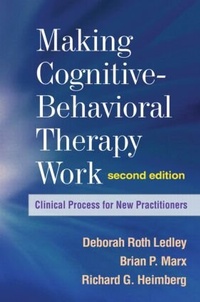
Making Cognitive-Behavioral Therapy Work, Second Edition
Clinical Process for New Practitioners
2nd Edition
Published on 15. October 2010
Book
Hardback
292 pages
978-1-60623-912-4 (ISBN)
Description
Used around the world by novice clinicians as well as experienced therapists new to cognitive-behavioral therapy (CBT), this bestselling book has been widely adopted as a text in clinical training programs. The authors provide a vivid picture of what it is actually like to do CBT and offer practical guidance for becoming a more skilled and confident clinician. Vignettes and examples illustrate the entire process of therapy, from intake and assessment to case conceptualization, treatment planning, intervention, and termination. Expert advice is given on building collaborative therapeutic relationships and getting the most out of supervision. Appendices feature recommended treatment manuals and other CBT resources.
Reviews / Votes
"Ledley and her esteemed colleagues have packed even more pearls of clinical wisdom into their second edition of this truly important book. It is filled with case examples, illustrative dialogues, hints, and suggestions to help clinicians sidestep potential pitfalls and enable their clients to benefit maximally from CBT. The material on how to make good use of supervision and continue to grow as a therapist is what clinched it for me--this book is required reading in my course on CBT for anxiety disorders."--Jonathan S. Abramowitz, PhD, Department of Psychology and Neuroscience and Director, Anxiety and Stress Clinic, University of North Carolina at Chapel Hill"I wish this kind of clinical resource had been available when I was a doctoral student learning CBT! This book covers it all--ethics, theory, case formulation, supervision, therapy, follow-up documentation, and professional development. A wonderful resource for the psychotherapist-in-training or for the experienced practitioner new to CBT methods. Most highly recommended as a classroom or practicum textbook."--Bruce A. Thyer, PhD, LCSW, College of Social Work, Florida State University
"This book will be immensely helpful to young clinicians attempting to master the structure and processes of CBT, from the scheduling of the first visit to the final booster session. Leading CBT therapists with years of clinical and supervisory experience provide extremely clear and practical suggestions in the context of real-world clinical vignettes. I highly recommend this book to anyone wishing to become a CBT therapist."--Neil A. Rector, PhD, Department of Psychiatry, University of Toronto, Canada
"This book astutely anticipates the challenges of clinical practice, demystifies the process of therapy, and fully prepares the novice clinician. Combining a matter-of-fact tone with illuminating case examples, the book is bound to instill confidence in the beginning therapist. This is an essential text for any course on CBT. The second edition incorporates the latest empirical research on therapy process and includes a helpful epilogue on continued growth as a therapist."--Christine Purdon, PhD, CPsych, Department of Psychology, University of Waterloo, Canada "This is a great read on how to apply cognitive behavioral therapy (CBT) to different clients. It is excellent for beginning therapists to begin using some of the clinical advice to help their clients....The book covers using the CBT treatment process from beginning to termination with various clients. It is very helpful in explaining the basics of CBT. The appendix is also very helpful in that it provides a wide variety of other resources to help aspiring clinicians with other readings in CBT."--Doody's Review Service
More details
Edition
2nd edition
Language
English
Place of publication
New York
United States
Target group
College/higher education
Dimensions
Height: 229 mm
Width: 152 mm
Weight
550 gr
ISBN-13
978-1-60623-912-4 (9781606239124)
Copyright in bibliographic data and cover images is held by Nielsen Book Services Limited or by the publishers or by their respective licensors: all rights reserved.
Schweitzer Classification
Other editions
New editions
Deborah Roth Ledley | Brian P. Marx | Richard G. Heimberg
Making Cognitive-Behavioral Therapy Work, Third Edition
Clinical Process for New Practitioners
Book
08/2018
3rd Edition
Guilford Press
€57.00
Shipment within 15-20 days
Previous edition
Deborah Roth Ledley | Brian P. Marx | Richard G. Heimberg
Making Cognitive-Behavioral Therapy Work, First Edition
Clinical Process for New Practitioners
Book
06/2005
1st Edition
Guilford Publications
€50.94
Article exhausted; check for reprint
Persons
Deborah Roth Ledley, PhD, is a psychologist in private practice at the Children's Center for OCD and Anxiety in Plymouth Meeting, Pennsylvania. From 2001 to 2005, she was Assistant Professor of Psychology in Psychiatry at the University of Pennsylvania School of Medicine, where she was also a faculty member at the Center for the Treatment and Study of Anxiety. Dr. Ledley has published articles, book chapters, and books on topics including the nature and treatment of social anxiety disorder, obsessive-compulsive disorder, and other anxiety disorders.
Brian P. Marx, PhD, is a staff psychologist at the National Center for PTSD, VA Boston Healthcare System, and Associate Professor of Psychiatry at Boston University School of Medicine. Dr. Marx has published numerous articles and book chapters on behavior therapy and assessment. His research interests include the association between posttraumatic stress disorder and functional impairment, identifying risk factors for posttraumatic difficulties, and developing brief, efficacious treatments for posttraumatic stress disorder.
Richard G. Heimberg, PhD, is Thaddeus L. Bolton Professor of Psychology and Director of the Adult Anxiety Clinic of Temple at Temple University. He is past president of the Association for Behavioral and Cognitive Therapies as well as former editor of the Association's journal Behavior Therapy. Dr. Heimberg is well known for his efforts to develop and evaluate cognitive-behavioral treatments for social anxiety and generalized anxiety disorder and has published several books and more than 300 articles and chapters on these and related topics.
Brian P. Marx, PhD, is a staff psychologist at the National Center for PTSD, VA Boston Healthcare System, and Associate Professor of Psychiatry at Boston University School of Medicine. Dr. Marx has published numerous articles and book chapters on behavior therapy and assessment. His research interests include the association between posttraumatic stress disorder and functional impairment, identifying risk factors for posttraumatic difficulties, and developing brief, efficacious treatments for posttraumatic stress disorder.
Richard G. Heimberg, PhD, is Thaddeus L. Bolton Professor of Psychology and Director of the Adult Anxiety Clinic of Temple at Temple University. He is past president of the Association for Behavioral and Cognitive Therapies as well as former editor of the Association's journal Behavior Therapy. Dr. Heimberg is well known for his efforts to develop and evaluate cognitive-behavioral treatments for social anxiety and generalized anxiety disorder and has published several books and more than 300 articles and chapters on these and related topics.
Content
1. Introducing Cognitive-Behavioral Process 2. Initial Interactions with Clients 3. The Process of Assessment 4. Conceptualizing the Case and Planning Treatment 5. Giving Feedback to Clients and Writing the Assessment Report 6. Starting the Cognitive-Behavioral Treatment Process 7. Dealing with Initial Challenges in Cognitive-Behavioral Therapy 8. The Next Sessions: Teaching the Core Techniques 9. Managing Client Noncompliance in Cognitive-Behavioral Therapy 10. Terminating Therapy 11. The Process of Supervision Epilogue: Continuing to Grow as a Cognitive-Behavioral Therapist Appendix A. Recommended Readings in Cognitive-Behavioral Therapy Appendix B. Suggested Journals, Websites, and Other Resources