

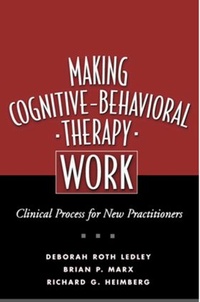
Making Cognitive-Behavioral Therapy Work, First Edition
Clinical Process for New Practitioners
1st Edition
Published on 30. June 2005
Book
Hardback
254 pages
978-1-59385-142-2 (ISBN)
Description
A highly practical guide for beginning cognitive-behavioral therapists, this concise primer fills the gap between academic training and what clinicians need to know for day-to-day work with clients. Illustrated are the "whats," "whens," and "how-tos" of the entire process of cognitive-behavioral therapy (CBT) - from intake, assessment, case conceptualization, and treatment planning, through conducting sessions, making the most of supervision, and termination. Interwoven with an extended case example is expert guidance on confidentiality, informed consent, record keeping, and report writing, and on managing relationship issues and common problems that arise in CBT. Invaluable appendices point the reader toward additional resources, including empirically supported treatment manuals, journals, and websites.
Reviews / Votes
"Many young clinicians are quite knowledgeable about research and clinical treatment protocols - but less sure about how to be a clinician. This book fills an important gap in the professional development of new practitioners. The authors provide a detailed, step-by-step guide to how to practice cognitive-behavioral therapy in the real world. Readers will benefit immensely from the book's specific ideas about case conceptualization; sample patient-therapist exchanges; troubleshooting tips; and guidance for continuing to develop one's professional skills and identity. An invaluable resource."- Robert L. Leahy, PhD, Department of Psychiatry, Weill-Cornell University Medical College, New York, USA"I wish this book had been available when I was a young clinician!" - Jacqueline B. Persons, PhD, San Francisco Bay Area Center for Cognitive Therapy, USA "Many young clinicians are quite knowledgeable about research and clinical treatment protocols - but less sure about how to be a clinician. This book fills an important gap in the professional development of new practitioners. The authors provide a detailed, step-by-step guide to how to practice cognitive-behavioral therapy in the real world. Readers will benefit immensely from the book's specific ideas about case conceptualization; sample patient-therapist exchanges; troubleshooting tips; and guidance for continuing to develop one's professional skills and identity. An invaluable resource." - Robert L. Leahy, Department of Psychiatry, Weill-Cornell University Medical College, New York, USA
"How timely that this book arrived on my desk as I was searching yet again for the right text for my course on cognitive and behavioral practice for second-year MSW students! This volume fits the bill in addressing many of the issues that challenge beginning clinicians in general, and social workers in particular, in learning CBT. The step-by-step approach, extended case example, and sample dialogues make the text very appealing for trainees early in their careers. Similarly, the checklists of strategies and the diagrams of CBT models are easy for readers to use. I only wish this text had been available years ago." - Gail Steketee, Boston University School of Social Work, USA
"I wish this book had been available when I was a young clinician!" - Jacqueline B. Persons, San Francisco Bay Area Center for Cognitive Therapy, USA
"I wish this kind of clinical resource had been available when was a doctoral student learning CBT! This book covers it all/m-/ethics, theory, case formulation, supervision, therapy, follow-up documentation, and professional development. A wonderful resource for the psychotherapist in training or for the experienced practitioner new to CBT methods. Most highly recommended as a classroom or practicum textbook." - Bruce A. Thyer, College of Social Work, Florida State University, USA
"This book will be immensely helpful to young clinicians attempting to master the structure and processes of CBT, from the scheduling of the first visit to the final booster session. Leading CBT therapists with years of clinical and supervisory experience provide extremely clear and practical suggestions in the context of real-world clinical vignettes. The second edition includes attention to such contemporary dilemmas such as the ethical handling of client contact via social media. I highly recommend this book to anyone wishing to become a CBT therapist." - Neil A. Rector, Department of Psychiatry, University of Toronto, Canada
"This book astutely anticipates the challenges of clinical practice, demystifies the process of therapy, and fully prepares the novice clinician. Combining a matter-of-fact tone with illuminating case examples, the book is bound to instill confidence in the beginning therapist. This is an essential text for any course on CBT. The second edition incorporates the latest empirical research on therapy process and includes a helpful epilogue on continued growth as a therapist." - Christine Purdon, Department of Psychology, University of Waterloo, Canada
More details
Language
English
Place of publication
New York
United States
Target group
College/higher education
Professional and scholarly
Weight
502 gr
ISBN-13
978-1-59385-142-2 (9781593851422)
Copyright in bibliographic data and cover images is held by Nielsen Book Services Limited or by the publishers or by their respective licensors: all rights reserved.
Schweitzer Classification
Other editions
New editions

Deborah Roth Ledley | Brian P. Marx | Richard G. Heimberg
Making Cognitive-Behavioral Therapy Work, Second Edition
Clinical Process for New Practitioners
Book
10/2010
2nd Edition
Guilford Publications
€58.37
Article exhausted; check for reprint
Content
Introducing Cognitive-Behavioral Process. Initial Interactions with Clients. The Process of Assessment. Conceptualizing the Case and Planning Treatment. Giving Feedback to Clients and Writing the Assessment Report. Starting the Cognitive-Behavioral Treatment Process. Dealing with Initial Challenges in Cognitive-Behavioral Therapy. The Next Sessions: Teaching the Core Techniques. Managing Client Noncompliance in Cognitive-Behavioral Therapy. Terminating Therapy. The Process of Supervision. Epilogue. Continuing to Grow as a Cognitive-Behavioral Therapist. Appendix A: Recommended Readings in Cognitive-Behavioral Therapy. Appendix B: Suggested Journals, Websites, and Other Resources.