

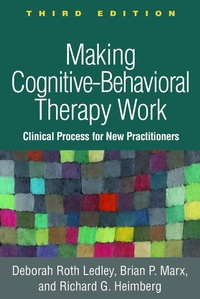
Making Cognitive-Behavioral Therapy Work
Clinical Process for New Practitioners
3rd Edition
Published on 31. May 2018
290 pages
978-1-4625-3572-9 (ISBN)
Description

Clinical psychologists, psychiatrists, clinical social workers, counselors, and psychiatric nurses; graduate students and trainees. Serves as a primary or supplemental text in graduate-level CBT and psychotherapy courses.
More details
Other editions
Additional editions
Deborah Roth Ledley | Brian P. Marx | Richard G. Heimberg
Making Cognitive-Behavioral Therapy Work, Third Edition
Clinical Process for New Practitioners
Book
01/2021
3rd Edition
Guilford Press
€38.00
Shipment within 15-20 days
Deborah Roth Ledley | Brian P. Marx | Richard G. Heimberg
Making Cognitive-Behavioral Therapy Work, Third Edition
Clinical Process for New Practitioners
Book
08/2018
3rd Edition
Guilford Press
€57.00
Shipment within 15-20 days
Persons
Deborah Roth Ledley, PhD, is a psychologist in private practice in suburban Philadelphia. She spent several years on the faculty of the University of Pennsylvania's Center for the Treatment and Study of Anxiety. Dr. Ledley's research has focused on the nature and treatment of anxiety. She has published over 50 scientific papers and book chapters as well as several books, including Making Cognitive-Behavioral Therapy Work, Third Edition; Improving Outcomes and Preventing Relapse in Cognitive-Behavioral Therapy; Becoming a Calm Mom; and The Worry Workbook for Kids. She lectures widely on the treatment of childhood anxiety.
Brian P. Marx, PhD, is a staff psychologist at the National Center for Posttraumatic Stress Disorder (PTSD), Veterans Affairs Boston Healthcare System, and Professor of Psychiatry at Boston University School of Medicine. Dr. Marx has written numerous articles and book chapters on behavior therapy and assessment. His research interests include the assessment and treatment of PTSD, identifying risk factors for posttraumatic difficulties, and the association between PTSD and suicidal behaviors.
Richard G. Heimberg, PhD, is the Thaddeus L. Bolton Professor of Psychology and Director of the Adult Anxiety Clinic of Temple at Temple University. He is past president of the Association for Behavioral and Cognitive Therapies (ABCT) and the Society for a Science of Clinical Psychology (SSCP) and former editor of the journal Behavior Therapy. Well known for his efforts to develop and evaluate cognitive-behavioral treatments for social anxiety and other anxiety disorders, Dr. Heimberg has authored several books and 450 articles and chapters. As an educator and mentor of clinical psychology doctoral students, he has received awards from ABCT, SSCP, the Society of Clinical Psychology, and the American Psychological Association of Graduate Students.
Content
Prologue: Common Challenges for New Clinicians
1. The Process of Cognitive-Behavioral Therapy
2. Initial Interactions with Clients
3. The Process of Assessment
4. Conceptualizing the Case and Planning Treatment
5. The Bridge from Assessment to Treatment
6. The First Few Sessions of CBT: Goals and Challenges
7. The Course of CBT: Goals and Challenges
8. Terminating Therapy: Goals and Challenges
9. Doing CBT with Special Populations
10. The Process of Supervision: Goals and Challenges
11. Revisiting the Common Challenges
Appendix A. Recommended Readings in CBT
Appendix B. Further Reading on Special Topics in CBT
Appendix C. Treatment Manuals and Client Workbooks
Appendix D. Useful Information for Cognitive-Behavioral Therapists
References
Index
1. The Process of Cognitive-Behavioral Therapy
2. Initial Interactions with Clients
3. The Process of Assessment
4. Conceptualizing the Case and Planning Treatment
5. The Bridge from Assessment to Treatment
6. The First Few Sessions of CBT: Goals and Challenges
7. The Course of CBT: Goals and Challenges
8. Terminating Therapy: Goals and Challenges
9. Doing CBT with Special Populations
10. The Process of Supervision: Goals and Challenges
11. Revisiting the Common Challenges
Appendix A. Recommended Readings in CBT
Appendix B. Further Reading on Special Topics in CBT
Appendix C. Treatment Manuals and Client Workbooks
Appendix D. Useful Information for Cognitive-Behavioral Therapists
References
Index
