

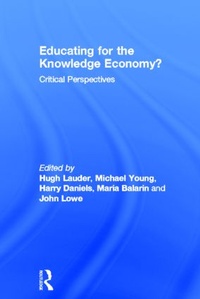
Educating for the Knowledge Economy?
Critical Perspectives
1st Edition
Published on 6. January 2012
Book
Hardback
264 pages
978-0-415-61506-8 (ISBN)
Description
The promise, embraced by governments around the world, is that the knowledge economy will provide knowledge workers with a degree of autonomy and permission to think which enables them to be creative and to attract high incomes. What credence should we give to this promise?
The current economic crisis is provoking a reappraisal of both economic and educational policy. Policy makers and educationists across the world see education as central to economic competitiveness. However, this book asks fundamental questions about the relationship between the economy and education since, in contrast to policy makers' rhetoric, the relationship between the two sectors is not straightforward. An unorthodox account of the knowledge economy and economic globalisation suggests that autonomy in the workplace and permission to think will be only given to the elite. In this view many aspirant well-educated middle-class young workers are doomed to disappointment.
In this book, leading scholars from the US, the UK, Australia and New Zealand discuss these issues and interrogate the assumptions and links between the different elements of education and how they might relate to the economy. Even if we assume that the official view of the knowledge economy is correct, are we educating young people to be autonomous, creative thinkers? Are current policies relating to knowledge, learning and assessment consistent with the kinds of workers and skills required for the knowledge economy?
Educating for the Knowledge Economy? will appeal to academics, policy makers, teachers and students interested in the central role of education in the knowledge economy.
The current economic crisis is provoking a reappraisal of both economic and educational policy. Policy makers and educationists across the world see education as central to economic competitiveness. However, this book asks fundamental questions about the relationship between the economy and education since, in contrast to policy makers' rhetoric, the relationship between the two sectors is not straightforward. An unorthodox account of the knowledge economy and economic globalisation suggests that autonomy in the workplace and permission to think will be only given to the elite. In this view many aspirant well-educated middle-class young workers are doomed to disappointment.
In this book, leading scholars from the US, the UK, Australia and New Zealand discuss these issues and interrogate the assumptions and links between the different elements of education and how they might relate to the economy. Even if we assume that the official view of the knowledge economy is correct, are we educating young people to be autonomous, creative thinkers? Are current policies relating to knowledge, learning and assessment consistent with the kinds of workers and skills required for the knowledge economy?
Educating for the Knowledge Economy? will appeal to academics, policy makers, teachers and students interested in the central role of education in the knowledge economy.
Reviews / Votes
"My final judgment? The book is well timed and a fascinating read that should appeal to those who have a penchant to read perspectives that challenge dominant views. It should be a useful source to policy makers seeking to embrace critical perspectives about issues that are often taken for granted."- Kenneth Dipholo, International Journal of Lifelong EducationMore details
Language
English
Place of publication
London
United Kingdom
Publishing group
Taylor & Francis Ltd
Target group
College/higher education
Postgraduate
Illustrations
8 s/w Abbildungen, 7 s/w Tabellen
7 Tables, black and white; 8 Illustrations, black and white
Dimensions
Height: 234 mm
Width: 156 mm
Weight
650 gr
ISBN-13
978-0-415-61506-8 (9780415615068)
Copyright in bibliographic data and cover images is held by Nielsen Book Services Limited or by the publishers or by their respective licensors: all rights reserved.
Schweitzer Classification
Other editions
Additional editions
Hugh Lauder | Michael Young | Harry Daniels
Educating for the Knowledge Economy?
Critical Perspectives
Book
01/2012
1st Edition
Routledge
€80.65
Shipment within 15-20 days
Hugh Lauder | Michael Young | Harry Daniels
Educating for the Knowledge Economy?
Critical Perspectives
E-Book
01/2012
1st Edition
Routledge
€68.49
Available for download
Hugh Lauder | Michael Young | Harry Daniels
Educating for the Knowledge Economy?
Critical Perspectives
E-Book
01/2012
1st Edition
Routledge
€68.49
Available for download
Persons
Hugh Lauder is Professor of Education and Political Economy at the University of Bath.
Michael Young is Professor of Education at the Institute of Education and Visiting Professor at the University of Bath.
Harry Daniels is Professor and Head of the Centre for Sociocultural and Activity Theory at the University of Bath.
Maria Balarin is Lecturer in Education, University of Bath.
John Lowe is Lecturer in Education, University of Bath.
Michael Young is Professor of Education at the Institute of Education and Visiting Professor at the University of Bath.
Harry Daniels is Professor and Head of the Centre for Sociocultural and Activity Theory at the University of Bath.
Maria Balarin is Lecturer in Education, University of Bath.
John Lowe is Lecturer in Education, University of Bath.
Content
Introduction: 1. Educating for The Knowledge Economy? Critical Perspectives Section I The 'knowledge economy' and Education 2. Globalisation, Crisis and the Political Economy of the International Monetary (Dis)Order 3. The Global Auction, Skill Bias Theory and Graduate Incomes: Reflections on Methodology 4. 'Openness' and the Global Knowledge Commons: An Emerging Mode of Social Production for Education and Science 5. Learning and Contradiction Across Boundaries Section II: Knowledge and the Economy 6. The Educational Revolution and the Transformation of Work 7. Forms of Knowledge and Curriculum Coherence 8. Education, Globalisation and the 'voice of knowledge' 9. The problem with Competency Based Training (and why constructivism makes things worse) Section III: Pedagogy, Assessment, the Demands of the Knowledge Economy and Social Justice? 10. Numbers in Grids of Intelligibility: Making Sense of How Educational Truth is Told 11. Assessing Educational Reform: Accountability, standards and the utility of qualifications 12. School and the Pupils' Work 13. Social Class and School Knowledge: revisiting the sociology and politics of the curriculum in the 21st century