

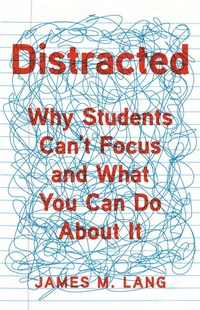
Distracted
Why Students Can't Focus and What You Can Do About It
Published on 5. November 2020
Book
Hardback
304 pages
978-1-5416-9980-9 (ISBN)
Description
A decade ago, James Lang banned cell phones in his classroom. Frustrated by how easily they could sidetrack his students, Lang sought out a distraction-free environment, hoping it would help his students pay attention to his lessons. But after just a few years, Lang gave in. Not only was his no-cellphones policy ineffective (even his best students ignored it), he realized that he, like many of his fellow teachers, was missing an important point. The problem isn't phones. It's our antiquated notions of the brain. In Distracted, Lang makes the case for a new way of thinking about how to teach young minds based on the emerging neuroscience of attention.
Although we have long prized the ability to focus, the most natural way of thinking is distraction. Our brains are designed to continually scan our environment, looking for new information, occasionally wandering off in different directions in search of new insights. This is not to say that iPhones are not good at distracting us, but that what they represent is in principle nothing new, because sustained periods of intense focus are not what humans are good at.
Of course, we still do need to pay attention to learn. The problem is that we think of learning as a matter of managing distraction, when we should instead think of it as actively cultivating attention. This starts with letting go of technology bans, which are little more than a fig leaf applied to the objective difficulty of paying attention. But it involves more active ways of rethinking classroom conventions too. For example, rather than structuring lessons as 45 or 60-minute blocks of lecturing, teachers could segment their classes into a series of smaller lessons, with regular shifts in focus, appealing to the brain's interest in novelty.
Simple changes can drastically improve students' performance, and in Distracted, Lang takes readers on a sprawling tour of how some of America's best teachers are improving student performance using concepts such as modular classrooms, flow states, and student-directed learning. Together, these insights offer a new way of thinking about how to not only more effectively teach a lesson plan, but to teach students the most important lesson of all: how to learn.
Although we have long prized the ability to focus, the most natural way of thinking is distraction. Our brains are designed to continually scan our environment, looking for new information, occasionally wandering off in different directions in search of new insights. This is not to say that iPhones are not good at distracting us, but that what they represent is in principle nothing new, because sustained periods of intense focus are not what humans are good at.
Of course, we still do need to pay attention to learn. The problem is that we think of learning as a matter of managing distraction, when we should instead think of it as actively cultivating attention. This starts with letting go of technology bans, which are little more than a fig leaf applied to the objective difficulty of paying attention. But it involves more active ways of rethinking classroom conventions too. For example, rather than structuring lessons as 45 or 60-minute blocks of lecturing, teachers could segment their classes into a series of smaller lessons, with regular shifts in focus, appealing to the brain's interest in novelty.
Simple changes can drastically improve students' performance, and in Distracted, Lang takes readers on a sprawling tour of how some of America's best teachers are improving student performance using concepts such as modular classrooms, flow states, and student-directed learning. Together, these insights offer a new way of thinking about how to not only more effectively teach a lesson plan, but to teach students the most important lesson of all: how to learn.
More details
Language
English
Place of publication
United States
Target group
Primary & secondary/elementary & high school
College/higher education
Professional and scholarly
Product notice
sewn/stitched
Cloth over boards
Dimensions
Height: 236 mm
Width: 163 mm
Thickness: 30 mm
Weight
508 gr
ISBN-13
978-1-5416-9980-9 (9781541699809)
Copyright in bibliographic data and cover images is held by Nielsen Book Services Limited or by the publishers or by their respective licensors: all rights reserved.
Schweitzer Classification
Other editions
Additional editions
E-Book
10/2020
Basic Books
€15.99
Available for download
Person
James M. Lang is a professor of English and director of the D'Amour Center for Teaching Excellence at Assumption University. He is the author of three previous books on higher education teaching and learning: Small Teaching, Cheating Lessons, and On Course. He is also a longtime monthly columnist for the Chronicle of Higher Education. He lives in Worcester, Massachusetts.