

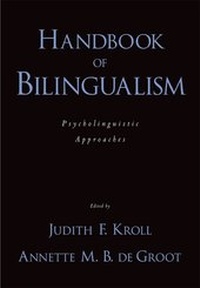
Handbook of Bilingualism
Psycholinguistic approaches
Published on 23. June 2005
Book
Hardback
610 pages
978-0-19-515177-0 (ISBN)
Description
Until recently, cognitive science virtually ignored the fact that most people of the world are bilingual. During the past ten years this situation has changed markedly. There is now an appreciation that learning and using more than one language is the more natural circumstance of cognition. As a result, there is a wealth of new research on second-language learning and bilingualism that provides not only crucial evidence for the universality of cognitive principles, but also an important tool for revealing constraints within the cognitive architecture.
In this volume, Judith Kroll and Annette de Groot have brought together the scientists at the forefront of research on second-language learning and bilingualism to present chapters that, rather than focusing simply on their own research, provide the first comprehensive overviews of this emerging field. Bilingualism provides a lens through which each of the central questions about language and cognition can be viewed. The five sections of this book focus on different facets of those questions: How is language acquired when infants are exposed to multiple-language input from birth, and how is it acquired when adults are required to learn a second language after early childhood? How do adult bilinguals comprehend and produce words and sentences when their two languages are potentially always active and in competition with one another? What are the neural mechanisms that underlie proficient bilingualism? What are the general consequences of bilingualism for cognition and for language and thought? This handbook will be essential reading for cognitive psychologists, linguists, applied linguists, and educators who wish to better understand the cognitive basis of bilingualism and the logic of experimental and formal approaches to language science.
In this volume, Judith Kroll and Annette de Groot have brought together the scientists at the forefront of research on second-language learning and bilingualism to present chapters that, rather than focusing simply on their own research, provide the first comprehensive overviews of this emerging field. Bilingualism provides a lens through which each of the central questions about language and cognition can be viewed. The five sections of this book focus on different facets of those questions: How is language acquired when infants are exposed to multiple-language input from birth, and how is it acquired when adults are required to learn a second language after early childhood? How do adult bilinguals comprehend and produce words and sentences when their two languages are potentially always active and in competition with one another? What are the neural mechanisms that underlie proficient bilingualism? What are the general consequences of bilingualism for cognition and for language and thought? This handbook will be essential reading for cognitive psychologists, linguists, applied linguists, and educators who wish to better understand the cognitive basis of bilingualism and the logic of experimental and formal approaches to language science.
Reviews / Votes
well-done * Vivian Cook, Language vol. 84, no. 1, 2008 *More details
Language
English
Place of publication
New York
United States
Target group
Professional and scholarly
Illustrations
2pp colour plates, numerous line figures and tables
Dimensions
Height: 183 mm
Width: 254 mm
Thickness: 51 mm
Weight
1247 gr
ISBN-13
978-0-19-515177-0 (9780195151770)
Copyright in bibliographic data and cover images is held by Nielsen Book Services Limited or by the publishers or by their respective licensors: all rights reserved.
Schweitzer Classification
Other editions
Additional editions
Book
04/2009
Oxford University Press Inc
€74.40
Shipment within 15-20 days

E-Book
02/2009
1st Edition
OUP USA
€43.49
Available for download
E-Book
02/2009
1st Edition
OUP USA
€43.49
Available for download
Persons
Content
PART 1: ACQUISITION ; PART 2: COMPREHENSION ; PART 3: PRODUCTION AND CONTROL ; PART 4: ASPECTS AND IMPLICATIONS OF BILINGUALISM