

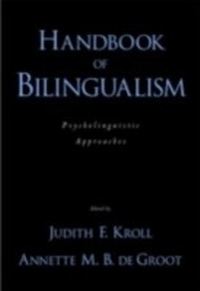
Handbook of Bilingualism
Psycholinguistic Approaches
1st Edition
Published on 16. February 2009
603 pages
978-0-19-803461-2 (ISBN)
Description

How is language acquired when infants are exposed to multiple language input from birth and when adults are required to learn a second language after early childhood? How do adult bilinguals comprehend and produce words and sentences when their two languages are potentially always active and in competition with one another? What are the neural mechanisms that underlie proficient bilingualism? What are the general consequences of bilingualism for cognition and for language and thought? This handbook will be essential reading for cognitive psychologists, linguists, applied linguists, and educators who wish to better understand the cognitive basis of bilingualism and the logic of experimental and formal approaches to language science.
More details
Other editions
Additional editions
Book
04/2009
Oxford University Press Inc
€74.28
Shipment within 15-20 days
Book
06/2005
Oxford University Press Inc
€142.37
Shipment within 15-20 days
Content
- Intro
- Contents
- Contributors
- I. Acquisition
- Introduction to Part I: Acquisition
- 1. The Learning of Foreign Language Vocabulary
- SYNTAX
- 2. Early Bilingual Acquisition: Focus on Morphosyntax and the Separate Development Hypothesis
- 3. A Unified Model of Language Acquisition
- 4. Phonology and Bilingualism
- BIOLOGICAL BASES
- 5. What Does the Critical Period Really Mean?
- 6. Interpreting Age Effects in Second Language Acquisition
- 7. Processing Constraints on L1 Transfer
- 8. Models of Monolingual and Bilingual Language Acquisition
- II. Comprehension
- Introduction to Part II: Comprehension
- 9. Bilingual Visual Word Recognition and Lexical Access
- 10. Computational Models of Bilingual Comprehension
- 11. The Representation of Cognate and Noncognate Words in Bilingual Memory: Can Cognate Status Be Characterized as a Special Kind of Morphological Relation?
- 12. Bilingual Semantic and Conceptual Representation
- 13. Ambiguities and Anomalies: What Can Eye Movements and Event-Related Potentials Reveal About Second Language Sentence Processing?
- III. Production and Control
- Introduction to Part III: Production and Control
- 14. Selection Processes in Monolingual and Bilingual Lexical Access
- 15. Lexical Access in Bilingual Production
- 16. Supporting a Differential Access Hypothesis: Code Switching and Other Contact Data
- 17. Language Selection in Bilinguals: Mechanisms and Processes
- 18. Automaticity in Bilingualism and Second Language Learning
- 19. Being and Becoming Bilingual: Individual Differences and Consequences for Language Production
- IV. Aspects and Implications of Bilingualism
- Introduction to Part IV: Aspects and Implications of Bilingualism
- COGNITIVE CONSEQUENCES
- 20. Consequences of Bilingualism for Cognitive Development
- 21. Bilingualism and Thought
- 22. Simultaneous Interpreting: A Cognitive Perspective
- COGNITIVE NEUROSCIENCE APPROACHES
- 23. Clearing the Cobwebs From the Study of the Bilingual Brain: Converging Evidence From Laterality and Electrophysiological Research
- 24. What Can Functional Neuroimaging Tell Us About the Bilingual Brain?
- 25. The Neurocognition of Recovery Patterns in Bilingual Aphasics
- 26. Models of Bilingual Representation and Processing: Looking Back and to the Future
- Author Index
- A
- B
- C
- D
- E
- F
- G
- H
- I
- J
- K
- L
- M
- N
- O
- P
- Q
- R
- S
- T
- U
- V
- W
- Y
- Z
- Subject Index
- A
- B
- C
- D
- E
- F
- G
- H
- I
- J
- K
- L
- M
- N
- O
- P
- Q
- R
- S
- T
- U
- V
- W
- Y
