

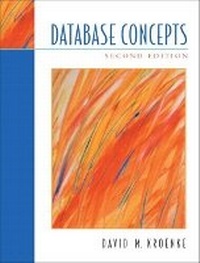
Database Concepts
2nd Edition
Published on 20. May 2004
Book
Paperback/Softback
256 pages
978-0-13-145141-4 (ISBN)
Description
Appropriate for all introductory courses on database development and management, as well as database courses designed around specific database products such as Microsoft Access, SQL Server, or MySQL.
In this book, one of the world's leading database experts introduces the essential concepts that students need to create and use working databases. Simply and accurately, David Kroenke introduces essential database concepts through three running projects that students can follow for themselves using virtually any contemporary database software. Kroenke begins by explaining why databases are used, how they improve on alternatives such as spreadsheets, what their components are, and how they are developed. Next, he introduces the relational model and defines basic relational terminology. This edition contains a thoroughly revamped discussion of normalization, including a new four-step process that makes it far easier to understand and perform. Kroenke then introduces the basics of SQL, introducing statements for data definition and modification, as well as SQL SELECT statements. Next, he turns to database design and management, including the entity-relationship (E-R) model and basic data modeling. The book contains a full chapter on administration, including concurrency control, security, and backup/recovery. Students will also find practical introductions to several key database trends, including Web and XML databases, distributed databases, OLAP, data mining, and object-relational DBMSes. Every chapter concludes with review questions and exercises. Finally, the book's Appendix introduces Microsoft Access and shows how it can be used to create simple databases.
In this book, one of the world's leading database experts introduces the essential concepts that students need to create and use working databases. Simply and accurately, David Kroenke introduces essential database concepts through three running projects that students can follow for themselves using virtually any contemporary database software. Kroenke begins by explaining why databases are used, how they improve on alternatives such as spreadsheets, what their components are, and how they are developed. Next, he introduces the relational model and defines basic relational terminology. This edition contains a thoroughly revamped discussion of normalization, including a new four-step process that makes it far easier to understand and perform. Kroenke then introduces the basics of SQL, introducing statements for data definition and modification, as well as SQL SELECT statements. Next, he turns to database design and management, including the entity-relationship (E-R) model and basic data modeling. The book contains a full chapter on administration, including concurrency control, security, and backup/recovery. Students will also find practical introductions to several key database trends, including Web and XML databases, distributed databases, OLAP, data mining, and object-relational DBMSes. Every chapter concludes with review questions and exercises. Finally, the book's Appendix introduces Microsoft Access and shows how it can be used to create simple databases.
More details
Edition
2nd edition
Language
English
Place of publication
United States
Publishing group
Pearson Education (US)
Target group
Professional and scholarly
Dimensions
Width: 276 mm
Thickness: 9 mm
Weight
520 gr
ISBN-13
978-0-13-145141-4 (9780131451414)
Copyright in bibliographic data and cover images is held by Nielsen Book Services Limited or by the publishers or by their respective licensors: all rights reserved.
Schweitzer Classification
Other editions
New editions
David M. Kroenke | David J. Auer
Database Concepts
Book
02/2007
3rd Edition
Pearson
€56.94
Article exhausted; check for reprint
Previous edition
Content
I. Database Fundamentals.
1. Getting Started.
2. The Relational Model.
3. Structured Query Language.
II: Database Design and Management.
4. Data Modeling and the Entity-Relationship Model.
5. Database Design.
6. Database Administration.
7. Advanced Topics.
Appendix.
Glossary.
1. Getting Started.
2. The Relational Model.
3. Structured Query Language.
II: Database Design and Management.
4. Data Modeling and the Entity-Relationship Model.
5. Database Design.
6. Database Administration.
7. Advanced Topics.
Appendix.
Glossary.