

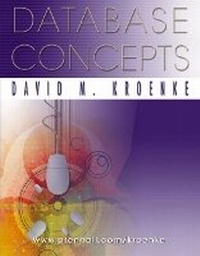
Database Concepts
Published on 22. May 2002
Book
Paperback/Softback
219 pages
978-0-13-008650-1 (ISBN)
Description
For courses in Database Management, particularly for non-majors or brief courses. Also well-suited for courses that devote significant amounts of time to a specific database platform (Access, Oracle) and use a separate platform-specific title as well.
In a simple 6 chapter, straightforward manner, this paperback text teaches students the essential concepts for database processing-fundamentals of the relational model, structured query language (SQL), data modeling, database design, and database administration. Technically accurate and readily understandable discussions are the result of many years of experience in the database field and as a textbook author.
In a simple 6 chapter, straightforward manner, this paperback text teaches students the essential concepts for database processing-fundamentals of the relational model, structured query language (SQL), data modeling, database design, and database administration. Technically accurate and readily understandable discussions are the result of many years of experience in the database field and as a textbook author.
More details
Language
English
Place of publication
United States
Publishing group
Pearson Education (US)
Target group
Professional and scholarly
Dimensions
Height: 275 mm
Width: 215 mm
Thickness: 10 mm
Weight
502 gr
ISBN-13
978-0-13-008650-1 (9780130086501)
Copyright in bibliographic data and cover images is held by Nielsen Book Services Limited or by the publishers or by their respective licensors: all rights reserved.
Schweitzer Classification
Other editions
New editions
David M. Kroenke
Database Concepts
Book
05/2004
2nd Edition
Pearson
€42.08
Article exhausted; check for reprint
Person
David M. Kroenke is one of the pioneers of database technology In 1971, while working at the Pentagon, he programmed one of the world's first database management system (DBMS) products. In 1974 Grace Hopper appointed him to the CODAYSL EUF committee, and in 1977 he worked as ,a consultant for Fred Brooks at IBM. Kroenke helped to start the Microrim Corporation, where he led the development of the R:base family of DBMS products. In a 1991 article, Wayne Ratliff credited one of Kroenke's textbooks for giving him the idea for the development of d:base. In 1989 Kroenke consulted Microsoft on the project that led to the development of Microsoft Access. He is also the father of the semantic object model, a data model that many believe is superior to the entity-relationship model.
Kroenke is the author of five computer textbooks; his text Database Processing was first published in 1977 and is currently in its eighth edition. In 1990 and 1991 he was the Hanson Professor of Management Science at the University of Washington. In that same year the International Association for Computer Information Systems named him Computer Educator of the Year. He holds a B.S. in economics from the U.S. Air Force Academy, an M.S. in management science from the University of Southern California, and a Ph.D. from Colorado State University where he studied linear models under Franklin Graybill.
Kroenke is the author of five computer textbooks; his text Database Processing was first published in 1977 and is currently in its eighth edition. In 1990 and 1991 he was the Hanson Professor of Management Science at the University of Washington. In that same year the International Association for Computer Information Systems named him Computer Educator of the Year. He holds a B.S. in economics from the U.S. Air Force Academy, an M.S. in management science from the University of Southern California, and a Ph.D. from Colorado State University where he studied linear models under Franklin Graybill.
Content
I. DATABASE FUNDAMENTALS.
1. Getting Started.
2. The Relational Model.
3. Structured Query Language (SQL).
II. DATABASE DESIGN AND MANAGEMENT.
4. Data Modeling and the Entity-Relationship Model.
5. Database Design.
6. Database Administration.
Appendix: Microsoft Access.
1. Getting Started.
2. The Relational Model.
3. Structured Query Language (SQL).
II. DATABASE DESIGN AND MANAGEMENT.
4. Data Modeling and the Entity-Relationship Model.
5. Database Design.
6. Database Administration.
Appendix: Microsoft Access.