

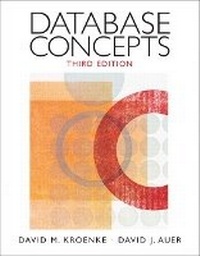
Database Concepts
3rd Edition
Published on 21. February 2007
Book
Paperback/Softback
448 pages
978-0-13-198625-1 (ISBN)
Description
********NEW ACCESS 2007 TUTORIAL AVAILABLE AT www.prenhall.com/kroenke********
********Complete Access 2007 Updates available. Click here.********
Appropriate for all introductory courses or brief courses on database development and management, as well as database courses designed around specific database products such as Microsoft Access, SQL Server, or MySQL.
Written by one of the world's leading database authorities, Database Concepts 3e, introduces the essential concepts students need to create and use small databases.
********Complete Access 2007 Updates available. Click here.********
Appropriate for all introductory courses or brief courses on database development and management, as well as database courses designed around specific database products such as Microsoft Access, SQL Server, or MySQL.
Written by one of the world's leading database authorities, Database Concepts 3e, introduces the essential concepts students need to create and use small databases.
More details
Edition
3rd edition
Language
English
Place of publication
United States
Publishing group
Pearson Education (US)
Target group
Professional and scholarly
Dimensions
Width: 274 mm
Thickness: 16 mm
Weight
880 gr
ISBN-13
978-0-13-198625-1 (9780131986251)
Copyright in bibliographic data and cover images is held by Nielsen Book Services Limited or by the publishers or by their respective licensors: all rights reserved.
Schweitzer Classification
Other editions
New editions
Book
03/2009
4th Edition
Pearson
€53.22
Article exhausted; check for reprint
Previous edition
David M. Kroenke
Database Concepts
Book
05/2004
2nd Edition
Pearson
€42.08
Article exhausted; check for reprint
Content
Table of Contents
Part I. Fundamentals
1. Getting Started
Why Use a Database? Problems with Lists. Using Relational Database Tables. Processing the Relational Tables. What is a Database System?
The Access Workbench I
2. The Relational Model
Relations. Types of Keys. The Problem of Null Values. Functional Dependencies and Normalization. The Access Workbench II
3. Structured Query Language
An Example Database. "Does Not Work With MS Access SQL". SQL for Data Definition. SQL for Inserting Relational Data. SQL for Relational Query. SQL for Relational Data Modification and Deletion. SQL for Table and Constraint Modification and Deletion. SQL Views. The Access Workbench III
Part II. Database Design and Management
4. Data Modeling and the Entity-Relationship Model
The Requirements Stage. The Entity-Relationship Data Model. Entity-Relationship Diagrams. In-Dependent Entities. Recursive Relationships. Developing an Example E-R Diagram. The Access Workbench IV
5. Database Design
Transforming a Data Model into a Database Design. Representing Entities with the Relational Model. Representing Relationships. Database Design at Heather Sweeney Designs. The Access Workbench V
6. Advanced Topics
The Heather Sweeney Design Database. The Need for Control, Security, and Reliability. Concurrency Control. Database Security. Database Backup and Recovery. Additional DBA Responsibilities. Distributed Database Processing. Object-Relational Databases. The Access Workbench VI
7. Database Administration
The Database Processing Environment. Queries, Forms, and Reports. Client/Server and Traditional Applicaiton Processing. Stored Procedures and Triggers. Web Database Processing. Database Processing and XML. Business Intelligence Systems. The Access Workbench VII
Appendix A. Getting Started with Microsoft SQL Server 2005 Express Edition
Appendix B. Getting Started with MySQL
Appendix C. SQL Views
Appendix D- Access 2007 Tutorial (available online at www.prenhall.com/kroenke)
Part I. Fundamentals
1. Getting Started
Why Use a Database? Problems with Lists. Using Relational Database Tables. Processing the Relational Tables. What is a Database System?
The Access Workbench I
2. The Relational Model
Relations. Types of Keys. The Problem of Null Values. Functional Dependencies and Normalization. The Access Workbench II
3. Structured Query Language
An Example Database. "Does Not Work With MS Access SQL". SQL for Data Definition. SQL for Inserting Relational Data. SQL for Relational Query. SQL for Relational Data Modification and Deletion. SQL for Table and Constraint Modification and Deletion. SQL Views. The Access Workbench III
Part II. Database Design and Management
4. Data Modeling and the Entity-Relationship Model
The Requirements Stage. The Entity-Relationship Data Model. Entity-Relationship Diagrams. In-Dependent Entities. Recursive Relationships. Developing an Example E-R Diagram. The Access Workbench IV
5. Database Design
Transforming a Data Model into a Database Design. Representing Entities with the Relational Model. Representing Relationships. Database Design at Heather Sweeney Designs. The Access Workbench V
6. Advanced Topics
The Heather Sweeney Design Database. The Need for Control, Security, and Reliability. Concurrency Control. Database Security. Database Backup and Recovery. Additional DBA Responsibilities. Distributed Database Processing. Object-Relational Databases. The Access Workbench VI
7. Database Administration
The Database Processing Environment. Queries, Forms, and Reports. Client/Server and Traditional Applicaiton Processing. Stored Procedures and Triggers. Web Database Processing. Database Processing and XML. Business Intelligence Systems. The Access Workbench VII
Appendix A. Getting Started with Microsoft SQL Server 2005 Express Edition
Appendix B. Getting Started with MySQL
Appendix C. SQL Views
Appendix D- Access 2007 Tutorial (available online at www.prenhall.com/kroenke)