

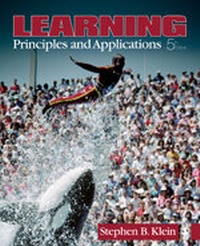
Learning
Principles and Applications
5th Edition
Published on 18. September 2008
Book
Paperback/Softback
544 pages
978-1-4129-5652-9 (ISBN)
Description
Known for its uncompromising academic rigor and easy-to-read style and format, Klein: Learning: Principles and Applications is now in its Fifth Edition. Over the past four editions, this text has received unending praise for its accessible and thorough coverage of both classic and current studies of animal and human research. Concepts and theories are introduced within the framework of highly effective pedagogical elements, such as: chapter-opening vignettes, 'Before You Go On' checkpoints, application boxes, chapter summaries, and critical thinking questions.aIn this new edition, the content has been updated and reorganized to reflect changes in the field, the pedagogical features have been strengthened and highlighted to continue to help students better comprehend the subject matter, and the ancillaries are all new.Key Features Chapter Opening Vignettes, and real-world examples peppered through the text, engage the reader on a personal level. Before You Go On bulleted questions emphasize mastery of key concepts throughout every chapter. End-of-chapter Critical Thinking questions help students integrate and apply chapter material. Coverage of Biological Influences on learning and memory outshines other texts. NEW! Theories of Learning and Applications are now presented in the same chapters for better continuity. NEW! A special focus on Cognition reflects new directions in the field.This text is accompanied byarobust ancillaries! TheaCompanion Student Study Site includes e-Flashcards, study quizzes, Web resources and exercises. Also included are SAGE journal articles with critical thinking questions so students can review original research that relates to the material in their textbook. Go to http:/www.sagepub.com/klein5study/ to view the site.The InstructorAEs Resources (on CD-ROM) is available to adopters of the textbook. It includes PowerPoint slides, a computerized test bank with multiple-choice, true/false, and short answer/essay questions, suggested exercises, Web resources, and more. Contact Customer Care at 800-818-7243 for your copy.
More details
Edition
5th Revised edition
Language
English
Place of publication
Thousand Oaks
United States
Target group
College/higher education
Edition type
Revised edition
Dimensions
Height: 232 mm
Width: 187 mm
Weight
879 gr
ISBN-13
978-1-4129-5652-9 (9781412956529)
Copyright in bibliographic data and cover images is held by Nielsen Book Services Limited or by the publishers or by their respective licensors: all rights reserved.
Schweitzer Classification
Other editions
New editions
Book
04/2011
6th Edition
SAGE Publications Inc
€107.90
Article is exhausted; no reprint
Person
Stephen B. Klein is professor in the psychology department at Mississippi State University. He received a B.S. degree in psychology in 1968 from Virginia Polytechnic Institute and a Ph.D. degree in psychology in 1971 from Rutgers University. Professor Klein taught at Old Dominion University for twelve years and at Fort Hays State University for seven years prior to coming to Mississippi State University in 1990. He also served as head of the psychology department at both Mississippi State University and Fort Hays State University. Professor Klein has written numerous articles for psychological journals in the area of the biological basis of learning and memory and is the author of Motivation: Biosocial Approaches, published by McGraw-Hill in 1982; Learning: Principles and Applications, published by McGraw-Hill in 1987, 1991, 1996, and 2002; Learning: Principles and Applications published by Sage in 2009, 2012, and 2015, and Biological Psychology, published by Prentice-Hall in 2000. Dr. Klein also coauthored with B. Michael Thorne Biological Psychology, published by Worth in 2007 and coedited with Robert Mowrer the two-volume text Contemporary Learning Theories in 1989 and Handbook of Contemporary Learning Theories in 2001, both published by Lawrence Erlbaum. His family includes his wife, Marie, and five children, Dora, David, Jason, Katherine, and William. In his spare time, he enjoys sports, most passionately baseball, and science fiction, especially Star Trek and Star Wars.
Content
Preface
Chapter One: An Introduction to Learning
The Gift of Knowledge
A Definition of Learning
Historical Origins of Behaviorism
The Ethics of Conducting Research
Critical Thinking Questions
Key Terms
Chapter Two: Traditional Learning Theories
The Oldies But Goodies
Traditional Learning Theories
Hull's Drive Theory
Spence's Acquired Motive Approach
Guthrie's Contiguity View
Tolman's Purposive Behaviorism
Skinner's Behavioristic Methodology
Critical Thinking Questions
Key Terms
Chapter Three: The Modification of Instinctive Behavior
Do You Have a Light?
The Instinctive Basis of Behavior
Habituation and Sensitization
Opponent-Process Theory
Critical Thinking Questions
Key Terms
Chapter Four: Principles of Pavlovian Conditioning
A Lingering Fear
The Acquisition of the Conditioned Response
Extinction of the Conditioned Response
A CR without a CS-UCS Pairing?
Critical Thinking Questions
Key Terms
Chapter Five: Theories and Applications of Pavlovian Conditioning
He Never Saw It Coming
Theories of Pavlovian Conditioning
Applications of Pavlovian Conditioning
Critical Thinking Questions
Key Terms
Chapter Six: Principles of Appetitive Conditioning
A Loss of Control
The Acquisition of an Appetitive Response
Extinction of an Operant or Instrumental Response
Critical Thinking Questions
Key Terms
Chapter Seven: Theories and Applications of Appetitive Conditioning
A Lack of Control
Theories of Appetitive Conditioning
Application: Contingency Management
Critical Thinking Questions
Key Terms
Chapter Eight: Principles of Aversive Conditioning
A Good Whipping
The Aversive Events Around Us
Escape Conditioning
The Avoidance of Aversive Events
Punishment
Critical Thinking Questions
Key Terms
Chapter Nine: Theories and Applications of Aversive Conditioning
The Pain of Failure
The Nature of Avoidance Behavior
Application: Response Prevention or Flooding
The Nature of Punishment
Application: The Use of Punishment
Critical Thinking Questions
Key Terms
Chapter Ten: Stimulus Control of Behavior
A Case of Mistaken Identity
The Generalization Process
Discrimination Learning
Critical Thinking Questions
Key Terms
Chapter Eleven: Cognitive Control of Behavior
The Insurmountable Barrier
Tolman's Purposive Behaviorism
The Concept of an Expectation
A Cognitive View of Depression
A Cognitive View of Phobic Behavior
Critical Thinking Questions
Key Terms
Chapter Twelve: Biological Influences on Learning
A Nauseating Experience
Generality of the Laws of Learning
A Behavior Systems Approach
Animal Misbehavior
Schedule-Induced Behavior
Flavor-Aversion Learning
Imprinting
The Avoidance of Aversive Events
The Biology of Reinforcement
Critical Thinking Questions
Key Terms
Chapter Thirteen: Complex Learning Tasks
A Day at the Beach
Concept Learning
Problem Solving
Language
Critical Thinking Questions
Key Terms
Chapter Fourteen: Memory Processes
A Fleeting Experience
Measures of Memory
A Three-Stage View of Memory Storage
Sensory Register
Short-Term Store
Alternatives to the Atkinson-Shiffrin Model
Long-Term Store
Memory Retrieval
Forgetting
Application: Mnemonics
Critical Thinking Questions
Key Terms
Glossary
References
Credits and Sources
Author Index
Subject Index
Chapter One: An Introduction to Learning
The Gift of Knowledge
A Definition of Learning
Historical Origins of Behaviorism
The Ethics of Conducting Research
Critical Thinking Questions
Key Terms
Chapter Two: Traditional Learning Theories
The Oldies But Goodies
Traditional Learning Theories
Hull's Drive Theory
Spence's Acquired Motive Approach
Guthrie's Contiguity View
Tolman's Purposive Behaviorism
Skinner's Behavioristic Methodology
Critical Thinking Questions
Key Terms
Chapter Three: The Modification of Instinctive Behavior
Do You Have a Light?
The Instinctive Basis of Behavior
Habituation and Sensitization
Opponent-Process Theory
Critical Thinking Questions
Key Terms
Chapter Four: Principles of Pavlovian Conditioning
A Lingering Fear
The Acquisition of the Conditioned Response
Extinction of the Conditioned Response
A CR without a CS-UCS Pairing?
Critical Thinking Questions
Key Terms
Chapter Five: Theories and Applications of Pavlovian Conditioning
He Never Saw It Coming
Theories of Pavlovian Conditioning
Applications of Pavlovian Conditioning
Critical Thinking Questions
Key Terms
Chapter Six: Principles of Appetitive Conditioning
A Loss of Control
The Acquisition of an Appetitive Response
Extinction of an Operant or Instrumental Response
Critical Thinking Questions
Key Terms
Chapter Seven: Theories and Applications of Appetitive Conditioning
A Lack of Control
Theories of Appetitive Conditioning
Application: Contingency Management
Critical Thinking Questions
Key Terms
Chapter Eight: Principles of Aversive Conditioning
A Good Whipping
The Aversive Events Around Us
Escape Conditioning
The Avoidance of Aversive Events
Punishment
Critical Thinking Questions
Key Terms
Chapter Nine: Theories and Applications of Aversive Conditioning
The Pain of Failure
The Nature of Avoidance Behavior
Application: Response Prevention or Flooding
The Nature of Punishment
Application: The Use of Punishment
Critical Thinking Questions
Key Terms
Chapter Ten: Stimulus Control of Behavior
A Case of Mistaken Identity
The Generalization Process
Discrimination Learning
Critical Thinking Questions
Key Terms
Chapter Eleven: Cognitive Control of Behavior
The Insurmountable Barrier
Tolman's Purposive Behaviorism
The Concept of an Expectation
A Cognitive View of Depression
A Cognitive View of Phobic Behavior
Critical Thinking Questions
Key Terms
Chapter Twelve: Biological Influences on Learning
A Nauseating Experience
Generality of the Laws of Learning
A Behavior Systems Approach
Animal Misbehavior
Schedule-Induced Behavior
Flavor-Aversion Learning
Imprinting
The Avoidance of Aversive Events
The Biology of Reinforcement
Critical Thinking Questions
Key Terms
Chapter Thirteen: Complex Learning Tasks
A Day at the Beach
Concept Learning
Problem Solving
Language
Critical Thinking Questions
Key Terms
Chapter Fourteen: Memory Processes
A Fleeting Experience
Measures of Memory
A Three-Stage View of Memory Storage
Sensory Register
Short-Term Store
Alternatives to the Atkinson-Shiffrin Model
Long-Term Store
Memory Retrieval
Forgetting
Application: Mnemonics
Critical Thinking Questions
Key Terms
Glossary
References
Credits and Sources
Author Index
Subject Index