

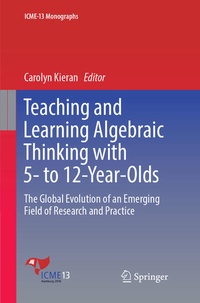
Teaching and Learning Algebraic Thinking with 5- to 12-Year-Olds
The Global Evolution of an Emerging Field of Research and Practice
Published on 1. September 2018
Book
Paperback/Softback
XIII, 443 pages
978-3-319-88586-5 (ISBN)
Description
This book highlights new developments in the teaching and learning of algebraic thinking with 5- to 12-year-olds. Based on empirical findings gathered in several countries on five continents, it provides a wealth of best practices for teaching early algebra. Building on the work of the ICME-13 (International Congress on Mathematical Education) Topic Study Group 10 on Early Algebra, well-known authors such as Luis Radford, John Mason, Maria Blanton, Deborah Schifter, and Max Stephens, as well as younger scholars from Asia, Europe, South Africa, the Americas, Australia and New Zealand, present novel theoretical perspectives and their latest findings.
The book is divided into three parts that focus on (i) epistemological/mathematical aspects of algebraic thinking, (ii) learning, and (iii) teaching and teacher development. Some of the main threads running through the book are the various ways in which structures can express themselves in children's developing algebraic thinking, the roles of generalization and natural language, and the emergence of symbolism. Presenting vital new data from international contexts, the book provides additional support for the position that essential ways of thinking algebraically need to be intentionally fostered in instruction from the earliest grades.
Reviews / Votes
"This book is an excellent resource in the teaching of early algebra. . The reader can certainly have a broad and international perspectives on teaching early algebra by reading this book and can be motivated to try out and conduct their own research study. I'm certainly motivated by this book." (Peter T. Olszewski, MAA Reviews, March, 2018)More details
Series
Edition
Softcover reprint of the original 1st ed. 2018
Language
English
Place of publication
Cham
Switzerland
Publishing group
Springer International Publishing
Target group
Professional and scholarly
Illustrations
130 s/w Abbildungen, 9 farbige Abbildungen
XIII, 443 p. 139 illus., 9 illus. in color.
Dimensions
Height: 235 mm
Width: 155 mm
Thickness: 25 mm
Weight
692 gr
ISBN-13
978-3-319-88586-5 (9783319885865)
DOI
10.1007/978-3-319-68351-5
Schweitzer Classification
Other editions
Additional editions
Carolyn Kieran
Teaching and Learning Algebraic Thinking with 5- to 12-Year-Olds
The Global Evolution of an Emerging Field of Research and Practice
Book
12/2017
Springer
€192.59
Shipment within 10-15 days
Content
Introduction.- Part I Theoretical Perspectives for Developing Early Algebraic Thinking.- The Emergence of Symbolic Algebraic Thinking in Primary School.- 2 Implementing a Framework for Early Algebra.- 3 New Words and Concepts for Early Algebra Teaching: Sharing with Teachers Epistemological Issues in Early Algebra to Develop Students' Early Algebraic Thinking.- 4 Seeking, Using, and Expressing Structure in Numbers and Numerical Operations: A Fundamental Path to Developing Early Algebraic Thinking.- 5 Cultivating Early Algebraic Thinking.- Part II Learning to Think Algebraically in Primary and Lower Middle School.- 6 Characteristics of Korean Students' Early Algebraic Thinking: A Generalized Arithmetic Perspective.- 7 Function Tasks, Input, Output, and The Predictive Rule: How some Singapore Primary Children Construct the Rule.- 8 Algebraic Understanding of Equalities in Primary Classes .- 9 Observations of Structure within Shape Patterns.- 10 Generalizing Fractional Structures: A Critical Precursor To Algebraic Thinking.- 11 First Encounter with Variables by First and Third Grade Spanish Students.- Part III Teaching for the Development of Early Algebraic Thinking.- 12 Making Implicit Algebraic Thinking Explicit: Exploiting National Characteristics of German Approaches.- 13 Early Algebra as Analysis of Structure: A Focus on Operations.- 14 How Early Is too Early for Thinking Algebraically?.- 15 Cycles of Generalizing Activities in the Classroom.- 16 Scaffolding Teacher Practice to Develop Early Algebraic Reasoning.- 17 Preservice Teachers' Knowledge to Teach Functional Thinking.- Conclusions and Looking Ahead.