

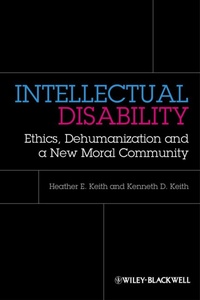
Intellectual Disability
Ethics, Dehumanization, and a New Moral Community
1st Edition
Published on 26. April 2013
Book
Hardback
248 pages
978-0-470-67432-1 (ISBN)
Description
Intellectual Disability: Ethics, Dehumanization, and a New Moral Community presents an interdisciplinary exploration of the roots and evolution of the dehumanization of people with intellectual disabilities.
Examines the roots of disability ethics from a psychological, philosophical, and educational perspective
Presents a coherent, sustained moral perspective in examining the historical dehumanization of people with diminished cognitive abilities
Includes a series of narratives and case descriptions to illustrate arguments
Reveals the importance of an interdisciplinary understanding of the social construction of intellectual disability
Examines the roots of disability ethics from a psychological, philosophical, and educational perspective
Presents a coherent, sustained moral perspective in examining the historical dehumanization of people with diminished cognitive abilities
Includes a series of narratives and case descriptions to illustrate arguments
Reveals the importance of an interdisciplinary understanding of the social construction of intellectual disability
Reviews / Votes
"The best use of this valuable contribution may be to disseminate it to the decision makers, legislators, and health care providers and, most importantly, to the educators and trainers who can extract the gems from this treasure chest to increase the wealth of knowledge and improve the awareness of direct workers, families, medical/behavioral health students, and community members about people with intellectual disabilities. In addition, this book could be used to correct a significant concern regarding the professionals who provide services to this population." (PsycCRITIQUES, 28 April 2014)"This well-thought-out reference is grounded in thorough research with an engaging narrative. Summing Up: Highly recommended. Lower-level undergraduates and above; general readers." (Choice, 1 March 2014)
"It is entirely refreshing to read about intellectual disability from a philosophical and social perspective. I would recommend this book to anyone with an interest in intellectual disability (be it clinical, academic or personal). It is a useful piece of literature that will aid anyone involved in this field to more readily appreciate the social, moral and historical context of intellectual disability, while providing a useful framework to consider for the future." The International Journal of Developmental Disabilities
More details
Language
English
Place of publication
Hoboken
United Kingdom
Publishing group
John Wiley and Sons Ltd
Target group
Professional and scholarly
Product notice
sewn/stitched
Cloth over boards
With dust jacket
Dimensions
Height: 231 mm
Width: 152 mm
Thickness: 23 mm
Weight
454 gr
ISBN-13
978-0-470-67432-1 (9780470674321)
Copyright in bibliographic data and cover images is held by Nielsen Book Services Limited or by the publishers or by their respective licensors: all rights reserved.
Schweitzer Classification
Other editions
Additional editions
Heather Keith | Kenneth D. Keith
Intellectual Disability
Ethics, Dehumanization, and a New Moral Community
E-Book
03/2013
Wiley-Blackwell
€115.99
Available for download
Heather Keith | Kenneth D. Keith
Intellectual Disability
Ethics, Dehumanization, and a New Moral Community
E-Book
03/2013
Wiley-Blackwell
€115.99
Available for download
Persons
Heather E. Keith is Associate Professor of Philosophy at Green Mountain College, Vermont. Her work has appeared in such publications as The Transactions of the Charles S. Peirce Society, The Journal of Chinese Philosophy, Streams of William James, and the Encyclopedia of American Philosophy.
Kenneth D. Keith is Professor Emeritus of Psychological Sciences at the University of San Diego. The author, co-author, or editor of more than 100 scientific and professional publications including The Wiley-Blackwell Encyclopedia of Cross-Cultural Psychology, Keith is also a Fellow of the American Psychological Association in the divisions on teaching and on international psychology, and a Fellow of the Western Psychological Association and the Association for Psychological Science.
Kenneth D. Keith is Professor Emeritus of Psychological Sciences at the University of San Diego. The author, co-author, or editor of more than 100 scientific and professional publications including The Wiley-Blackwell Encyclopedia of Cross-Cultural Psychology, Keith is also a Fellow of the American Psychological Association in the divisions on teaching and on international psychology, and a Fellow of the Western Psychological Association and the Association for Psychological Science.
Content
Acknowledgements vii Prologue:Why Study Disability? ix
Part I The Roots of Dehumanization 1
1 Intellectual Disability: History and Evolution of Definitions 3
2 The Social Construction of Purgatory: Ideas and Institutions 19
3 A Failure of Intelligence 37
4 The Consequences of Reason: Moral Philosophy and Intelligence 53
Part II Out of the Darkness 77
5 Defining the Person: The Moral and Social Consequences of Philosophies of Selfhood 79
6 Alternative Views of Moral Engagement: Relationality and Rationality 95
7 Culture and Intellectual Disability 116
Part III Disability Ethics for a New Age 131
8 Quality of Life and Perception of Self 133
9 Application and Best Practices: Rights, Education, and Ethics 151
10 Epilogue: Visions of the Future 170
References 177
Name Index 215
Subject Index 225
Part I The Roots of Dehumanization 1
1 Intellectual Disability: History and Evolution of Definitions 3
2 The Social Construction of Purgatory: Ideas and Institutions 19
3 A Failure of Intelligence 37
4 The Consequences of Reason: Moral Philosophy and Intelligence 53
Part II Out of the Darkness 77
5 Defining the Person: The Moral and Social Consequences of Philosophies of Selfhood 79
6 Alternative Views of Moral Engagement: Relationality and Rationality 95
7 Culture and Intellectual Disability 116
Part III Disability Ethics for a New Age 131
8 Quality of Life and Perception of Self 133
9 Application and Best Practices: Rights, Education, and Ethics 151
10 Epilogue: Visions of the Future 170
References 177
Name Index 215
Subject Index 225