

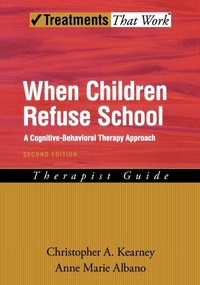
When Children Refuse School
A Cognitive-Behavioral Therapy Approach, Therapist Guide
2nd Edition
Published on 5. April 2007
Book
Paperback/Softback
288 pages
978-0-19-530830-3 (ISBN)
Description
Many children and teenagers refuse to attend school or have anxiety-related difficulties that stop them from remaining in classes for an entire day. School refusal behaviour can contribute to a child's academic, social and psychological problems, can impact upon their chances for future educational, financial and personal success, and can significantly affect family functioning.
This Therapist Guide outlines treatment protocols based on CBT techniques that can be used to effectively address the main types of school refusal behaviour. It concentrates on four primary reasons why children typically refuse school: to relieve school-related distress; to avoid negative social or evaluative situations at school; to receive attention from a parent or a significant other; and to obtain tangible rewards outside of school.
The guide includes tools for assessing a child's reasons for school refusal behaviour and presents well-tested techniques arranged by function to tailor treatment to a child's particular characteristics. Each treatment package also contains a detailed discussion of special topics pertinent to treating young people with school refusal behaviour, such as medication, panic attacks and being teased. A corresponding Workbook is available for parents, who often play an important part in a child's
recovery.
This Therapist Guide outlines treatment protocols based on CBT techniques that can be used to effectively address the main types of school refusal behaviour. It concentrates on four primary reasons why children typically refuse school: to relieve school-related distress; to avoid negative social or evaluative situations at school; to receive attention from a parent or a significant other; and to obtain tangible rewards outside of school.
The guide includes tools for assessing a child's reasons for school refusal behaviour and presents well-tested techniques arranged by function to tailor treatment to a child's particular characteristics. Each treatment package also contains a detailed discussion of special topics pertinent to treating young people with school refusal behaviour, such as medication, panic attacks and being teased. A corresponding Workbook is available for parents, who often play an important part in a child's
recovery.
More details
Series
Edition
2nd Revised edition
Language
English
Place of publication
New York
United States
Target group
Professional and scholarly
Edition type
Revised edition
Product notice
Paperback (trade)
Dimensions
Height: 252 mm
Width: 177 mm
Thickness: 19 mm
Weight
511 gr
ISBN-13
978-0-19-530830-3 (9780195308303)
Copyright in bibliographic data and cover images is held by Nielsen Book Services Limited or by the publishers or by their respective licensors: all rights reserved.
Schweitzer Classification
Other editions
Additional editions
Christopher A. Kearney | Anne Marie Albano
When Children Refuse School
A Cognitive-Behavioral Therapy Approach
E-Book
03/2007
2nd Edition
OUP eBook
€41.49
Available for download
Christopher A. Kearney | Anne Marie Albano
When Children Refuse School: A Cognitive-Behavioral Therapy Approach Therapist Guide
E-Book
03/2007
1st Edition
Oxford University Press
€37.79
Available for download
Previous edition

Christopher Kearney
When Children Refuse School: Therapist guide
A cognitive-behavioral therapy approach
Book
11/2004
Oxford University Press Inc
€24.79
Article exhausted; check for reprint
Persons
Author
Professor of Psychology and Director of UNLV Child School Refusal and Anxiety Disorders ClinicUniversity of Nevada, Las Vegas
Associate Professor of Clinical PsychologyColumbia University/New York State Psychiatric Institute and Director of the Columbia University Clinic for Anxiety and Related Disorders
Content
1. Introductory Information for Therapists ; 2. Assessment ; 3. Consultation Session and General Treatment Session Procedures ; 4. Children Refusing School to Avoid School-Related Stimuli That Provoke Negative Affectivity ; 5. Children Refusing School to Escape Aversive Social and/or Evaluative Situations ; 6. Children Refusing School for Attention ; 7. Children Refusing School for Tangible Rewards Outside of School ; 8. Slip and Relapse Prevention