

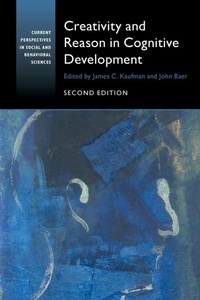
Creativity and Reason in Cognitive Development
2nd Edition
Published on 15. February 2016
Book
Paperback/Softback
406 pages
978-1-107-43883-5 (ISBN)
Description
This book explores the development of cognitive skills related to reasoning and creativity, two strands that can intertwine to work together at times but may also be at odds. Spontaneity and freedom from constraint, characteristic of the thinking of young children, may be essential to creativity, which has prompted many to question how much we lose as we progress through childhood. Research and common sense tell us that effort, practice, and study are necessary for the highest levels of creative accomplishment, yet such intentional exertions seem antithetical to these hallmarks of creativity. In this revised and expanded second edition, leading scholars shed new light on creativity's complex relationship to the acquisition of domain-based skills and the development of more general logical reasoning skills. Creativity and Reason in Cognitive Development will be an essential reference for researchers, psychologists, and teachers seeking to better understand the most up-to-date work in the field.
More details
Series
Edition
2nd Revised edition
Language
English
Place of publication
Cambridge
United Kingdom
Target group
Professional and scholarly
Edition type
Revised edition
Product notice
Paperback (trade)
Illustrations
6 Tables, black and white; 2 Halftones, unspecified; 21 Line drawings, unspecified
Dimensions
Height: 230 mm
Width: 152 mm
Thickness: 22 mm
Weight
567 gr
ISBN-13
978-1-107-43883-5 (9781107438835)
Copyright in bibliographic data and cover images is held by Nielsen Book Services Limited or by the publishers or by their respective licensors: all rights reserved.
Schweitzer Classification
Other editions
Previous edition
James C. Kaufman | John Baer
Creativity and Reason in Cognitive Development
Book
05/2006
Cambridge University Press
€38.37
Article exhausted; check for reprint
Persons
James C. Kaufman is Professor of Educational Psychology at the Neag School of Education, University of Connecticut. He is the author or editor of more than thirty books, including Creativity 101 (2009), The Cambridge Handbook of Creativity (Cambridge, 2010) and Creativity and Mental Illness (Cambridge, 2014). He is also the founding coeditor of Psychology of Popular Media Culture and past president of the American Psychological Association's Division 10. John Baer is a Professor of Educational Psychology at Rider University. He has written numerous books on creativity, including Teaching for Creativity in the Common Core Classroom, Essentials of Creativity Assessment, and Being Creative Inside and Outside the Classroom.
Content
1. Creativity, reason, and cognitive development: ten years later John Baer and James C. Kaufman; Part I. Creativity and Reason in Childhood and the Schools: 2. Creativity in young children's thought Susan A. Gelman and Gail M. Gottfried; 3. Early experiences and creativity: an ecological perspective Cynthia Paris and Diane Crossan Lawler; 4. Imaginative play Sandra W. Russ and Olena Zyga; 5. Revisiting the relationship among schooling, learning, and creativity Ronald A. Beghetto and Jonathan A. Plucker; 6. Higher-level thinking in gifted education Joyce VanTassel-Baska; 7. A young artist's story: advancing knowledge and the development of artistic talent and creativity in children Susan M. Rostan; Part II. Creativity and Reason in Cognition and Neuroscience: 8. The role of domain knowledge in creative problem solving Richard E. Mayer; 9. Processes, strategies, and knowledge in creative thought: multiple interacting systems Michael D. Mumford, Tristan McIntosh, Tyler Mulhearn, Logan Steele and Logan Watts; 10. Dynamic processes within associative memory stores: piecing together the neural basis of creative cognition Adam S. Bristol and Indre V. Viskontas; 11. Creativity and constraint: friends, not foes Catrinel Haught; 12. Creative genius, knowledge, and reason: the lives and works of eminent creators Dean Keith Simonton; 13. Attention, cognitive flexibility, and creativity: insights from the brain Oshin Vartanian; Part III. Creativity and Reason: Interactions and Related Constructs: 14. Opening up creativity: the lenses of axis and focus Mia Keinaenen, Kimberly M. Sheridan and Howard Gardner; 15. Creativity and reason: friends or foes? Jacques-Henri Guignard and Todd Lubart; 16. Creative self-beliefs: their nature, development, and correlates Maciej Karwowski and Baptiste Barbot; 17. Individual differences in intelligence, personality, and creativity Adrian Furnham; 18. An update on 'does culture always matter: for creativity, yes, for deductive reasoning, no!' Weihua Niu, Sophia Braha and John X. Zhang.