

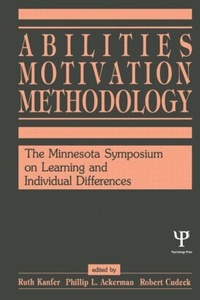
Abilities, Motivation and Methodology
The Minnesota Symposium on Learning and Individual Differences
Published on 1. December 1989
Book
Paperback/Softback
540 pages
978-0-8058-0496-6 (ISBN)
Description
Diverse developments in ability and motivation research, and in the derivations of new methodological techniques have often run on parallel courses. The editors of this volume felt that communication across domains could be vastly improved through intensive interaction between researchers. This interaction was realized in The Minnesota Symposium on Learning and Individual Differences, which directly addressed ability, motivation and methodology concerns. This book, compiled as a result of the Symposium, unites theoretical and empirical advances in learning and individual differences.
The resulting volume, divided in five parts, encompasses not only prepared papers that were presented at the symposium, but compiled and edited transcriptions of the spontaneous discussions that took place at the symposium.
Part I provides an orientation to the treatment of learning and individual differences from three major perspectives: experimental psychology, motivational psychology, and differential/ methodological psychology. Part II continues and expands the discussion of quantitative methodology and applications to learning and individual differences. Part III is devoted primarily to developments in the cognitive ability domain, while Part IV addresses the impact of non-cognitive, personal constructs on learning and performance. The volume concludes with Part V which contains chapters from the closing session of the conference.
The resulting volume, divided in five parts, encompasses not only prepared papers that were presented at the symposium, but compiled and edited transcriptions of the spontaneous discussions that took place at the symposium.
Part I provides an orientation to the treatment of learning and individual differences from three major perspectives: experimental psychology, motivational psychology, and differential/ methodological psychology. Part II continues and expands the discussion of quantitative methodology and applications to learning and individual differences. Part III is devoted primarily to developments in the cognitive ability domain, while Part IV addresses the impact of non-cognitive, personal constructs on learning and performance. The volume concludes with Part V which contains chapters from the closing session of the conference.
More details
Language
English
Place of publication
New York
United States
Publishing group
Taylor & Francis Inc
Target group
College/higher education
Dimensions
Height: 229 mm
Width: 152 mm
Weight
839 gr
ISBN-13
978-0-8058-0496-6 (9780805804966)
Copyright in bibliographic data and cover images is held by Nielsen Book Services Limited or by the publishers or by their respective licensors: all rights reserved.
Schweitzer Classification
Other editions
Additional editions
Ruth Kanfer | Phillip L. Ackerman | Robert Cudeck
Abilities, Motivation and Methodology
The Minnesota Symposium on Learning and Individual Differences
E-Book
06/2014
1st Edition
Routledge
€101.99
Available for download
Ruth Kanfer | Phillip L. Ackerman | Robert Cudeck
Abilities, Motivation and Methodology
The Minnesota Symposium on Learning and Individual Differences
E-Book
06/2014
1st Edition
Routledge
€101.99
Available for download

Ruth Kanfer | Phillip L. Ackerman | Robert Cudeck
Abilities, Motivation and Methodology
The Minnesota Symposium on Learning and Individual Differences
Book
11/1989
Lawrence Erlbaum Associates Inc
€106.80
Article exhausted; check different version
Persons
Robert Cudeck, Ruth Kanfer, Phillip L. Ackerman
Content
Contents: Preface. J. B. Overmier, W.E. Montague, J.J. Jenkins, Prolegomenon. Part I: Historical Perspectives.J.A. Adams, Historical Background and Appraisal of Research on Individual Differences in Learning. U. Kleinbeck, H. Quast, R. Schwarz, Volitional Effects on Performance -- Conceptual Considerations and Results from Dual- Task Studies. J.B. Carroll, Factor Analysis Since Spearman: Where Do We Stand? What Do We Know? Part II: Methodological Strategies.J.J. McArdle, A Structural Modeling Experiment with Multiple Growth Functions. D.F. Lohman, Estimating Individual Differences in Information Processing Using Speed-Accuracy Models. R. Cudeck, Simple Solutions and Complex Problems. Part III: Cognitive Abilities and Information Processing.J.W. Pellegrino, E.B. Hunt, P. Yee, Assessment and Modeling of Information Coordination Abilities. J. Gustafsson, Broad and Narrow Abilities in Research on Learning and Instruction. P.C. Kyllonen, D.J. Woltz, Role of Cognitive Factors in the Acquisition of Cognitive Skill. P.L. Ackerman, Abilities, Elementary Information Processes, and Other Sights to See at the Zoo. Part IV: Motivational and Volitional Processes.W. Revelle, Personality, Motivation, and Cognitive Performance. J. Kuhl, K. Kraska, Self-Regulation and Metamotivation: Computational Mechanisms, Development, and Assessment. R. Kanfer, Non-Cognitive Processes, Dispositions and Performance: Connecting the Dots Within and Across Paradigms. Part V: Paradigms in Transition.G. Mulder, A.A. Wijers, H.G.O.M. Smid, K.A. Brookhuis, L.J.M. Mulder, Individual Differences in Computational Mechanisms: A Psychophysiological Analysis. R.E. Snow, Cognitive-Conative Aptitude Interactions in Learning. J.J. Jenkins, Closing Remarks. Conference Program. Additional Discussion Participants. Name Index. Subject Index.