

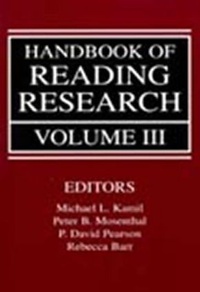
Handbook of Reading Research, Volume III
Published on 1. April 2000
Book
Hardback
1024 pages
978-0-8058-2398-1 (ISBN)
Description
In Volume III, as in Volumes I and II, the classic topics of reading are included--from vocabulary and comprehension to reading instruction in the classroom--and, in addition, each contributor was asked to include a brief history that chronicles the legacies within each of the volume's many topics. However, on the whole, Volume III is not about tradition. Rather, it explores the verges of reading research between the time Volume II was published in 1991 and the research conducted after this date. The editors identified two broad themes as representing the myriad of verges that have emerged since Volumes I and II were published: (1) broadening the definition of reading, and (2) broadening the reading research program. The particulars of these new themes and topics are addressed.
More details
Language
English
Place of publication
New York
United States
Publishing group
Taylor & Francis Inc
Target group
College/higher education
Professional and scholarly
Dimensions
Height: 254 mm
Width: 178 mm
Weight
2050 gr
ISBN-13
978-0-8058-2398-1 (9780805823981)
Copyright in bibliographic data and cover images is held by Nielsen Book Services Limited or by the publishers or by their respective licensors: all rights reserved.
Schweitzer Classification
Other editions
Additional editions
Michael L. Kamil | Peter B. Mosenthal | P. David Pearson
Handbook of Reading Research, Volume III
E-Book
11/2016
Routledge
€158.99
Available for download
Michael L. Kamil | Peter B. Mosenthal | P. David Pearson
Handbook of Reading Research, Volume III
E-Book
11/2016
Routledge
€158.99
Available for download
Michael L. Kamil | Peter B. Mosenthal | P. David Pearson
Handbook of Reading Research, Volume III
Book
03/2000
Routledge
€163.68
Shipment within 10-20 days
Persons
Michael L. Kamil, Peter B. Mosenthal, P. David Pearson, Rebecca Barr
Content
Contents: Preface. Part I: Literacy Research Around the World.I.A.G. Wilkinson, P. Freebody, J. Elkins, Reading Research in Australia and Aotearoa/New Zealand. C. Harrison, Reading Research in the United Kingdom. K.S. Meredith, J.L. Steele, Education in Transition: Trends in Central and Eastern Europe. I.S. Santana, Literacy Research in Latin America. J.S. Gaffney, R.C. Anderson, Trends in Reading Research in the United States: Changing Intellectual Currents Over Three Decades. Part II: Methods of Literacy Research.J.F. Baumann, A.M. Duffy-Hester, Making Sense of Classroom Worlds: Methodology in Teacher Research. T.D. Piggot, R. Barr, Designing Programmatic Interventions. E.J. Monaghan, D.K. Hartman, Undertaking Historical Research in Literacy. D.E. Alvermann, Narrative Approaches. M. Siegel, S.L. Fernandez, Critical Approaches. S. Florio-Ruane, M. McVee, Ethnographic Approaches to Literacy Research. P. Afflerbach, Verbal Reports and Protocol Analysis. S.B. Neuman, S. McCormick, A Case for Single-Subject Experiments in Literacy Research. J.P. Gee, Discourse and Sociocultural Studies in Reading. T. Shanahan, Research Synthesis: Making Sense of the Accumulation of Knowledge in Reading. Part III: Literacy Processes.B.A. Shaywitz, K.R. Pugh, A.R. Jenner, R.K. Fulbright, J.M. Fletcher, J.C. Gore, S.E. Shaywitz, The Neurobiology of Reading and Reading Disability (Dyslexia). U. Goswami, Phonological and Lexical Processes. W.E. Nagy, J.A. Scott, Vocabulary Processes. P.A. Alexander, T.L. Jetton, Learning From Text: A Multidimensional and Developmental Perspective. S.R. Goldman, J.A. Rakestraw, Jr., Structural Aspects of Constructing Meaning From Text. L.C. Wilkinson, E.R. Silliman, Classroom Language and Literacy Learning. L. Galda, G.E. Ash, B.E. Cullinan, Children's Literature. J. Marshall, Research on Response to Literature. J.T. Guthrie, A. Wigfield, Engagement and Motivation in Reading. Part IV: Literacy Practices.D.B. Yaden, Jr., D.W. Rowe, L. MacGillivray, Emergent Literacy: A Matter (Polyphony) of Perspectives. E.H. Hiebert, B.M. Taylor, Beginning Reading Instruction: Research on Early Interventions. B.A. Blachman, Phonological Awareness. C.L.Z. Blachowicz, P. Fisher, Vocabulary Instruction. S. Templeton, D. Morris, Spelling. M. Pressley, What Should Comprehension Instruction Be the Instruction of? L.M. Morrow, L.B. Gambrell, Literature-Based Reading Instruction. J.R. Gavelek, T.E. Raphael, S.M. Biondo, D. Wang, Integrated Literacy Instruction. S.E. Wade, E.B. Moje, The Role of Text in Classroom Learning. T.W. Bean, Reading in the Content Areas: Social Constructivist Dimensions. S.L. Nist, M.L. Simpson, College Studying. L. Klenk, M.W. Kibby, Re-Mediating Reading Difficulties: Appraising the Past, Reconciling the Present, Constructing the Future. S.L. Lytle, Teacher Research in the Contact Zone. P.L. Anders, J.V. Hoffman, G.G. Duffy, Teaching Teachers to Teach Reading: Paradigm Shifts, Persistent Problems, and Challenges. D.J. Leu, Jr., Literacy and Technology: Deictic Consequences for Literacy Education in an Information Age. M.L. Kamil, S.M. Intrator, H.S. Kim, The Effects of Other Technologies on Literacy and Literacy Learning. Part V: Literacy Policies.E.B. Bernhardt, Second-Language Reading as a Case Study of Reading Scholarship in the 20th Century. G.E. Garcia, Bilingual Children's Reading. K.H. Au, A Multicultural Perspective on Policies for Improving Literacy Achievement: Equity and Excellence. V. Purcell-Gates, Family Literacy. V.L. Gadsden, Intergenerational Literacy Within Families. A. McGill-Franzen, Policy and Instruction: What Is the Relationship? S.W. Valencia, K.K. Wixson, Policy-Oriented Research on Literacy Standards and Assessment.