

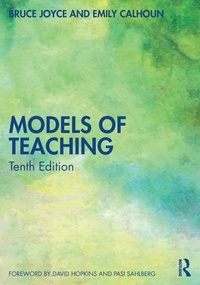
Models of Teaching
10th Edition
Published on 2. August 2024
Book
Paperback/Softback
404 pages
978-1-032-57601-5 (ISBN)
Description
This fully updated edition of a classic text explores established approaches to teaching that are grounded in research and experience to ensure high levels of learning.
Models of Teaching combines rationale and research with real-life examples and applications in the classroom, showing how teachers, professional learning communities, and school faculties can improve student attainment. The volume contains the major psychological and philosophical approaches to teaching and schooling, including thoroughly documented research on the models of teaching and their effects on student success, and offers teachers the tools to accelerate student learning.
Features include:
three completely new chapters covering the origins of models in teaching, explicit strategy instruction and metacognition for teaching reading comprehension, and best practices for teachers coaching other teachers, expanding instruction, and supporting school renewal;
scenarios for each model to explore the concepts in action;
discussions of research relevant to each model throughout the text;
advice from the authors about the use of the models in teaching;
support for incorporating the language arts and science standards and supporting STEM
instruction.
With the aim of providing a strong impact on student achievement while keeping in line with the current emphasis on standards-based education, this classic resource will be essential reading for pre-service and new teachers as well as current teaching professionals.
This text is supported by extensive multimedia materials, including video demonstrations of the models in action, PowerPoint slides and an Instructor's Manual, available at www.modelsofteaching.org.
Models of Teaching combines rationale and research with real-life examples and applications in the classroom, showing how teachers, professional learning communities, and school faculties can improve student attainment. The volume contains the major psychological and philosophical approaches to teaching and schooling, including thoroughly documented research on the models of teaching and their effects on student success, and offers teachers the tools to accelerate student learning.
Features include:
three completely new chapters covering the origins of models in teaching, explicit strategy instruction and metacognition for teaching reading comprehension, and best practices for teachers coaching other teachers, expanding instruction, and supporting school renewal;
scenarios for each model to explore the concepts in action;
discussions of research relevant to each model throughout the text;
advice from the authors about the use of the models in teaching;
support for incorporating the language arts and science standards and supporting STEM
instruction.
With the aim of providing a strong impact on student achievement while keeping in line with the current emphasis on standards-based education, this classic resource will be essential reading for pre-service and new teachers as well as current teaching professionals.
This text is supported by extensive multimedia materials, including video demonstrations of the models in action, PowerPoint slides and an Instructor's Manual, available at www.modelsofteaching.org.
More details
Edition
10th edition
Language
English
Place of publication
London
United Kingdom
Publishing group
Taylor & Francis Ltd
Target group
College/higher education
Professional and scholarly
Postgraduate, Professional Reference, and Undergraduate Advanced
Illustrations
60 s/w Abbildungen, 48 s/w Photographien bzw. Rasterbilder, 12 s/w Zeichnungen, 24 s/w Tabellen
24 Tables, black and white; 12 Line drawings, black and white; 48 Halftones, black and white; 60 Illustrations, black and white
Dimensions
Height: 254 mm
Width: 178 mm
Thickness: 24 mm
Weight
822 gr
ISBN-13
978-1-032-57601-5 (9781032576015)
Copyright in bibliographic data and cover images is held by Nielsen Book Services Limited or by the publishers or by their respective licensors: all rights reserved.
Schweitzer Classification
Other editions
Additional editions

Bruce Joyce | Emily Calhoun
Models of Teaching
Book
08/2024
10th Edition
Routledge
€205.20
Shipment within 10-20 days
Bruce Joyce | Emily Calhoun
Models of Teaching
E-Book
08/2024
10th Edition
Routledge
€83.49
Available for download
Bruce Joyce | Emily Calhoun
Models of Teaching
E-Book
08/2024
10th Edition
Routledge
€83.49
Available for download
Persons
Bruce Joyce is a practitioner-scholar in education, who has previously held professorships at the University of Delaware, USA; The University of Chicago, USA; The Ontario Institute of Studies in Education, Canada; and Teachers College, Columbia, USA.
Emily Calhoun, former Coordinator of the League of Professional Schools the University of Georgia, USA, is currently the director of The Phoenix Alliance in Saint Simons Island, Georgia, USA.
Emily Calhoun, former Coordinator of the League of Professional Schools the University of Georgia, USA, is currently the director of The Phoenix Alliance in Saint Simons Island, Georgia, USA.
Content
Foreword
Preface
Preamble
Part One: Models of Teaching and Communities of Learners
Chapter 1: The Search for Effective Ways To Educate-Introducing the Models of Teaching
Chapter 2: Creating Communities of Expert Learners: Building on Our Students' Capacity To Learn
Part Two: Basic Information-Processing Models of Teaching
Chapter 3: Learning to Learn Inductively: Exploring Data Sets, Creating Categories, and Developing Concepts
Chapter 4: Scientific Inquiry: Building Learning Around Investigations and Teaching the Culture of Sciencing
Chapter 5: Concept Attainment: The Explicit Teaching of Concepts
Chapter 6: The Picture Word Inductive Model: Developing Literacy through Inquiry
Part Three: Special Purpose Information-Processing Models
Chapter 7: Synectics: Teaching the Left Brain to Put the Right Side to Work
Chapter 8: Memorization: Getting the Facts Straight, Now and for the Long Term
Chapter 9: Using Advance Organizers to Design Presentations--From Lectures to Courses, Including Media
Part Four: The Social Family of Models of Teaching
Chapter 10: Partners in Learning: Getting Everybody on Board
Chapter 11: Group Investigation--the Classic Democratic-Process-Inquiry-Driven Model: Beginning with a Puzzlement, a Problem, or a Project
Chapter 12: Role Playing for the Study of Values
Part Five: The Personal Family of Models
Chapter 13: Nondirective Teaching: The Learner at the Center
Chapter 14: Inquiry Training
Part Six: The Behavioral Family of Models
Chapter 15: Using Explicit Instruction and Metacognition When Teaching Reading Comprehension
Chapter 16: Mastery Learning: Bit by Bit, Block by Block, We Climb Our Way to Mastery
Chapter 17: Direct Instruction: Applied Psychology Goes to Work
Part Seven: The Conditions of Learning and Educators as Curriculum Developers, Learners, and Leaders of School Renewal
Chapter 18: The Dynamics of Disequilibrium: Making Discomfort Productive
Chapter 19: The Conditions of Learning: Creating Curricula and Designing Instruction
Chapter 20: Teachers Coaching Teachers: Facilitating Learning and Neutralizing the Discomfort of Change
Appendix: Peer Coaching Guides
References and Related Literature
Index
Preface
Preamble
Part One: Models of Teaching and Communities of Learners
Chapter 1: The Search for Effective Ways To Educate-Introducing the Models of Teaching
Chapter 2: Creating Communities of Expert Learners: Building on Our Students' Capacity To Learn
Part Two: Basic Information-Processing Models of Teaching
Chapter 3: Learning to Learn Inductively: Exploring Data Sets, Creating Categories, and Developing Concepts
Chapter 4: Scientific Inquiry: Building Learning Around Investigations and Teaching the Culture of Sciencing
Chapter 5: Concept Attainment: The Explicit Teaching of Concepts
Chapter 6: The Picture Word Inductive Model: Developing Literacy through Inquiry
Part Three: Special Purpose Information-Processing Models
Chapter 7: Synectics: Teaching the Left Brain to Put the Right Side to Work
Chapter 8: Memorization: Getting the Facts Straight, Now and for the Long Term
Chapter 9: Using Advance Organizers to Design Presentations--From Lectures to Courses, Including Media
Part Four: The Social Family of Models of Teaching
Chapter 10: Partners in Learning: Getting Everybody on Board
Chapter 11: Group Investigation--the Classic Democratic-Process-Inquiry-Driven Model: Beginning with a Puzzlement, a Problem, or a Project
Chapter 12: Role Playing for the Study of Values
Part Five: The Personal Family of Models
Chapter 13: Nondirective Teaching: The Learner at the Center
Chapter 14: Inquiry Training
Part Six: The Behavioral Family of Models
Chapter 15: Using Explicit Instruction and Metacognition When Teaching Reading Comprehension
Chapter 16: Mastery Learning: Bit by Bit, Block by Block, We Climb Our Way to Mastery
Chapter 17: Direct Instruction: Applied Psychology Goes to Work
Part Seven: The Conditions of Learning and Educators as Curriculum Developers, Learners, and Leaders of School Renewal
Chapter 18: The Dynamics of Disequilibrium: Making Discomfort Productive
Chapter 19: The Conditions of Learning: Creating Curricula and Designing Instruction
Chapter 20: Teachers Coaching Teachers: Facilitating Learning and Neutralizing the Discomfort of Change
Appendix: Peer Coaching Guides
References and Related Literature
Index