

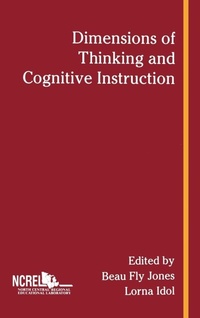
Dimensions of Thinking and Cognitive Instruction
Published on 1. May 1990
Book
Hardback
536 pages
978-0-8058-0346-4 (ISBN)
Description
By establishing a conceptual framework and a common language for educators to work together, this volume attempts to answer the challenge facing all teachers -- how can students improve the quality of their thinking? Methods of strengthening the thought process include: helping students learn to monitor their attention and commitments; asking questions that require students to organize, analyze, and integrate information; setting tasks that involve complex processes such as problem solving and research; and modeling and reinforcing fair-mindedness.
Reviews / Votes
"...an essential text for both researchers and educators interested in thinking and instruction."-Contemporary Psychology
More details
Language
English
Place of publication
New York
United States
Publishing group
Taylor & Francis Inc
Target group
College/higher education
Professional and scholarly
Dimensions
Height: 235 mm
Width: 157 mm
Thickness: 38 mm
Weight
1062 gr
ISBN-13
978-0-8058-0346-4 (9780805803464)
Copyright in bibliographic data and cover images is held by Nielsen Book Services Limited or by the publishers or by their respective licensors: all rights reserved.
Schweitzer Classification
Other editions
Additional editions
Beau Fly Jones | Lorna Idol
Dimensions of Thinking and Cognitive Instruction
Book
07/2016
1st Edition
Routledge
€78.70
Shipment within 10-20 days
Beau Fly Jones | Lorna Idol
Dimensions of Thinking and Cognitive Instruction
E-Book
05/2013
1st Edition
Routledge
€69.99
Available for download
Beau Fly Jones | Lorna Idol
Dimensions of Thinking and Cognitive Instruction
E-Book
05/2013
1st Edition
Routledge
€69.99
Available for download
Persons
Beau Fly Jones, Lorna Idol
Content
Contents: B.F. Jones, L. Idol, Introduction. S.G. Paris, P. Winograd, How Metacognition Can Promote Academic Learning and Instruction. J.G. Borkowski, M. Carr, E. Rellinger, M. Pressley, Self- Regulated Cognition: Interdependence of Metacognition, Attributions, and Self-Esteem. H.J. Klausmeier, Conceptualizing. K.J. Roth, Developing Meaningful Conceptual Understanding in Science. S.L. Kline, J.G. Delia, Reasoning About Communication and Communicative Skill. P.D. Pearson, T.E. Raphael, Reading Comprehension as a Dimension of Thinking. J.R. Hayes, Individuals and Environments in Writing Instruction. E.A. Silver, S.P. Marshall, Mathematical and Scientific Problem Solving: Findings, Issues, and Instructional Implications. R.D. Tweney, B.J. Walker, Science Education and the Cognitive Psychology of Science. H. Borko, R.J. Shavelson, Teacher Decision Making. S.J. Derry, Learning Strategies for Acquiring Useful Knowledge. J.D. Bransford, N. Vye, C. Kinzer, V. Risko, Teaching Thinking and Content Knowledge: Toward an Integrated Approach. D.N. Perkins, The Nature and Nurture of Creativity. R.W. Paul, Critical and Reflective Thinking: A Philosophical Perspective. R.S. Nickerson, Dimensions of Thinking: A Critique. B.F. Jones, L. Idol, Conclusions.