

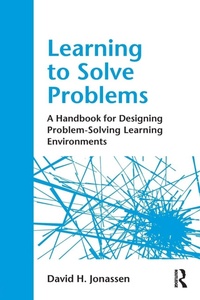
Learning to Solve Problems
A Handbook for Designing Problem-Solving Learning Environments
1st Edition
Published on 7. September 2010
Book
Paperback/Softback
472 pages
978-0-415-87194-5 (ISBN)
Description
This book provides a comprehensive, up-to-date look at problem solving research and practice over the last fifteen years. The first chapter describes differences in types of problems, individual differences among problem-solvers, as well as the domain and context within which a problem is being solved. Part one describes six kinds of problems and the methods required to solve them. Part two goes beyond traditional discussions of case design and introduces six different purposes or functions of cases, the building blocks of problem-solving learning environments. It also describes methods for constructing cases to support problem solving. Part three introduces a number of cognitive skills required for studying cases and solving problems. Finally, Part four describes several methods for assessing problem solving. Key features includes:
Teaching Focus - The book is not merely a review of research. It also provides specific research-based advice on how to design problem-solving learning environments.
Illustrative Cases - A rich array of cases illustrates how to build problem-solving learning environments. Part two introduces six different functions of cases and also describes the parameters of a case.
Chapter Integration - Key theories and concepts are addressed across chapters and links to other chapters are made explicit. The idea is to show how different kinds of problems, cases, skills, and assessments are integrated.
Author expertise - A prolific researcher and writer, the author has been researching and publishing books and articles on learning to solve problems for the past fifteen years.
This book is appropriate for advanced courses in instructional design and technology, science education, applied cognitive psychology, thinking and reasoning, and educational psychology. Instructional designers, especially those involved in designing problem-based learning, as well as curriculum designers who seek new ways of structuring curriculum will find it an invaluable reference tool.
Teaching Focus - The book is not merely a review of research. It also provides specific research-based advice on how to design problem-solving learning environments.
Illustrative Cases - A rich array of cases illustrates how to build problem-solving learning environments. Part two introduces six different functions of cases and also describes the parameters of a case.
Chapter Integration - Key theories and concepts are addressed across chapters and links to other chapters are made explicit. The idea is to show how different kinds of problems, cases, skills, and assessments are integrated.
Author expertise - A prolific researcher and writer, the author has been researching and publishing books and articles on learning to solve problems for the past fifteen years.
This book is appropriate for advanced courses in instructional design and technology, science education, applied cognitive psychology, thinking and reasoning, and educational psychology. Instructional designers, especially those involved in designing problem-based learning, as well as curriculum designers who seek new ways of structuring curriculum will find it an invaluable reference tool.
More details
Language
English
Place of publication
London
United Kingdom
Publishing group
Taylor & Francis Ltd
Target group
College/higher education
Illustrations
100 s/w Zeichnungen, 13 s/w Tabellen
13 Tables, black and white; 100 Line drawings, black and white
Dimensions
Height: 229 mm
Width: 152 mm
Thickness: 28 mm
Weight
763 gr
ISBN-13
978-0-415-87194-5 (9780415871945)
Copyright in bibliographic data and cover images is held by Nielsen Book Services Limited or by the publishers or by their respective licensors: all rights reserved.
Schweitzer Classification
Other editions
Additional editions
David H. Jonassen
Learning to Solve Problems
A Handbook for Designing Problem-Solving Learning Environments
E-Book
09/2010
Routledge
€109.99
Available for download
David H. Jonassen
Learning to Solve Problems
A Handbook for Designing Problem-Solving Learning Environments
E-Book
09/2010
Routledge
€109.99
Available for download
David H. Jonassen
Learning to Solve Problems
A Handbook for Designing Problem-Solving Learning Environments
Book
09/2010
1st Edition
Routledge
€263.70
Shipment within 15-20 days
Person
David H. Jonassen is Curators' Professor in the School of Information Science and Learning Technologies at the University of Missouri.
Content
1. How Does Problem Solving Vary?
Part I. Problem-Specific Design Models
2. Solving Story Problems
3. Decision Making
4. Troubleshooting/Diagnosis
5. Strategic Performance
6. Policy Analysis
7. Design Problem Solving
Part II. Cases: The Building Blocks Problem-Solving Learning Environments
8. Cases as Problems to Solve
9. Cases as Worked Examples of Well-Structured Problems
10. Case Studies: Examples of Ill-Structured Problems
11. Cases as Analogues
12. Cases as Prior Experiences
13. Cases as Alternative Perspectives
14. Cases as Simulations
Part III. Cognitive Skills in Problem-Solving
15. Defining the Problem: Problem Schemas
16. Analogically Comparing Problems
17. Understanding Causal Relationships in Problems
18. Questions for Scaffolding Problem Solving
19. Modeling Problems
20. Arguing to Learn to Solve Problems
21. Metacognitive Regulation of Problem Solving
Part IV. Assessing Problem Solving
22. Assessing Problem Solving
Part I. Problem-Specific Design Models
2. Solving Story Problems
3. Decision Making
4. Troubleshooting/Diagnosis
5. Strategic Performance
6. Policy Analysis
7. Design Problem Solving
Part II. Cases: The Building Blocks Problem-Solving Learning Environments
8. Cases as Problems to Solve
9. Cases as Worked Examples of Well-Structured Problems
10. Case Studies: Examples of Ill-Structured Problems
11. Cases as Analogues
12. Cases as Prior Experiences
13. Cases as Alternative Perspectives
14. Cases as Simulations
Part III. Cognitive Skills in Problem-Solving
15. Defining the Problem: Problem Schemas
16. Analogically Comparing Problems
17. Understanding Causal Relationships in Problems
18. Questions for Scaffolding Problem Solving
19. Modeling Problems
20. Arguing to Learn to Solve Problems
21. Metacognitive Regulation of Problem Solving
Part IV. Assessing Problem Solving
22. Assessing Problem Solving