

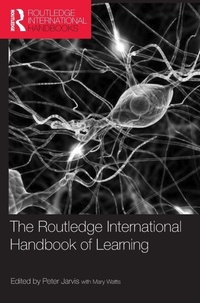
The Routledge International Handbook of Learning
1st Edition
Published on 15. December 2011
Book
Hardback
602 pages
978-0-415-57130-2 (ISBN)
Description
As our understanding of learning focuses on the whole person rather than individual aspects of learning, so the process of learning is beginning to be studied from a wide variety of perspectives and disciplines. This handbook presents a comprehensive overview of the contemporary research into learning: it brings together a diverse range of specialities with chapters written by leading scholars throughout the world from a wide variety of different approaches. The International Handbook of Learning captures the complexities of the learning process in seven major parts. Its 54 chapters are sub-divided in seven parts:
Learning and the person: senses, cognitions, emotions, personality traits and learning styles
Learning across the lifespan
Life-wide learning
Learning across the disciplines: covering everything from anthropology to neuroscience
Meaning systems' interpretation
Learning and disability
Historical and contemporary learning theorists.
Written by international experts, this book is the first comprehensive multi-disciplinary analysis of learning, packing a diverse collection of research into one accessible volume.
Learning and the person: senses, cognitions, emotions, personality traits and learning styles
Learning across the lifespan
Life-wide learning
Learning across the disciplines: covering everything from anthropology to neuroscience
Meaning systems' interpretation
Learning and disability
Historical and contemporary learning theorists.
Written by international experts, this book is the first comprehensive multi-disciplinary analysis of learning, packing a diverse collection of research into one accessible volume.
More details
Series
Language
English
Place of publication
London
United Kingdom
Publishing group
Taylor & Francis Ltd
Target group
College/higher education
Postgraduate and Professional
Illustrations
15 s/w Abbildungen, 4 s/w Tabellen
4 Tables, black and white; 15 Illustrations, black and white
Dimensions
Height: 250 mm
Width: 175 mm
Thickness: 37 mm
Weight
1207 gr
ISBN-13
978-0-415-57130-2 (9780415571302)
Copyright in bibliographic data and cover images is held by Nielsen Book Services Limited or by the publishers or by their respective licensors: all rights reserved.
Schweitzer Classification
Other editions
Additional editions
Peter Jarvis | Mary Watts
The Routledge International Handbook of Learning
Book
11/2017
1st Edition
Routledge
€81.89
Shipment within 10-20 days
Peter Jarvis | Mary Watts
The Routledge International Handbook of Learning
E-Book
12/2011
1st Edition
Routledge
€69.99
Available for download
Peter Jarvis | Mary Watts
The Routledge International Handbook of Learning
E-Book
12/2011
1st Edition
Routledge
€69.99
Available for download
Persons
Peter Jarvis is Professor of Continuing Education at the University of Surrey, Guildford, UK.
Mary Watts is Emeritus Professor of Psychology at City University, London, UK.
Mary Watts is Emeritus Professor of Psychology at City University, London, UK.
Content
Introduction: Learning - an overview
Part 1 Learning and the Person
Senses
Cognitions
Skills and roles
Emotions
Embodiment
Gender
Identity
Personality, Personality Traits and Learning Styles
Non-learning
Part 2 Learning across the Lifespan
Prenatal and the First Year
Early Childhood
The School Years
Adolescence
Adulthood
Mid-life
Older Adults
Biography
Development
Part 3 Learning across the Disciplines
Philosophy
Ethics e.g. indoctrination, socialisation
Psychology - cognitive and evolutionary
Sociology
Anthropology
Politics
Geography/Cultural differences
Biology - evolution and genetics
Pharmacology
Neuroscience
Physiology
Part 4 Meaning Systems' Interpretation
Buddhist
Christian
Confucianism
Hindu
Islamic
Jewish
Part 5 Learning Sites
Informal learning - everyday living
Formal learning - school
Non-formal learning - work
Learning and the inter-relationship of the sites of learning in everyday living
Self-directed learning
e-learning
Part 6 Learning and Disability
Physical disabilities
Autism, dyslexia and dyscalculia and other learning difficulties
Part 7 Historical and Contemporary Learning Theorists
Pavlov, Watson, Skinner
Piaget
Vigotsky
Dewey
Bruner
Gardner
Jarvis
Illeris
Mezirow
Engestrom
Concluding Discussion
Part 1 Learning and the Person
Senses
Cognitions
Skills and roles
Emotions
Embodiment
Gender
Identity
Personality, Personality Traits and Learning Styles
Non-learning
Part 2 Learning across the Lifespan
Prenatal and the First Year
Early Childhood
The School Years
Adolescence
Adulthood
Mid-life
Older Adults
Biography
Development
Part 3 Learning across the Disciplines
Philosophy
Ethics e.g. indoctrination, socialisation
Psychology - cognitive and evolutionary
Sociology
Anthropology
Politics
Geography/Cultural differences
Biology - evolution and genetics
Pharmacology
Neuroscience
Physiology
Part 4 Meaning Systems' Interpretation
Buddhist
Christian
Confucianism
Hindu
Islamic
Jewish
Part 5 Learning Sites
Informal learning - everyday living
Formal learning - school
Non-formal learning - work
Learning and the inter-relationship of the sites of learning in everyday living
Self-directed learning
e-learning
Part 6 Learning and Disability
Physical disabilities
Autism, dyslexia and dyscalculia and other learning difficulties
Part 7 Historical and Contemporary Learning Theorists
Pavlov, Watson, Skinner
Piaget
Vigotsky
Dewey
Bruner
Gardner
Jarvis
Illeris
Mezirow
Engestrom
Concluding Discussion