

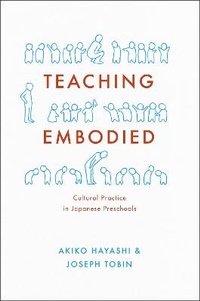
Teaching Embodied
Cultural Practice in Japanese Preschools
Published on 17. July 2015
Book
Paperback/Softback
224 pages
978-0-226-26310-6 (ISBN)
Description
When we look beyond lesson planning and curricula - those explicit facets that comprise so much of our discussion about education - we remember that teaching is an inherently social activity, shaped by a rich array of implicit habits, comportments, and ways of communicating. This is as true in the United States as it is in Japan, where Akiko Hayashi and Joseph Tobin have long studied early education from a cross-cultural perspective. Taking readers inside the classrooms of Japanese preschools, Teaching Embodied explores the everyday, implicit behaviors that form a crucially important - but grossly understudied-aspect of educational practice. Hayashi and Tobin embed themselves in the classrooms of three different teachers at three different schools to examine how teachers act, think, and talk.
Drawing on extended interviews, their own real-time observations, and hours of video footage, they focus on how teachers embody their lessons: how they use their hands to gesture, comfort, or discipline; how they direct their posture, gaze, or physical location to indicate degrees of attention; and how they use the tone of their voice to communicate empathy, frustration, disapproval, or enthusiasm. Comparing teachers across schools and over time, they offer an illuminating analysis of the gestures that comprise a total body language, something that, while hardly ever explicitly discussed, the teachers all share to a remarkable degree. Showcasing the tremendous importance of - and dearth of attention to - this body language, they offer a powerful new inroad into educational study and practice and a deeper understanding of how teaching actually works, no matter what culture or country it is being practiced in.
Drawing on extended interviews, their own real-time observations, and hours of video footage, they focus on how teachers embody their lessons: how they use their hands to gesture, comfort, or discipline; how they direct their posture, gaze, or physical location to indicate degrees of attention; and how they use the tone of their voice to communicate empathy, frustration, disapproval, or enthusiasm. Comparing teachers across schools and over time, they offer an illuminating analysis of the gestures that comprise a total body language, something that, while hardly ever explicitly discussed, the teachers all share to a remarkable degree. Showcasing the tremendous importance of - and dearth of attention to - this body language, they offer a powerful new inroad into educational study and practice and a deeper understanding of how teaching actually works, no matter what culture or country it is being practiced in.
Reviews / Votes
"Teaching Embodied is well written and clear-a delight to read. It does a beautiful job of illustrating, persuasively, culture as tacit, embodied, and intercorporeal." (Kathryn M. Anderson-Levitt, University of California, Los Angeles)More details
Language
English
Place of publication
Chicago
United States
Publishing group
The University of Chicago Press
Target group
Professional and scholarly
College/higher education
Dimensions
Height: 23 mm
Width: 15 mm
Thickness: 1 mm
Weight
312 gr
ISBN-13
978-0-226-26310-6 (9780226263106)
Copyright in bibliographic data and cover images is held by Nielsen Book Services Limited or by the publishers or by their respective licensors: all rights reserved.
Schweitzer Classification
Other editions
Additional editions
E-Book
07/2015
1st Edition
University of Chicago Press
€30.24
Available for download
Persons
Akiko Hayashi is a postdoctoral fellow in education at the University of Georgia. Joseph Tobin is professor of early childhood education at the University of Georgia and the author of several books, including Preschool in Three Cultures Revisited, also published by the University of Chicago Press.