

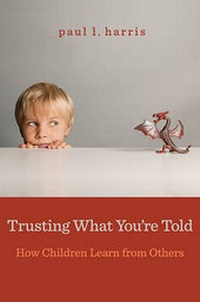
Trusting What You're Told
How Children Learn from Others
Published on 25. May 2012
Book
Hardback
272 pages
978-0-674-06572-7 (ISBN)
Description
If children were little scientists who learn best through firsthand observations and mini-experiments, as conventional wisdom holds, how would a child discover that the earth is round - never mind conceive of heaven as a place someone might go after death? Overturning both cognitive and commonplace theories about how children learn, "Trusting What You're Told" begins by reminding us of a basic truth: Most of what we know we learned from others. Children recognize early on that other people are an excellent source of information. And so they ask questions. But youngsters are also remarkably discriminating as they weigh the responses they elicit. And how much they trust what they are told has a lot to do with their assessment of its source. "Trusting What You're Told" opens a window into the moral reasoning of elementary school vegetarians, the preschooler's ability to distinguish historical narrative from fiction, and the six-year-old's nuanced stance toward magic: skeptical, while still open to miracles.
Paul Harris shares striking cross-cultural findings, too, such as that children in religious communities in rural Central America resemble Bostonian children in being more confident about the existence of germs and oxygen than they are about souls and God. We are biologically designed to learn from one another, Harris demonstrates, and this greediness for explanation marks a key difference between human beings and our primate cousins. Even Kanzi, a genius among bonobos, never uses his keyboard to ask for information: he only asks for treats.
Paul Harris shares striking cross-cultural findings, too, such as that children in religious communities in rural Central America resemble Bostonian children in being more confident about the existence of germs and oxygen than they are about souls and God. We are biologically designed to learn from one another, Harris demonstrates, and this greediness for explanation marks a key difference between human beings and our primate cousins. Even Kanzi, a genius among bonobos, never uses his keyboard to ask for information: he only asks for treats.
Reviews / Votes
In Trusting What You're Told, Harris argues that the longstanding idea that kids should be self-learners who gain knowledge mainly from their own explorations and observations is flawed. In the book's introduction, Harris notes that we adults could barely get through the day without information from other people. It's the same with kids, he says...Harris' book explores lots of interesting ideas, including the impact of a mother's level of education on a child's inquisitiveness and why kids trust what they learn from their parents. -- Julie Rasicot Education Week blog 20120525More details
Language
English
Place of publication
Cambridge, Mass.
United States
Publishing group
Harvard University Press
Target group
Professional and scholarly
US School Grade: College Graduate Student
Product notice
sewn/stitched
Cloth over boards
With printed dust jacket
Illustrations
3 halftones, 3 line illustrations, 19 graphs
Dimensions
Height: 210 mm
Width: 140 mm
Thickness: 15 mm
Weight
666 gr
ISBN-13
978-0-674-06572-7 (9780674065727)
Copyright in bibliographic data and cover images is held by Nielsen Book Services Limited or by the publishers or by their respective licensors: all rights reserved.
Schweitzer Classification
Other editions
Additional editions
E-Book
05/2012
1st Edition
Harvard University Press
€29.69
Available for download
Person
Paul L. Harris is Victor S. Thomas Professor of Education at Harvard University.