

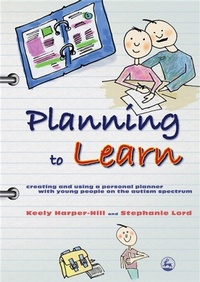
Planning to Learn
Creating and Using a Personal Planner with Young People on the Autism Spectrum
Published on 15. July 2007
Book
Paperback/Softback
144 pages
978-1-84310-561-9 (ISBN)
Description
Late intervention often means that young people on the autism spectrum appear to act on impulse, seem disorganized, or fail to learn from past experiences.
In this practical, effective resource, the authors share tried and tested techniques for creating and using a personal planner to help individuals on the autism spectrum to develop independence.
Planning to Learn is split into three parts. The first part guides adults in helping young people to make sense of the world and to develop and practise coping strategies for any given situation. The authors also explain how simple visual and verbal cues can help people to cope successfully in stressful situations. The second part provides worksheets for the young person to complete to learn how to use plans in different situations, for example staying calm when waiting for a doctor, or coping with a change in the school timetable. Each individual makes a unique planner with procedures to refer to, such as responding to pressure, calming down, being organised, and being around people. The third part includes useful cards, schedules and plans for photocopying and including in the planner.
This illustrated photocopiable workbook is packed with guidance, support and helpful notes for those new to, or experienced in, working with children and young people with ASD. It can be used within educational and community settings or at home.
In this practical, effective resource, the authors share tried and tested techniques for creating and using a personal planner to help individuals on the autism spectrum to develop independence.
Planning to Learn is split into three parts. The first part guides adults in helping young people to make sense of the world and to develop and practise coping strategies for any given situation. The authors also explain how simple visual and verbal cues can help people to cope successfully in stressful situations. The second part provides worksheets for the young person to complete to learn how to use plans in different situations, for example staying calm when waiting for a doctor, or coping with a change in the school timetable. Each individual makes a unique planner with procedures to refer to, such as responding to pressure, calming down, being organised, and being around people. The third part includes useful cards, schedules and plans for photocopying and including in the planner.
This illustrated photocopiable workbook is packed with guidance, support and helpful notes for those new to, or experienced in, working with children and young people with ASD. It can be used within educational and community settings or at home.
Reviews / Votes
This book would be a very useful resource in any learning situation where 1: 1 support is available - in school, college, or at home. The concept is simple and very clearly explained, making it accessible to all staff and parents. -- Naplic This book is likely to be of interest to teachers, support workers and therapists working with young people (secondary aged and above) with autism spectrum disorder in education or community settings. This would be a good resource for settings working with this client group and speech and language therapy departments may wish to have a reference copy. -- Speech & Language Therapy in Practice In this practical, effective resource, the authors use tried and tested techniques for creating and using a personal planner to help individuals on the spectrum to develop independence. -- Autism Us A photocopiable workbook designed to give practical support in domestic, educational or community settings. -- Current Awareness Service All in all it's an excellent resource that can be applied not to just children and young people in the autism spectrum. It's a refreshingly bright learning resource that many children will enjoy using, ultimately promoting self confidence and learning. -- The Encephalitis Society Planning to Learn is aimed at pupils on the autistic spectrum who would benefit from help with organisation and planning. This book would help pupils to arrange their timetable on a daily basis, cope with change during the school day, and give them life skills for the future. -- Special: Supporting and Developing Good PracticeMore details
Language
English
Place of publication
London
United Kingdom
Target group
Professional and scholarly
Product notice
Paperback (UK-trade)
Dimensions
Height: 276 mm
Width: 216 mm
Thickness: 9 mm
Weight
408 gr
ISBN-13
978-1-84310-561-9 (9781843105619)
Copyright in bibliographic data and cover images is held by Nielsen Book Services Limited or by the publishers or by their respective licensors: all rights reserved.
Schweitzer Classification
Other editions
Additional editions
Keely Harper-Hill | Stephanie Lord
Planning to Learn
Creating and Using a Personal Planner with Young People on the Autism Spectrum
E-Book
07/2007
1st Edition
Jessica Kingsley Publishers
€40.09
Available for download
Persons
Keely Harper-Hill has worked with young people with autism since the 1990s. She is an independent Speech and Language Therapist and is currently completing her masters degree in Autism. Keely will move to Brisbane, Australia, in the New Year, to set up in private practice. Stephanie Lord has worked with young people with autism since 1979. She developed the Touch Talks programme for children with autism. Stephanie is Chair of the Association for Heads and teachers of Adults and Children with Autism, as well as representing education on the International Federation of Aromatherapists. She is currently Principal of Heathermount, The Learning Centre.
Content
Introduction. Topic 1: Making a Plan. Topic 2: Plans to Calm. Topic 3: Plans to be Organised. Topic 4: Plans to be with People. Topic 5: Plans to think. Photocopiable Sheets for a Personal Planner. Index.