

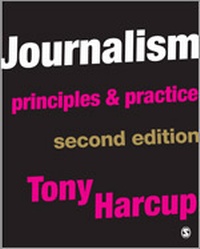
Journalism
Principles and Practice
2nd Edition
Published on 18. March 2009
Book
Hardback
256 pages
978-1-84787-249-4 (ISBN)
Description
"A holistic assessment of what journalism is all about, with plenty of enterprising interpretations of our trade - a word I prefer to 'profession'. I never met a more 'unprofessional' breed than that of my fellow hacks. This book will, I hope, lead our successors both to question and rebel more than we have."
- Jon Snow, Channel 4 News
"Stands out in a crowded field."
The Guardian
"The bible of professional education in journalism... Every student of journalism should buy a copy."
- THE (Times Higher Education)
This is the indispensable guide to the theory and practice of journalism, now updated with 25% entirely new material. With its innovative text design, it creatively combines the experience and advice of practising journalists with the theories and insights from the academic study of journalism.
This second edition thoroughly addresses the 'converged' nature of much 21st century journalism, with discussion and examples of online practice embedded throughout to represent the reality that online journalism is increasingly part of the job for all journalists.
New and improved features include:
More examples, more depth, and more interviews with journalists.
A whole new chapter on telling stories through pictures, whether on TV or online.
Fresh new examples reflecting today's journalistic practice.
More insights from online journalists on blogging, the use of video and audio on the web, interactive maps and other ways of doing journalism online.
This edition embraces the new without abandoning the fundamentals of what journalism is all about. It will continue to inspire students of journalism to reflect on everyday practice and connect it to academic debate.
- Jon Snow, Channel 4 News
"Stands out in a crowded field."
The Guardian
"The bible of professional education in journalism... Every student of journalism should buy a copy."
- THE (Times Higher Education)
This is the indispensable guide to the theory and practice of journalism, now updated with 25% entirely new material. With its innovative text design, it creatively combines the experience and advice of practising journalists with the theories and insights from the academic study of journalism.
This second edition thoroughly addresses the 'converged' nature of much 21st century journalism, with discussion and examples of online practice embedded throughout to represent the reality that online journalism is increasingly part of the job for all journalists.
New and improved features include:
More examples, more depth, and more interviews with journalists.
A whole new chapter on telling stories through pictures, whether on TV or online.
Fresh new examples reflecting today's journalistic practice.
More insights from online journalists on blogging, the use of video and audio on the web, interactive maps and other ways of doing journalism online.
This edition embraces the new without abandoning the fundamentals of what journalism is all about. It will continue to inspire students of journalism to reflect on everyday practice and connect it to academic debate.
Reviews / Votes
A holistic assessment of what journalism is all about, with plenty of enterprising interpretations of our trade - a word I prefer to "profession". I never met a more "unprofessional" breed than that of my fellow hacks. This book will, I hope, lead our successors both to question and rebel more than we haveJon Snow
Channel 4 News
The bible of professional education in journalism, now modernised and expanded in a timely second edition. It incorporates latest developments in multimedia convergence without losing any of the verve and intelligence that characterised the original. This book blends seamlessly the theoretical with the practical and encourages students to perceive the multidimensional challenges inherent in good, responsible reporting. The first edition stood head and shoulders above its competitors and this edition maintains the same high standard. The new section on storytelling through pictures is particularly valuable.... Every student of journalism should buy a copy
THE
(Times Higher Education)
This is a terrific text: original in its blend of theory and practice; always eminently readable; packed with references, anecdotes and ideas - and bang up to date. Above all, Tony Harcup conveys throughout his passion for responsible, reflective journalism. A must for all committed to improving the media
- Professor Richard Keeble
Professor of Journalism, University of Lincoln
Novel, user-friendly layout... exhilarating and inspiring... seldom, if ever, have the practical and the theoretical been so well assimilated
Free Press
This excellent and easy-to-read book will help young journalists understand the real nature of today's media - and their role within in
Jeremy Dear, NUJ, General Secretary
Stands out in a crowded field
The Guardian
Harcup's book is designed to be read, and even enjoyed, by student and professor alike. He clearly takes the view that learning should be fun. That we should do what we can to impart knowledge and understanding and provide the tools for future development in a way that makes the students realise that it is important to be able develop professional skills and understanding; that this is just the first step on a long road to professional excellence and that they should learn to enjoy the journey. Harcup's light, bright style emphasises his journalistic background and years of experience both in the quality of the writing and in the quality of the advice
Professor Chris Frost
Ethical Space
What this book continues to do very successfully is to engage in meaningful dialogue with professionals who are already well-versed in the realities of the industry, and it is thus essential reading for any journalism graduate who is about to enter the profession. For researchers in communications and linguistics who want to gain a better understanding of the intricacies of news media production, there is no better place to start than with this volume
Helen Caple
Discourse & Communication
More details
Edition
2nd Revised edition
Language
English
Place of publication
London
United Kingdom
Target group
College/higher education
Edition type
Revised edition
Dimensions
Height: 232 mm
Width: 186 mm
Weight
620 gr
ISBN-13
978-1-84787-249-4 (9781847872494)
Copyright in bibliographic data and cover images is held by Nielsen Book Services Limited or by the publishers or by their respective licensors: all rights reserved.
Schweitzer Classification
Other editions
New editions
Book
04/2015
3rd Edition
SAGE Publications Ltd
€172.61
Article exhausted; check for reprint
Previous edition
Book
12/2003
1st Edition
SAGE Publications Inc
€106.80
Article exhausted; check for reprint
Person
Tony Harcup is an Emeritus Fellow of the University of Sheffield whose writing about journalism can be found on reading lists around the world and has been translated into Chinese, Korean and Polish, among other languages.
Before moving into journalism education, Tony spent many years working as a staff and freelance journalist on alternative and mainstream media ranging from small local weekly publications to national newspapers, magazines and websites.
He has researched extensively in the fields of news values, journalistic ethics, alternative journalism and journalism education. His best-selling book Journalism: Principles and Practice (Sage, 2021) is now in its fourth edition, and his other titles include The Ethical Journalist (Sage, 2007) and What's the Point of News? (Palgrave, 2020).
Before moving into journalism education, Tony spent many years working as a staff and freelance journalist on alternative and mainstream media ranging from small local weekly publications to national newspapers, magazines and websites.
He has researched extensively in the fields of news values, journalistic ethics, alternative journalism and journalism education. His best-selling book Journalism: Principles and Practice (Sage, 2021) is now in its fourth edition, and his other titles include The Ethical Journalist (Sage, 2007) and What's the Point of News? (Palgrave, 2020).
Content
Who, What, Where, When, Why and How? An Introduction to Journalism
Constraints and Influences on Journalists
What Is News?
Where Does News Come From?
The Journalist as Objective Reporter
The Journalist as Investigator
The Journalist as Entertainer
Interviewing
Writing News
Writing Features
Telling It in Pictures
Style for Journalists
Conclusion: The Challenge for Journalism
Appendix: NUJ Code of Conduct
Constraints and Influences on Journalists
What Is News?
Where Does News Come From?
The Journalist as Objective Reporter
The Journalist as Investigator
The Journalist as Entertainer
Interviewing
Writing News
Writing Features
Telling It in Pictures
Style for Journalists
Conclusion: The Challenge for Journalism
Appendix: NUJ Code of Conduct