

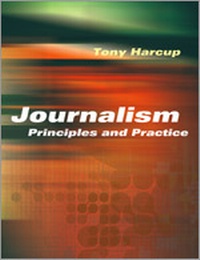
Journalism
Principles and Practice
1st Edition
Published on 3. December 2003
Book
Hardback
179 pages
978-0-7619-7498-7 (ISBN)
Description
`Will prove extremely relevant and popular on courses where students are pursuing Media and Journalism degrees' - Granville Williams, Huddersfield University
`Journalism: Principles and Practice is essential reading for students, teachers and journalists. It seems destined to become a classic text of journalism education' - Professor Bob Franklin, Cardiff University
'Journalism: Principles and Practice combines practical advice with critical reflection and draws on Tony's 20 years' experience as a journalist. It explains how to "do journalism", how to be a journalist and how to relate all the well-intentioned theory about the profession to doing the real job in the real world' - Hold the Front Page
`Novel, user-friendly layout... exhilarating and inspiring... seldom, if ever, have the practical and the theoretical been so well assimilated' - Free Press
`This excellent and easy-to-read book will help young journalists understand the real nature of today's media - and their role within in' - Jeremy Dear, NUJ, General Secretary
Offering a wide-ranging introduction to journalism and combining the experience and advice of practising journalists with insights gained by the academic study of journalism, Journalism: Principles and Practice:
- relates theory to practice throughout
- spans print, broadcasting and online journalism
- includes sections on news, features, sources, interviewing, and ethics
- includes a Style Guide for Journalists and a list of useful websites
In addition to explaining `how to do' journalism, each chapter introduces a range of more theoretical concepts designed to encourage reflective practice. However, it also uses the perspective of practitioners to question media theory.
`Journalism: Principles and Practice is essential reading for students, teachers and journalists. It seems destined to become a classic text of journalism education' - Professor Bob Franklin, Cardiff University
'Journalism: Principles and Practice combines practical advice with critical reflection and draws on Tony's 20 years' experience as a journalist. It explains how to "do journalism", how to be a journalist and how to relate all the well-intentioned theory about the profession to doing the real job in the real world' - Hold the Front Page
`Novel, user-friendly layout... exhilarating and inspiring... seldom, if ever, have the practical and the theoretical been so well assimilated' - Free Press
`This excellent and easy-to-read book will help young journalists understand the real nature of today's media - and their role within in' - Jeremy Dear, NUJ, General Secretary
Offering a wide-ranging introduction to journalism and combining the experience and advice of practising journalists with insights gained by the academic study of journalism, Journalism: Principles and Practice:
- relates theory to practice throughout
- spans print, broadcasting and online journalism
- includes sections on news, features, sources, interviewing, and ethics
- includes a Style Guide for Journalists and a list of useful websites
In addition to explaining `how to do' journalism, each chapter introduces a range of more theoretical concepts designed to encourage reflective practice. However, it also uses the perspective of practitioners to question media theory.
Reviews / Votes
`Will prove extremely relevant and popular on courses where students are pursuing Media and Journalism degrees' - Granville Williams, Huddersfield University`Journalism: Principles and Practice is essential reading for students, teachers and journalists. It seems destined to become a classic text of journalism education' - Professor Bob Franklin, University of Sheffield
`This excellent and easy-to-read book will help young journalists understand the real nature of today's media - and their role within in' - Jeremy Dear, NUJ, General Secretary
More details
Edition
First Edition
Language
English
Place of publication
Thousand Oaks
United States
Target group
College/higher education
Product notice
Cloth over boards
Dimensions
Height: 246 mm
Width: 189 mm
Weight
600 gr
ISBN-13
978-0-7619-7498-7 (9780761974987)
Copyright in bibliographic data and cover images is held by Nielsen Book Services Limited or by the publishers or by their respective licensors: all rights reserved.
Schweitzer Classification
Other editions
New editions
Book
03/2009
2nd Edition
SAGE Publications Ltd
€123.50
Article exhausted; check for reprint
Person
Tony Harcup is an Emeritus Fellow of the University of Sheffield whose writing about journalism can be found on reading lists around the world and has been translated into Chinese, Korean and Polish, among other languages.
Before moving into journalism education, Tony spent many years working as a staff and freelance journalist on alternative and mainstream media ranging from small local weekly publications to national newspapers, magazines and websites.
He has researched extensively in the fields of news values, journalistic ethics, alternative journalism and journalism education. His best-selling book Journalism: Principles and Practice (Sage, 2021) is now in its fourth edition, and his other titles include The Ethical Journalist (Sage, 2007) and What's the Point of News? (Palgrave, 2020).
Before moving into journalism education, Tony spent many years working as a staff and freelance journalist on alternative and mainstream media ranging from small local weekly publications to national newspapers, magazines and websites.
He has researched extensively in the fields of news values, journalistic ethics, alternative journalism and journalism education. His best-selling book Journalism: Principles and Practice (Sage, 2021) is now in its fourth edition, and his other titles include The Ethical Journalist (Sage, 2007) and What's the Point of News? (Palgrave, 2020).
Content
Who, What, Where, When, Why and How? An Introduction to Journalism
Constraints and Influences on Journalists
What is News?
Where Does News Come From?
The Journalist as Objective Reporter
The Journalist as Investigator
The Journalist as Entertainer
Interviewing
Writing News
Writing Features
Style for Journalists
Beyond Print
Broadcasting and Online Journalism
Conclusion
The Challenge for Journalism
Constraints and Influences on Journalists
What is News?
Where Does News Come From?
The Journalist as Objective Reporter
The Journalist as Investigator
The Journalist as Entertainer
Interviewing
Writing News
Writing Features
Style for Journalists
Beyond Print
Broadcasting and Online Journalism
Conclusion
The Challenge for Journalism