

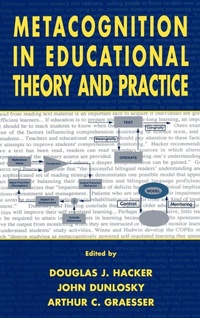
Metacognition in Educational Theory and Practice
Published on 1. March 1998
Book
Hardback
422 pages
978-0-8058-2481-0 (ISBN)
Description
This volume presents the most current perspectives on the role of metacognition in diverse educationally relevant domains. The purpose is to examine the ways in which theoretical investigations of metacognition have recently produced a strong focus on educational practice.
The book is organized around four general themes relevant to education: metacognition and problem solving, metacognition and verbal comprehension, metacognition and the education of nontraditional populations, and metacognition and studentship. Chapter authors review current literature as it applies to their chapter topic; discuss theoretical implications and suggestions for future research; and provide educational applications. Each chapter describes testable theory and provides examples of how theory can be applied to the classroom. The volume will have wide appeal to researchers and students concerned with the scientific investigation of metacognition, and to practitioners concerned with the cultivation of learning and achievement in their students.
The unique contribution of this book to the literature on metacognition is its presentation of the most current research examining specific theoretical aspects of metacognition in domains directly relevant to education. This is especially valuable for the many researchers and practitioners who subscribe to the concept that by fostering metacognitive processes during instruction, more durable and transferable learning can be achieved.
The book is organized around four general themes relevant to education: metacognition and problem solving, metacognition and verbal comprehension, metacognition and the education of nontraditional populations, and metacognition and studentship. Chapter authors review current literature as it applies to their chapter topic; discuss theoretical implications and suggestions for future research; and provide educational applications. Each chapter describes testable theory and provides examples of how theory can be applied to the classroom. The volume will have wide appeal to researchers and students concerned with the scientific investigation of metacognition, and to practitioners concerned with the cultivation of learning and achievement in their students.
The unique contribution of this book to the literature on metacognition is its presentation of the most current research examining specific theoretical aspects of metacognition in domains directly relevant to education. This is especially valuable for the many researchers and practitioners who subscribe to the concept that by fostering metacognitive processes during instruction, more durable and transferable learning can be achieved.
More details
Series
Language
English
Place of publication
New York
United States
Publishing group
Taylor & Francis Inc
Target group
College/higher education
Professional and scholarly
Dimensions
Height: 235 mm
Width: 157 mm
Thickness: 29 mm
Weight
832 gr
ISBN-13
978-0-8058-2481-0 (9780805824810)
Copyright in bibliographic data and cover images is held by Nielsen Book Services Limited or by the publishers or by their respective licensors: all rights reserved.
Schweitzer Classification
Other editions
Additional editions
Douglas J. Hacker | John Dunlosky | Arthur C. Graesser
Metacognition in Educational Theory and Practice
E-Book
04/1998
1st Edition
Routledge
€94.19
Available for download
Douglas J. Hacker | John Dunlosky | Arthur C. Graesser
Metacognition in Educational Theory and Practice
E-Book
03/1998
1st Edition
Routledge
€101.99
Available for download
Douglas J. Hacker | John Dunlosky | Arthur C. Graesser
Metacognition in Educational Theory and Practice
E-Book
03/1998
1st Edition
Routledge
€101.99
Available for download
Douglas J. Hacker | John Dunlosky | Arthur C. Graesser
Metacognition in Educational Theory and Practice
Book
03/1998
Routledge
€110.10
Shipment within 10-20 days
Persons
Douglas J. Hacker, John Dunlosky, Arthur C. Graesser
Content
Contents: T.O. Nelson, Metacognitive Food for Thought in Educational Theory and Practice. Preface. D.J. Hacker, Definitions and Empirical Foundations. R.L. Dominowski, Verbalization and Problem Solving. J.E. Davidson, R.J. Sternberg, Smart Problem Solving: How Metacognition Helps. M. Carr, B. Biddlecomb, Metacognition in Mathematics From a Constructivist Perspective. B.M. Sitko, Knowing How to Write: Metacognition and Writing Instruction. R.H. Maki, Test Predictions Over Text Material. J. Otero, Influence of Knowledge Activation and Context on Comprehension Monitoring of Science Texts. D.J. Hacker, Self-Regulated Comprehension During Normal Reading. G.E. Garcia, R.T. Jimenez, P.D. Pearson, Metacognition, Childhood Bilingualism, and Reading. S.M. McGlynn, Impaired Awareness of Deficits in a Psychiatric Context: Implications of Rehabilitation. J. Dunlosky, C. Hertzog, Training Programs to Improve Learning in Later Adulthood: Helping Older Adults Educate Themselves. P.H. Winne, A.F. Hadwin, Studying as Self-Regulated Learning. N.J. Vye, D.L. Schwartz, J.D. Bransford, B.J. Barron, L. Zech, The Cognition and Technology Group at Vanderbilt, SMART Environments That Support Monitoring, Reflection, and Revision. M. Pressley, S. Van Etten, L. Yokoi, G. Freebern, P. Van Meter, The Metacognition of College Studentship: A Grounded Theory Approach. J. Dunlosky, Epilogue. Linking Metacognitive Theory to Education.