

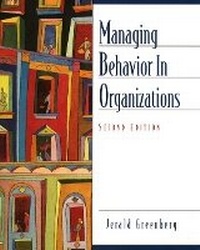
Managing Behavior in Organizations
2nd Edition
Published on 10. November 1998
Book
Paperback/Softback
400 pages
978-0-13-922790-5 (ISBN)
Description
This concise Organizational Behavior text covers all of the key topics in just 13 chapters, providing a succinct guide-about 400 pages shorter than comprehensive texts-to understanding organizational behavior, its current theories and their value to modern organizational practices. It also offers self-assessments and individual and group exercises to help students put concepts into practice.
More details
Edition
2nd edition
Language
English
Place of publication
United States
Publishing group
Pearson Education (US)
Target group
Professional and scholarly
Dimensions
Height: 235 mm
Width: 190 mm
Thickness: 15 mm
Weight
610 gr
ISBN-13
978-0-13-922790-5 (9780139227905)
Copyright in bibliographic data and cover images is held by Nielsen Book Services Limited or by the publishers or by their respective licensors: all rights reserved.
Schweitzer Classification
Other editions
New editions

Jerald Greenberg
Managing Behavior in Organizations
Book
07/2001
3rd Edition
Pearson
€53.22
Article exhausted; check for reprint
Previous edition

Jerald Greenberg
Managing Behavior in Organizations
Book
01/1996
2nd Edition
Pearson Education (US)
€52.18
Article exhausted; check for reprint
Content
1. What is Organizational Behavior and How Do We Learn About It?
2. Basic Psychology in Organizations: Social Perception, Learning, and Personality.
3. What Motivates People to Work?
4. Work-Related Attitudes: Feelings About Our Jobs, Organizations, and Co-Workers.
5. Joining Up and Fitting In: Socialization, Culture, and Career Development.
6. Organizational Communication and Power.
7. Groups and Teams in Organizations.
8. The Quest for Leadership.
9. Prosocial Behavior, Cooperation, Conflict, and Stress.
10. Making Decisions in Organizations.
11. Culture, Creativity, and Innovation.
12. Designing Effective Organizations.
13 Technology in Organizations.
14. Managing Organizational Change and Development.
Index.
2. Basic Psychology in Organizations: Social Perception, Learning, and Personality.
3. What Motivates People to Work?
4. Work-Related Attitudes: Feelings About Our Jobs, Organizations, and Co-Workers.
5. Joining Up and Fitting In: Socialization, Culture, and Career Development.
6. Organizational Communication and Power.
7. Groups and Teams in Organizations.
8. The Quest for Leadership.
9. Prosocial Behavior, Cooperation, Conflict, and Stress.
10. Making Decisions in Organizations.
11. Culture, Creativity, and Innovation.
12. Designing Effective Organizations.
13 Technology in Organizations.
14. Managing Organizational Change and Development.
Index.