

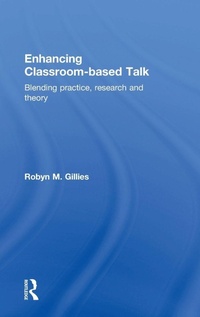
Enhancing Classroom-based Talk
Blending practice, research and theory
1st Edition
Published on 15. December 2015
Book
Hardback
152 pages
978-1-138-81828-6 (ISBN)
Description
Enhancing Classroom-based Talk provides an overview of the major research and theoretical perspectives that underpin the development of classroom-based talk. It outlines specific dialogic strategies and elaborates on the key role that teachers play in promoting interactions, challenging thinking and scaffolding the learning of students.
While it is important to know how different dialogic approaches can enhance students' interactions and learning and the effects they have on students' social, emotional and cognitive development, it is also important to understand how students' interactions promote understanding and learning during small group discussions. Throughout the book, teachers will be shown how to embed different dialogic approaches in their classrooms to promote discourse, with chapters covering:
Interest in classroom-based talk
The teacher's role in promoting dialogue in the classroom
Dialogic approaches to teaching
Strategies to promote students' interactions, thinking and learning
Help seeking and help giving behaviours
Creating environments that promote classroom-based talk
Enhancing Classroom-based Talk will be a valuable asset to all those concerned with promoting classroom-based talk, as well as postgraduate students, teachers and academics who are regularly called upon to assist in developing classroom interventions that provide for the academic and social needs of students.
While it is important to know how different dialogic approaches can enhance students' interactions and learning and the effects they have on students' social, emotional and cognitive development, it is also important to understand how students' interactions promote understanding and learning during small group discussions. Throughout the book, teachers will be shown how to embed different dialogic approaches in their classrooms to promote discourse, with chapters covering:
Interest in classroom-based talk
The teacher's role in promoting dialogue in the classroom
Dialogic approaches to teaching
Strategies to promote students' interactions, thinking and learning
Help seeking and help giving behaviours
Creating environments that promote classroom-based talk
Enhancing Classroom-based Talk will be a valuable asset to all those concerned with promoting classroom-based talk, as well as postgraduate students, teachers and academics who are regularly called upon to assist in developing classroom interventions that provide for the academic and social needs of students.
Reviews / Votes
"Enhancing Classroom-based Talk will be a valuable asset to all those concerned with promoting classroom-based talk, as well as postgraduate students, teachers and academics who are regularly called upon to assist in developing classroom interventions that provide for the academic and social needs of students." - Sarah Brew, Parents in TouchMore details
Language
English
Place of publication
London
United Kingdom
Publishing group
Taylor & Francis Ltd
Target group
College/higher education
Professional and scholarly
Illustrations
3 s/w Tabellen
3 Tables, black and white
Dimensions
Height: 240 mm
Width: 161 mm
Thickness: 13 mm
Weight
411 gr
ISBN-13
978-1-138-81828-6 (9781138818286)
Copyright in bibliographic data and cover images is held by Nielsen Book Services Limited or by the publishers or by their respective licensors: all rights reserved.
Schweitzer Classification
Other editions
Additional editions
E-Book
12/2015
Routledge
€65.99
Available for download
E-Book
12/2015
Routledge
€65.99
Available for download
Book
12/2015
1st Edition
Routledge
€72.20
Shipment within 10-20 days
Person
Robyn M. Gillies is Professor of Education at The University of Queensland, Australia. She has worked extensively in primary and secondary schools to help teachers embed student-centred pedagogical practices into their classroom curricula, promoting student engagement, problem-solving and learning.
Content
Introduction Section 1 1. Outdoor exploration starts with the adults 2. Supporting and observing children's outdoor explorations 3. Setting up your site Section 2 4. Autumn - Winter Term (September - December) 5. Winter - Spring Term (January - April) 6. Spring - Summer Term (April - July) Section 3 Bibliography Contacts and resources Index