

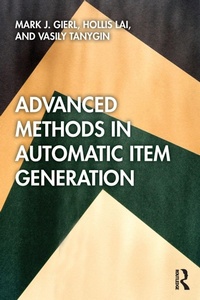
Advanced Methods in Automatic Item Generation
1st Edition
Published on 19. May 2021
Book
Paperback/Softback
246 pages
978-0-367-45832-4 (ISBN)
Description
Advanced Methods in Automatic Item Generation is an up-to-date survey of the growing research on automatic item generation (AIG) in today's technology-enhanced educational measurement sector. As test administration procedures increasingly integrate digital media and Internet use, assessment stakeholders-from graduate students to scholars to industry professionals-have numerous opportunities to study and create different types of tests and test items. This comprehensive analysis offers thorough coverage of the theoretical foundations and concepts that define AIG, as well as the practical considerations required to produce and apply large numbers of useful test items.
More details
Language
English
Place of publication
London
United Kingdom
Publishing group
Taylor & Francis Ltd
Target group
College/higher education
Professional and scholarly
Postgraduate and Professional
Illustrations
32 s/w Tabellen, 26 s/w Abbildungen, 26 s/w Zeichnungen
32 Tables, black and white; 26 Line drawings, black and white; 26 Illustrations, black and white
Dimensions
Height: 229 mm
Width: 152 mm
Thickness: 14 mm
Weight
365 gr
ISBN-13
978-0-367-45832-4 (9780367458324)
Copyright in bibliographic data and cover images is held by Nielsen Book Services Limited or by the publishers or by their respective licensors: all rights reserved.
Schweitzer Classification
Other editions
Additional editions
Mark J. Gierl | Hollis Lai | Vasily Tanygin
Advanced Methods in Automatic Item Generation
Book
05/2021
1st Edition
Routledge
€206.40
Shipment within 15-20 days
Mark J. Gierl | Hollis Lai | Vasily Tanygin
Advanced Methods in Automatic Item Generation
E-Book
05/2021
1st Edition
Routledge
€55.49
Available for download
Mark J. Gierl | Hollis Lai | Vasily Tanygin
Advanced Methods in Automatic Item Generation
E-Book
05/2021
1st Edition
Routledge
€55.49
Available for download
Persons
Mark J. Gierl is Professor of Educational Psychology at the University of Alberta, Canada. He holds the Tier 1 Canada Research Chair in Educational Measurement.
Hollis Lai is Associate Professor of Dentistry in the Faculty of Medicine and Dentistry at the University of Alberta, Canada.
Vasily Tanygin is a full-stack software developer who has over a decade of experience creating automatic item generation and educational assessment technologies. He graduated with a specialist degree in software systems development from Mari State Technical University, Russia.
Hollis Lai is Associate Professor of Dentistry in the Faculty of Medicine and Dentistry at the University of Alberta, Canada.
Vasily Tanygin is a full-stack software developer who has over a decade of experience creating automatic item generation and educational assessment technologies. He graduated with a specialist degree in software systems development from Mari State Technical University, Russia.
Content
Preface
Chapter 1. Introduction: The Changing Context of Educational Testing
Section 1: Basic Concepts Required for Generating Constructed- and Selected-Response Items
Chapter 2. Cognitive Model Development: Cognitive Models and Item Generation
Chapter 3. Item Model Development: Template-Based AIG Using Item Modelling
Chapter 4. Item Generation: Three General Approaches for Generating Test Items
Chapter 5. Distractor Generation: The Importance of the Selected-Response Item in Educational Testing
Chapter 6. Putting It All Together to Generate Test Items: Overview
Chapter 7. Methods for Validating Generated Items: A Focus on Model-Level Outcomes
Section 2: Advanced Topics in AID
Chapter 8. Content Coding: Challenges Inherent to Managing Generated Items in a Bank
Chapter 9. Generating Alternative Item Types Using Auxiliary Information: Expanding the Expression of Generated Items
Chapter 10. Rationale Generation: Creating Rationales as Part of the Generation Process
Chapter 11. Multilingual Item Generation: Beyond Monolingual Item Development
Chapter 12. Conclusions and Future Directions
Chapter 1. Introduction: The Changing Context of Educational Testing
Section 1: Basic Concepts Required for Generating Constructed- and Selected-Response Items
Chapter 2. Cognitive Model Development: Cognitive Models and Item Generation
Chapter 3. Item Model Development: Template-Based AIG Using Item Modelling
Chapter 4. Item Generation: Three General Approaches for Generating Test Items
Chapter 5. Distractor Generation: The Importance of the Selected-Response Item in Educational Testing
Chapter 6. Putting It All Together to Generate Test Items: Overview
Chapter 7. Methods for Validating Generated Items: A Focus on Model-Level Outcomes
Section 2: Advanced Topics in AID
Chapter 8. Content Coding: Challenges Inherent to Managing Generated Items in a Bank
Chapter 9. Generating Alternative Item Types Using Auxiliary Information: Expanding the Expression of Generated Items
Chapter 10. Rationale Generation: Creating Rationales as Part of the Generation Process
Chapter 11. Multilingual Item Generation: Beyond Monolingual Item Development
Chapter 12. Conclusions and Future Directions