

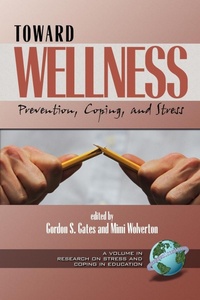
Toward Wellness
Prevention, Coping and Stress
Will be published approx. on 1. January 2002
Book
Paperback/Softback
204 pages
978-1-931576-34-5 (ISBN)
Description
This series of Works on stress and coping is centered on understanding the sources, experiences, and consequences of stress and coping in the educational arena. In formal organizations to informal experiences, those engaged in educational endeavors shape and are shaped by events and interactions that invoke salient to subtle stress and coping responses. We invite authors to submit manuscripts that present studies focused on stress and/or coping in any of the contexts, positions, peoples, and activities encompassed under the umbrella of education. Research using either qualitative or quantitative methodologies will be acceptable. The series is expected to appeal to a broad readership of scholars in the fields of education, psychology, sociology, and business who are interested in understanding the nature of stress and coping in education.
More details
Series
Language
English
Place of publication
Charlotte
United States
Publishing group
Emerald Publishing Inc
Target group
College/higher education
Professional and scholarly
Illustrations
Illustrations
Dimensions
Height: 234 mm
Width: 156 mm
Thickness: 11 mm
Weight
319 gr
ISBN-13
978-1-931576-34-5 (9781931576345)
Copyright in bibliographic data and cover images is held by Nielsen Book Services Limited or by the publishers or by their respective licensors: all rights reserved.
Schweitzer Classification
Other editions
Additional editions
E-Book
01/2003
1st Edition
Information Age Publishing
from
€62.33
Available for download
Content
Introduction; Gordon S. Gates and Mimi Wolverton.
Chapter 1. Factor Structure of the Preventive Resources Inventory and Its Relationship to Existing Measures of Stress and Coping; Christopher J. McCarthy, Richard G. Lambert, Michelle Beard and Anna Dematatis.
Chapter 2. Unraveling the Mental Representation Students Make of Stressful Events; Monique Boekaerts.
Chapter 3. Assessing Coping of School-Aged Youth: Validation of the Coping Resources Inventory Scales for Educational Enhancement; William L. Curlette, Kenneth B. Matheny, Christopher J. McCarthy, and Anne E. Seraphine.
Chapter 4. Predictors of Study Coping and Examination-Taking Coping Strategies among Graduate Students; Anthony J. Onwuegbuzie and Kathleen M.T. Collins.
Chapter 5. The Interconnections between Job Satisfaction and Work-Related Stress in Academic Deans; Mimi Wolverton, Marvin L. Wolverton, and Walter H. Gmelch.
Chapter 6. A Study of Texas School Board President Stress: Struggling with Duties of the Presidency; Gordon S. Gates and Gwyn A. Boyter.
Chapter 7. A Comparison of Burnout between General and Special Education Teachers; Alan R. Shoho.
Chapter 8. Burnout among Special Educators: A Meta-Analysis; Stacey Edmonson and David Thompson.
Chapter 1. Factor Structure of the Preventive Resources Inventory and Its Relationship to Existing Measures of Stress and Coping; Christopher J. McCarthy, Richard G. Lambert, Michelle Beard and Anna Dematatis.
Chapter 2. Unraveling the Mental Representation Students Make of Stressful Events; Monique Boekaerts.
Chapter 3. Assessing Coping of School-Aged Youth: Validation of the Coping Resources Inventory Scales for Educational Enhancement; William L. Curlette, Kenneth B. Matheny, Christopher J. McCarthy, and Anne E. Seraphine.
Chapter 4. Predictors of Study Coping and Examination-Taking Coping Strategies among Graduate Students; Anthony J. Onwuegbuzie and Kathleen M.T. Collins.
Chapter 5. The Interconnections between Job Satisfaction and Work-Related Stress in Academic Deans; Mimi Wolverton, Marvin L. Wolverton, and Walter H. Gmelch.
Chapter 6. A Study of Texas School Board President Stress: Struggling with Duties of the Presidency; Gordon S. Gates and Gwyn A. Boyter.
Chapter 7. A Comparison of Burnout between General and Special Education Teachers; Alan R. Shoho.
Chapter 8. Burnout among Special Educators: A Meta-Analysis; Stacey Edmonson and David Thompson.