

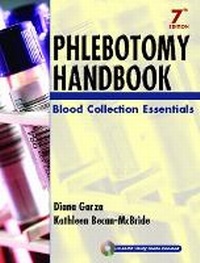
Phlebotomy Handbook
Blood Collection Essentials
7th Edition
Published on 2. September 2004
Book
Paperback/Softback
592 pages
978-0-13-113334-1 (ISBN)
Description
For Phlebotomy, Introduction to Clinical Laboratory Science, Medical Assisting, and Nursing courses.
Now in full-color with a landmark CD-ROM, this is the most timely, comprehensive market-leading source of blood and specimen collection information available on the worldwide market. It provides today's health care students with the latest safety guidelines; condensed information about new federal regulations; updates on equipment and supplies; new NCCLS standards and hazard prevention techniques; competencies important in the workplace; strategies for the certification process and securing a job; and extensive coverage on transcultural communication skills for all ages. Aside from its updated technical and procedural information, this edition is easy-to-read in a step-by-step format.
Now in full-color with a landmark CD-ROM, this is the most timely, comprehensive market-leading source of blood and specimen collection information available on the worldwide market. It provides today's health care students with the latest safety guidelines; condensed information about new federal regulations; updates on equipment and supplies; new NCCLS standards and hazard prevention techniques; competencies important in the workplace; strategies for the certification process and securing a job; and extensive coverage on transcultural communication skills for all ages. Aside from its updated technical and procedural information, this edition is easy-to-read in a step-by-step format.
More details
Edition
7th edition
Language
English
Place of publication
United States
Publishing group
Pearson Education (US)
Target group
Professional and scholarly
Dimensions
Width: 231 mm
Thickness: 24 mm
Weight
864 gr
ISBN-13
978-0-13-113334-1 (9780131133341)
Copyright in bibliographic data and cover images is held by Nielsen Book Services Limited or by the publishers or by their respective licensors: all rights reserved.
Schweitzer Classification
Other editions
New editions
Diana Garza | Kathleen Becan-McBride
Phlebotomy Handbook
Blood Specimen Collection from Basic to Advanced
Book
05/2009
8th Edition
Pearson
€71.64
Article exhausted; check for reprint
Previous edition
Book
05/2002
6th Edition
Pearson
€35.89
Article exhausted; check for reprint
Content
I. OVERVIEW.
1. Phlebotomy Practice and Quality Essentials.
2. Ethical, Legal, and Regulatory Issues.
3. Basic Anatomy and Physiology of Organ Systems.
4. The Circulatory System.
II. SAFETY PROCEDURES AND EQUIPMENT.
5. Infection Control.
6. Safety and First Aid.
7. Specimen Documentation, Specimen Handling, and Transportation.
8. Blood Collection Equipment.
III. PHLEBOTOMY PROCEDURES.
9. Venipuncture Procedures.
10. Procedures for Collecting Capillary Blood Specimens.
11. Preanalytical Complications in Blood Collections.
IV. SPECIAL PROCEDURES AND POINT OF CARE TESTING.
12. Pediatric Procedures.
13. Arterial, Intravenous (IV), and Special Collection Procedures.
14. Elderly, Home, and Long-term Care Collections.
15. Urinalysis and, Body Fluids, and Other Specimens Collections.
16. Forensic Toxicology, Workplace Testing, Sports Medicine, and Related Areas.
APPENDICES.
Finding a Job.
The Basics of Vital Signs.
CDC Recommendations for Hand-Hygiene In Health Care Including Antimicrobial Spectrum and Characteristics of Hand-Hygiene Antiseptic Agents.
Sample Procedure for Performance of a Routine Venipuncture.
Laboratory Assays and the Required Types of Anticoagulants.
Maximum Amounts of Blood to be Drawn from Patients Younger Than 14 Years.
OSHA Labeling Requirements.
Whole Blood or Aperesis Donation Procedure.
Units of Measurement and Symbols.
Formulas and Calculations.
Military Time (24-hour clock).
Basic Spanish for Specimen Collection Procedures.
Answers to Self Study Questions and Cases.
Glossary.
1. Phlebotomy Practice and Quality Essentials.
2. Ethical, Legal, and Regulatory Issues.
3. Basic Anatomy and Physiology of Organ Systems.
4. The Circulatory System.
II. SAFETY PROCEDURES AND EQUIPMENT.
5. Infection Control.
6. Safety and First Aid.
7. Specimen Documentation, Specimen Handling, and Transportation.
8. Blood Collection Equipment.
III. PHLEBOTOMY PROCEDURES.
9. Venipuncture Procedures.
10. Procedures for Collecting Capillary Blood Specimens.
11. Preanalytical Complications in Blood Collections.
IV. SPECIAL PROCEDURES AND POINT OF CARE TESTING.
12. Pediatric Procedures.
13. Arterial, Intravenous (IV), and Special Collection Procedures.
14. Elderly, Home, and Long-term Care Collections.
15. Urinalysis and, Body Fluids, and Other Specimens Collections.
16. Forensic Toxicology, Workplace Testing, Sports Medicine, and Related Areas.
APPENDICES.
Finding a Job.
The Basics of Vital Signs.
CDC Recommendations for Hand-Hygiene In Health Care Including Antimicrobial Spectrum and Characteristics of Hand-Hygiene Antiseptic Agents.
Sample Procedure for Performance of a Routine Venipuncture.
Laboratory Assays and the Required Types of Anticoagulants.
Maximum Amounts of Blood to be Drawn from Patients Younger Than 14 Years.
OSHA Labeling Requirements.
Whole Blood or Aperesis Donation Procedure.
Units of Measurement and Symbols.
Formulas and Calculations.
Military Time (24-hour clock).
Basic Spanish for Specimen Collection Procedures.
Answers to Self Study Questions and Cases.
Glossary.