

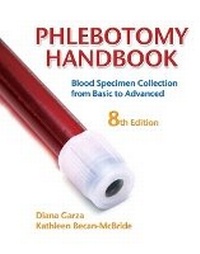
Phlebotomy Handbook
Blood Specimen Collection from Basic to Advanced
8th Edition
Published on 29. May 2009
Book
Paperback/Softback
696 pages
978-0-13-513424-5 (ISBN)
Description
Phlebotomy Handbook: Blood Specimen Collection from Basic to Advanced is a comprehensive book covering blood and specimen collection. It provides today's health care professionals with the latest safety guidelines; condensed information about new federal regulations; updates on equipment and supplies; new NCCLS standards and hazard prevention techniques; competencies important in the workplace; strategies for the certification process and securing a job; and extensive coverage on transcultural communication skills for all ages. Aside from its updated technical and procedural information, this edition is easy-to-read in a step-by-step format. New features to this edition are: Action and Practice presents an additional case study with questions to test your critical thinking skills; Check Yourself presents a brief description of a procedure to be performed along with questions to test your knowledge of the requirements and steps to perform to complete the procedure; and Competency Checklists provide a list of competencies you should master relevant to the chapter content and NAACLS competencies.
More details
Other editions
New editions
Diana Garza | Kathleen Becan-McBride
Phlebotomy Handbook Plus NEW MyLab Health Professions with Pearson eText -- Access Card Package
Book
09/2015
9th Edition
Prentice Hall
€127.98
Article is exhausted; no reprint
Diana Garza | Kathleen Becan-McBride
Phlebotomy Handbook
Book
08/2014
9th Edition
Pearson
€90.36
Article exhausted; check for reprint
Previous edition
Book
09/2004
7th Edition
Pearson
€49.51
Article exhausted; check for reprint
Persons
Diana Garza received her Bachelor of Science degree in Biology from Vanderbilt University in Nashville, TN, followed by an additional year to complete her Medical Technology requirements at Vanderbilt University Medical Center. Her interest in laboratory sciences and in teaching led her to earn a Masters in Science Education at the Peabody School of Vanderbilt University. She worked at Vanderbilt Medical Center in the Microbiology Department while a graduate student. A move back to her home state of Texas led her to a collaborative graduate program with Baylor College of Medicine at the University of Houston, and resulted in her Doctorate of Education in Allied Health Education and Administration, all the while she worked in the Microbiology Laboratory at the University of Texas M.D. Anderson Cancer Center (MDACC). Her laboratory and teaching experience continued at the University of Texas Health Science Center at Houston and for many years at MDACC, where she later became the Administrative Director of the Division of Laboratory Medicine. While in Houston, Drs Garza and Becan-McBride were involved in numerous courses for technologists, nurses, and physicians to teach phlebotomy techniques. As young faculty members, they began to develop curriculum materials for their own use and in 1984, collaborated in publishing one of the first comprehensive textbooks focused solely on phlebotomy pracitices. Their successful coauthoring partnership has endured for over 2 decades. In 1990, Dr Garza joined the faculty of Texas Woman's University-Houston Center, where she taught internet-based quality improvement courses and became editor of several journals and continuing education publications. She has taught extensively, been a reviewer/inspector in many regulatory processes, participated in accreditation procedures, and authored, edited, and published numerous manuscripts in the field of phlebotomy, health care, and quality management. She currently sits on numerous health care advisory boards, nationwide committees, consults with companies and organizations, and continues her writing and editorial pursuits, mostly in the field of phlebotomy.
Content
Brief Contents
Part I Overview AND SAFETY PROCEDURES
Chapter 1 Phlebotomy Practice and Quality Assessment
Chapter 2 Communication, Computerization, and Documentation
Chapter 3 Professional Ethics, Legal, and Regulatory Issues
Chapter 4 Infection Control
Chapter 5 Safety and First Aid
Chapter 6 Medical Terminology Anatomy and Physiology of Organ Systems
Chapter 7 The Cardiovascular and Lymphatic Systems
Part II PHLEBOTOMY Equipment AND PROCEDURES
Chapter 8 Blood Collection Equipment
Chapter 9 Preanalytical Complications Causing Medical Errors in Blood Collection
Chapter 10 Venipuncture Procedures
Chapter 11 Capillary Blood Specimens
Chapter 12 Specimen Handling, Transportation and Processing
Part III POINT OF CARE TESTING AND Special Procedures
Chapter 13 Pediatric and Geriatric Procedures
Chapter 14 Point-of-Care (POC) Collections
Chapter 15 Arterial, Intravenous (IV), and Special Collection ProceduresChapter 16 Urinalysis, Body Fluids, and Other Specimens
Chapter 17 Drug Use, Forensic Toxicology, Workplace Testing, Sports Medicine, and Related Areas
Part I Overview AND SAFETY PROCEDURES
Chapter 1 Phlebotomy Practice and Quality Assessment
Chapter 2 Communication, Computerization, and Documentation
Chapter 3 Professional Ethics, Legal, and Regulatory Issues
Chapter 4 Infection Control
Chapter 5 Safety and First Aid
Chapter 6 Medical Terminology Anatomy and Physiology of Organ Systems
Chapter 7 The Cardiovascular and Lymphatic Systems
Part II PHLEBOTOMY Equipment AND PROCEDURES
Chapter 8 Blood Collection Equipment
Chapter 9 Preanalytical Complications Causing Medical Errors in Blood Collection
Chapter 10 Venipuncture Procedures
Chapter 11 Capillary Blood Specimens
Chapter 12 Specimen Handling, Transportation and Processing
Part III POINT OF CARE TESTING AND Special Procedures
Chapter 13 Pediatric and Geriatric Procedures
Chapter 14 Point-of-Care (POC) Collections
Chapter 15 Arterial, Intravenous (IV), and Special Collection ProceduresChapter 16 Urinalysis, Body Fluids, and Other Specimens
Chapter 17 Drug Use, Forensic Toxicology, Workplace Testing, Sports Medicine, and Related Areas