

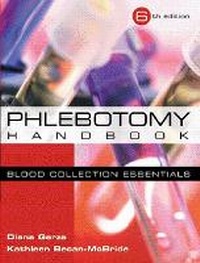
Phlebotomy Handbook
Blood Collection Essentials
6th Edition
Published on 30. May 2002
Book
Paperback/Softback
544 pages
978-0-13-092887-0 (ISBN)
Description
For medical lab technology, medical assisting, respiratory therapy, radiological technology, and nursing courses.
This text is the most accurate and current source of blood and specimen collection information for today's health care students and professionals. Designed to provide health care professionals with the clinical, technical, and communication skills and knowledge, it features sections devoted to safety; equipment and collection; special procedures and point of care testing; and quality and legal issues.
This text is the most accurate and current source of blood and specimen collection information for today's health care students and professionals. Designed to provide health care professionals with the clinical, technical, and communication skills and knowledge, it features sections devoted to safety; equipment and collection; special procedures and point of care testing; and quality and legal issues.
More details
Edition
6th edition
Language
English
Place of publication
United States
Publishing group
Pearson Education (US)
Target group
Professional and scholarly
Dimensions
Height: 229 mm
Width: 191 mm
ISBN-13
978-0-13-092887-0 (9780130928870)
Copyright in bibliographic data and cover images is held by Nielsen Book Services Limited or by the publishers or by their respective licensors: all rights reserved.
Schweitzer Classification
Other editions
New editions
Book
09/2004
7th Edition
Pearson
€49.59
Article exhausted; check for reprint
Previous edition

Book
12/1998
5th Edition
Appleton and Lange
€49.76
Article exhausted; check for reprint
Content
I. OVERVIEW.
1. Phlebotomy Practice and the Health Care Setting.
2. Basic Anatomy and Physiology of Organ Systems.
3. The Circulatory System.
Phlebotomy Case Studies.
Changing Roles in Phlebotomy Practice.Collection from the Dorsal Side of the Hand.Communication and Cultural Sensitivity: Keys to Success.II. SAFETY PROCEDURES.
4. Infection Control.
5. Safety and First Aid.
6. Specimen Documentation and Transportation.
Phlebotomy Case Studies.
Accidental Injury.Transporting Specimens from Homebound Patients to the Laboratory.Improving Speed and Accuracy in Phlebotomy Practice.III. EQUIPMENT AND PROCEDURES.
7. Blood Collection Equipment.
8. Venipuncture Procedures.
9. Skin Puncture Procedures.
10. Complications in Blood Collections.
Phlebotomy Case Studies.
Ambulatory Health Care Collections.Venipuncture Site Selections.Finding the Right Site.IV. SPECIAL PROCEDURES AND POINT OF CARE TESTING.
11. Pediatric Procedures.
12. Arterial, Intravenous (IV), and Special Collection Procedures.
13. Elderly, Home, and Long-term Care Collections.
14. Urinalysis and Body Fluid Collections.
15. Specimen Collection for Forensic Toxicology, Workplace Testing, Sports Medicine, and Related Areas.
Phlebotomy Case Studies.
Home Care Collections.Bedside Glucose Testing.Newborn Nursery Collections.Collecting from an Infant.V. QUALITY, MANAGEMENT, ETHICAL AND LEGAL ISSUES.
16. Quality, Competency, and Performance Assessment.
17. Ethical, Legal and Regulatory Issues.
Phlebotomy Case Studies.
Communication and Consent.An Ethical Dilemma.APPENDICES.
Units of Measurement and Symbols.
Metric Conversion Chart.
Formulas and Calculations.
Answers to Study Questions and Cases.
Glossary.
1. Phlebotomy Practice and the Health Care Setting.
2. Basic Anatomy and Physiology of Organ Systems.
3. The Circulatory System.
Phlebotomy Case Studies.
Changing Roles in Phlebotomy Practice.Collection from the Dorsal Side of the Hand.Communication and Cultural Sensitivity: Keys to Success.II. SAFETY PROCEDURES.
4. Infection Control.
5. Safety and First Aid.
6. Specimen Documentation and Transportation.
Phlebotomy Case Studies.
Accidental Injury.Transporting Specimens from Homebound Patients to the Laboratory.Improving Speed and Accuracy in Phlebotomy Practice.III. EQUIPMENT AND PROCEDURES.
7. Blood Collection Equipment.
8. Venipuncture Procedures.
9. Skin Puncture Procedures.
10. Complications in Blood Collections.
Phlebotomy Case Studies.
Ambulatory Health Care Collections.Venipuncture Site Selections.Finding the Right Site.IV. SPECIAL PROCEDURES AND POINT OF CARE TESTING.
11. Pediatric Procedures.
12. Arterial, Intravenous (IV), and Special Collection Procedures.
13. Elderly, Home, and Long-term Care Collections.
14. Urinalysis and Body Fluid Collections.
15. Specimen Collection for Forensic Toxicology, Workplace Testing, Sports Medicine, and Related Areas.
Phlebotomy Case Studies.
Home Care Collections.Bedside Glucose Testing.Newborn Nursery Collections.Collecting from an Infant.V. QUALITY, MANAGEMENT, ETHICAL AND LEGAL ISSUES.
16. Quality, Competency, and Performance Assessment.
17. Ethical, Legal and Regulatory Issues.
Phlebotomy Case Studies.
Communication and Consent.An Ethical Dilemma.APPENDICES.
Units of Measurement and Symbols.
Metric Conversion Chart.
Formulas and Calculations.
Answers to Study Questions and Cases.
Glossary.