

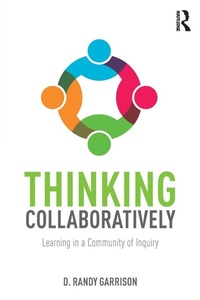
Thinking Collaboratively
Learning in a Community of Inquiry
1st Edition
Published on 12. June 2015
Book
Paperback/Softback
148 pages
978-1-138-82432-4 (ISBN)
Description
Thinking Collaboratively is a theoretical and practical guide to thinking and learning in deep and meaningful ways within purposeful communities of inquiry. Critical thinking has long been recognized as an important educational goal but, until now, has largely been conceived and operationalized as an individual attitude and ability. Increasingly, however, a more relevant and complete cognitive construct has been emerging: thinking collaboratively. Thinking collaboratively is the means to inquire, test, and apply new understandings, and to make sense of the information that bombards us continuously. In short, thinking collaboratively is required to flourish in our highly connected world and, in this book based on more than a decade of research, Garrison provides an essential introduction to this vital concept.
Reviews / Votes
"Thinking Collaboratively is the definitive book on thinking and learning through collaboration. Presenting theory along with specific and effective principles of practice, it is a must-read for all who seek to improve learning and instruction within the new paradigm."Paul Gorsky, The Open University of Israel
"Thinking Collaboratively describes new ways to conceive of and support thinking and learning in a changing education environment-ways that ultimately allow learners to 'flourish in our highly connected world.' D. Randy Garrison provides comprehensive, leading-edge insights on teaching and learning. This recent contribution is a must-read for all those engaged in the evolving world of education."
Dr. Martha Cleveland-Innes, Professor and Chair, Centre for Distance Education, Athabasca University, Canada
"In this masterfully designed book, Randy Garrison has taken decades of his research, technology experimentations, model building, and instructor training programs and offers the reader with a new lens to think about the myriad theoretical and practical trends in education confronting each of us today. Fortunately, the realm of 'Thinking Collaboratively' emerges through it all to provide a base from which to discover, discuss, and reflect upon this exciting new learning and work-related world we now find ourselves in."
Curtis J. Bonk, Professor, Instructional Systems Technology Department, Indiana University Bloomington, USA
"Thinking Collaboratively: Learning in A Community of Inquiry is a must-read for all those involved in teaching and learning at all educational levels"
Saouma BouJaoude, The International Review of Education - Journal of Lifelong Learning
More details
Language
English
Place of publication
London
United Kingdom
Publishing group
Taylor & Francis Ltd
Target group
College/higher education
Illustrations
3 s/w Abbildungen
3 Illustrations, black and white
Dimensions
Height: 229 mm
Width: 152 mm
Thickness: 9 mm
Weight
242 gr
ISBN-13
978-1-138-82432-4 (9781138824324)
Copyright in bibliographic data and cover images is held by Nielsen Book Services Limited or by the publishers or by their respective licensors: all rights reserved.
Schweitzer Classification
Other editions
Additional editions

Book
06/2015
1st Edition
Routledge
€241.30
Shipment within 10-20 days
E-Book
06/2015
Routledge
€52.49
Available for download
E-Book
06/2015
Routledge
€52.49
Available for download
Person
D. Randy Garrison is a retired professor of the Werklund School of Education at the University of Calgary, Canada. Dr. Garrison has published extensively on teaching and learning in adult, higher, and distance education contexts. He has authored, co-authored, or edited eleven books and well over 100 refereed articles and chapters. He has also won several awards including the 2009 Sloan-C Award for Most Outstanding Achievement in Online Learning by an Individual.
Content
Preface
Chapter 1: Introduction
Foundational Constructs
Technology
Critical thinking
The Community of Inquiry
Summary
Chapter 2: Thinking and Learning
Critical and Reflective Thinking
Collaborative Constructivism
Community and Collaboration
Collaboration and Competition
Metacognition and Regulation
Summary
Chapter 3: Technology and Thinking
Technological Innovations
Technology Enhanced Approaches
Summary
Chapter 4: A New Era
Distance Education
Campus-Based Education
Online Learning
Summary
Chapter 5: The Community of Inquiry
Communities of Inquiry
Inquiry
Deep Approaches to Learning
The Community of Inquiry Framework
Metacognition
Summary
Chapter 6: Community of Inquiry Research
A Coherent Framework
Social Presence
Cognitive presence
Teaching Presence
Shared Metacognition
Summary
Chapter 7: Principles of Practice
Principles
Design
Facilitation
Direction
Assessment
Summary
Chapter 8: Leading Collaboratively
Collaboration and Bureaucracy
Initiating and Sustaining Change
Faculty Development
Summary
Chapter 9: Conclusion
Appendix A: Community of Inquiry Survey Instrument
Appendix B: Shared Metacognition Survey Instrument
References
Index
Chapter 1: Introduction
Foundational Constructs
Technology
Critical thinking
The Community of Inquiry
Summary
Chapter 2: Thinking and Learning
Critical and Reflective Thinking
Collaborative Constructivism
Community and Collaboration
Collaboration and Competition
Metacognition and Regulation
Summary
Chapter 3: Technology and Thinking
Technological Innovations
Technology Enhanced Approaches
Summary
Chapter 4: A New Era
Distance Education
Campus-Based Education
Online Learning
Summary
Chapter 5: The Community of Inquiry
Communities of Inquiry
Inquiry
Deep Approaches to Learning
The Community of Inquiry Framework
Metacognition
Summary
Chapter 6: Community of Inquiry Research
A Coherent Framework
Social Presence
Cognitive presence
Teaching Presence
Shared Metacognition
Summary
Chapter 7: Principles of Practice
Principles
Design
Facilitation
Direction
Assessment
Summary
Chapter 8: Leading Collaboratively
Collaboration and Bureaucracy
Initiating and Sustaining Change
Faculty Development
Summary
Chapter 9: Conclusion
Appendix A: Community of Inquiry Survey Instrument
Appendix B: Shared Metacognition Survey Instrument
References
Index