

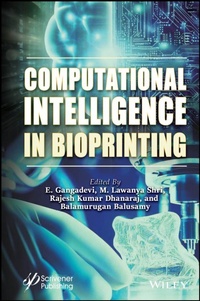
Computational Intelligence in Bioprinting
Challenges and Future Directions
1st Edition
Published on 11. March 2024
Book
Hardback
352 pages
978-1-394-20439-7 (ISBN)
Description
COMPUTATIONAL INTELLIGENCE IN BIOPRINTING The book provides a comprehensive exploration of the evolving field of bioprinting in regenerative medicine and is an essential guide for professionals seeking a thorough understanding of the field.
Computational Intelligence in Bioprinting provides a comprehensive overview of the evolving field of bioprinting in reformative medicine, defining the process of printing structures using viable cells, biomaterials, and living molecules. The primary goal is to provide substitutes for tissue implants, which might lead to eliminating the requirement for organ donors, as well as to transform animal testing for the learning and analysis of disease and the growth of treatments. The book offers a comprehensive overview of bioprinting technologies and their applications, emphasizing the integration of computation intelligence, artificial intelligence, and other computer science advancements in the field. By harnessing the power of computational intelligence techniques such as AI, machine learning, optimization algorithms, and data analytics, existing hurdles can be overcome and the full potential of bioprinting can be unlocked.
The book covers an extensive range of topics, including bio-ink formulation and characterization, bioprinter hardware and software design, tissue and organ modeling, image analysis, process optimization, and quality control.
Audience
The book is aimed at professionals, practitioners and researchers in the fields of bioprinting, tissue engineering, and computational intelligence in medicine.
Computational Intelligence in Bioprinting provides a comprehensive overview of the evolving field of bioprinting in reformative medicine, defining the process of printing structures using viable cells, biomaterials, and living molecules. The primary goal is to provide substitutes for tissue implants, which might lead to eliminating the requirement for organ donors, as well as to transform animal testing for the learning and analysis of disease and the growth of treatments. The book offers a comprehensive overview of bioprinting technologies and their applications, emphasizing the integration of computation intelligence, artificial intelligence, and other computer science advancements in the field. By harnessing the power of computational intelligence techniques such as AI, machine learning, optimization algorithms, and data analytics, existing hurdles can be overcome and the full potential of bioprinting can be unlocked.
The book covers an extensive range of topics, including bio-ink formulation and characterization, bioprinter hardware and software design, tissue and organ modeling, image analysis, process optimization, and quality control.
Audience
The book is aimed at professionals, practitioners and researchers in the fields of bioprinting, tissue engineering, and computational intelligence in medicine.
More details
Language
English
Place of publication
New York
United States
Publishing group
John Wiley & Sons Inc
Target group
Professional and scholarly
Product notice
sewn/stitched
Cloth over boards
Dimensions
Height: 218 mm
Width: 145 mm
Thickness: 25 mm
Weight
567 gr
ISBN-13
978-1-394-20439-7 (9781394204397)
Copyright in bibliographic data and cover images is held by Nielsen Book Services Limited or by the publishers or by their respective licensors: all rights reserved.
Schweitzer Classification
Other editions
Additional editions
E. Gangadevi | M. Lawanya Shri | Rajesh Kumar Dhanaraj
Computational Intelligence in Bioprinting
Challenges and Future Directions
E-Book
03/2024
1st Edition
Wiley
€157.99
Available for download
E. Gangadevi | M. Lawanya Shri | Rajesh Kumar Dhanaraj
Computational Intelligence in Bioprinting
Challenges and Future Directions
E-Book
02/2024
1st Edition
Wiley
€150.99
Available for download
Persons
E. Gangadevi, is an assistant professor in the Department of Computer Science at Loyola College in Chennai, India. She has published two patents, authored / edited two books, more than 20 research papers in international journals and many book chapters.
M. Lawanya Shri, PhD, is an associate professor at the School of Information Technology and Engineering, VIT, Vellore, India. She has two patents, more than 50 articles in refereed journals and international conferences, and contributed many chapters to books.
Rajesh Kumar Dhanaraj, PhD, is a professor at the School of Computing Science and Engineering at Galgotias University in India. He has authored/edited more than 25 books on various technologies, 21 patents, and 50+ articles and papers in various refereed journals and international conferences.
Balamurugan Balusamy, PhD, is an associate dean to students at Shiv Nadar University at the Delhi-NCR Campus in Noida, India. He has authored/edited more than 80 books as well as over 200 contributions to international journals and conferences.
M. Lawanya Shri, PhD, is an associate professor at the School of Information Technology and Engineering, VIT, Vellore, India. She has two patents, more than 50 articles in refereed journals and international conferences, and contributed many chapters to books.
Rajesh Kumar Dhanaraj, PhD, is a professor at the School of Computing Science and Engineering at Galgotias University in India. He has authored/edited more than 25 books on various technologies, 21 patents, and 50+ articles and papers in various refereed journals and international conferences.
Balamurugan Balusamy, PhD, is an associate dean to students at Shiv Nadar University at the Delhi-NCR Campus in Noida, India. He has authored/edited more than 80 books as well as over 200 contributions to international journals and conferences.